
Clear messaging is the single most important factor in whether a visitor converts, buys, or leaves your website. Design attracts the eye. Messaging closes the deal. Business owners and marketers who understand why messaging matters more than design gain a direct advantage over competitors who spend their budgets on visual polish while their copy confuses visitors. The evidence is consistent: 73% of global consumers prefer messaging when interacting with businesses, and that preference directly influences purchase decisions. This article breaks down the research, the comparison, and the practical steps to put messaging first.
Why messaging matters more than design in business communication
Messaging, in a marketing and branding context, is the set of words, phrases, and statements that communicate what you offer, who it is for, and why it matters. It includes your headline, tagline, body copy, calls to action, and every label on your site. Design is the visual layer that presents those words. The two are not equal in their impact on conversions.
Sites with unclear messaging show higher bounce rates even when the visual design is polished. Visitors do not leave because the layout is ugly. They leave because they cannot quickly understand what the business does or why they should care. A visitor who is confused does not scroll. They click away.
Messaging works because it aligns with how people make decisions. Buyers need to understand an offer before they can trust it. Trust comes from clarity, not color palettes. When your headline answers the question “What do you do and for whom?” in under five seconds, you remove the friction that kills conversions.
- Clarity beats beauty. A clear value proposition on a plain page outperforms a vague headline on a stunning design.
- Messaging reduces cognitive load. When visitors do not have to decode your offer, they spend mental energy on deciding, not deciphering.
- Design supports messaging. Visual hierarchy, white space, and typography exist to make your words easier to read, not to replace them.
- Bounce rates signal messaging failure. High bounce rates on well-designed pages almost always point to a messaging problem, not a design problem.
Pro Tip: Before you invest in a redesign, rewrite your homepage headline. Test two versions with Google Optimize or a simple A/B test. The headline that produces more scroll depth is your messaging winner.
Messaging vs. design: which one actually drives conversions?
The design vs. messaging debate is not theoretical. A/B testing data settles it clearly. Simple, crude designs with stronger messaging consistently outperform polished, complex designs in conversion experiments. That finding repeats across industries and audience types. The implication is direct: if you have to choose where to invest, invest in the words first.

| Factor | Strong messaging | Strong design only |
|---|---|---|
| Trust | Built through clarity and relevance | Built through visual credibility |
| Clarity | Immediate, reduces bounce rate | Depends on copy quality |
| Engagement | Holds attention through relevance | Attracts initial attention |
| Conversions | Directly drives action | Supports but does not close |
| Long-term recall | Tied to brand promise | Tied to visual identity |
One category where messaging and design fully overlap is microcopy. Microcopy covers button labels, error messages, form field instructions, and confirmation text. Clear microcopy reduces user errors by up to 50% and produces the highest return on investment of any UI element. Most design systems track hundreds of visual components but treat button labels as an afterthought. That is a costly mistake.
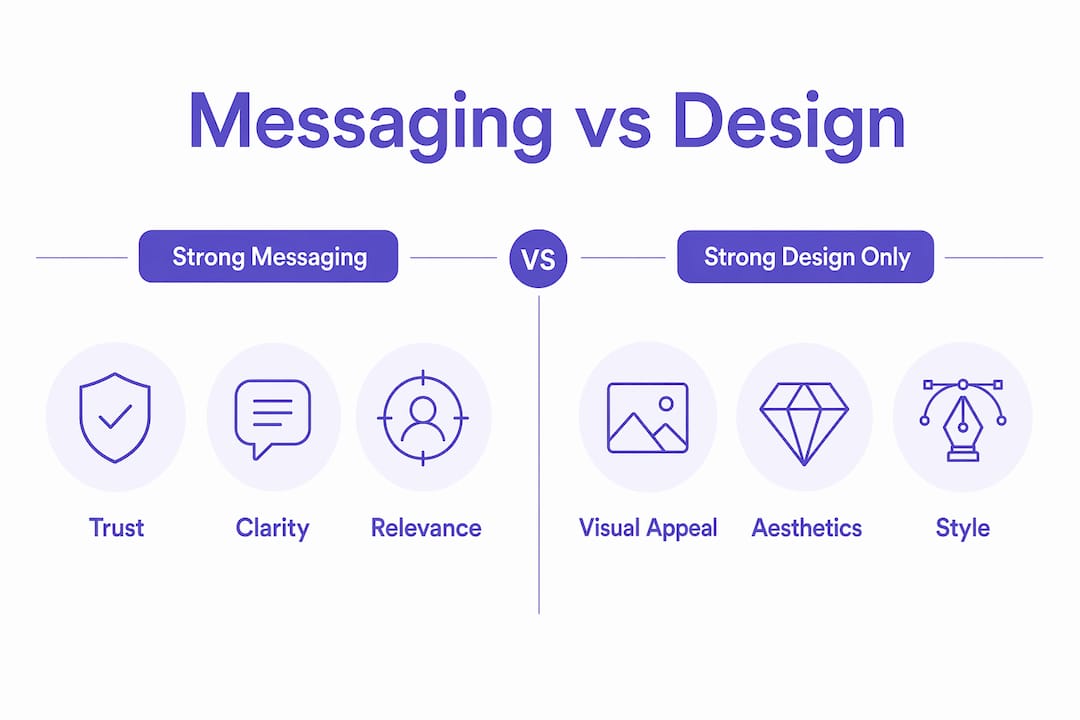
The relationship between messaging and design is not adversarial. Design is the delivery mechanism. Messaging is the payload. A well-designed page with weak copy is a fast car with no destination. A clear message on a clean layout is what actually moves people to act. The goal is to build a homepage where every visual choice exists to make the message land harder.
Pro Tip: Audit your call-to-action buttons. Replace vague labels like “Submit” or “Click Here” with specific ones like “Get My Free Quote” or “Book a 20-Minute Call.” Specific labels outperform generic ones in nearly every test.
How messaging channels are reshaping digital engagement in 2026
The dominance of messaging is not limited to website copy. It extends to every channel where your business communicates. 85% of U.S. adults use messaging apps multiple times weekly. That usage pattern has permanently shifted how consumers expect to interact with brands. Businesses that meet customers in messaging channels convert at higher rates than those that rely on static web pages alone.
Consumer expectations inside those channels are specific. 46% of consumers prioritize fast, real-time messaging support, and 42% value the ability to maintain conversation history across sessions. The 85% satisfaction rate for messaging-based transactions shows that when messaging works well, customers notice and reward it with loyalty.
AI has made personalized messaging affordable at scale. An AI-handled interaction costs roughly $0.50 compared to $6.00 for a human agent. That 12x cost efficiency means businesses can deliver relevant, personalized messages across SMS, chat, and email without proportional increases in headcount. The result is more touchpoints, better timing, and higher purchase likelihood.
Conversational design is the UX layer where this shift becomes most visible. Visual UI design is now a commodity. The real differentiator in AI-driven products is the quality of the conversational logic, the prompts, the responses, and the flow of the dialogue. Messaging strategy now drives user experience more than visual design does.
Key advantages of treating messaging as a data asset:
- Unified messaging platforms reduce fragmentation and create consistent customer experiences.
- Synchronized messaging data enables personalized marketing that increases purchase likelihood.
- Brands that track messaging performance gain feedback loops that design metrics cannot provide.
- Consistent tone and language across channels builds brand recognition faster than visual consistency alone.
How to prioritize messaging over design in your marketing
Prioritizing messaging does not mean ignoring design. It means auditing your words before you redesign your visuals. Most business owners do the opposite. They hire a designer before they have a clear value proposition. The result is a beautiful site that does not convert.
1. Audit your current messaging for clarity.
Read your homepage headline out loud. If a stranger cannot tell you what your business does and who it serves after hearing it once, rewrite it. Apply the same test to your service pages, email subject lines, and ad copy.
2. Identify your single strongest value proposition.
One clear promise beats three vague ones. Your headline should state the specific outcome you deliver, the audience you serve, and the reason to believe it. For example: “We build conversion-focused websites for service businesses that need more booked calls.”
3. Fix your microcopy first.
Button labels, form instructions, and error messages are the highest-ROI copy on your site. Rewrite every button to describe the action and the outcome. Replace “Submit” with “Send My Request.” Replace “Learn More” with “See How It Works.”
4. Align messaging with user goals, not business goals.
Your visitor does not care that you are “passionate about excellence.” They care whether you can solve their specific problem. Write every headline and subheading from the visitor’s perspective, not the brand’s.
5. Test messaging before you redesign.
Run A/B tests on headlines and calls to action using tools like Google Optimize or VWO before committing to a visual overhaul. Messaging wins in testing tell you exactly where to invest in design improvements. You can also review real examples of converting websites to see how messaging and layout work together in practice.
6. Bring UX writers into the design process early.
Design and copy should be developed together, not sequentially. When a UX writer and a designer collaborate from the first wireframe, the layout is built to serve the message, not the other way around.
Pro Tip: Use the “5-second test” on your homepage. Show it to someone unfamiliar with your business for five seconds, then ask them what you do. If they cannot answer accurately, your messaging needs work before your design does.
Key takeaways
Messaging is the foundation of conversion. Design without clear messaging produces attractive pages that fail to turn visitors into customers.
| Point | Details |
|---|---|
| Messaging drives conversions | Clear copy outperforms polished design in A/B tests across industries. |
| Microcopy is high-ROI | Button labels and error messages reduce errors and lift conversions more than visual updates. |
| Consumer preference favors messaging | 73% of global consumers prefer messaging interactions with businesses over other channels. |
| AI scales messaging affordably | AI-handled messaging costs 12x less than human agents, enabling personalized outreach at scale. |
| Design supports, not replaces, messaging | Visual design exists to make your message clearer, not to substitute for it. |
The uncomfortable truth about design budgets
I have reviewed hundreds of websites for business owners who were frustrated that their “beautiful new site” was not generating leads. In almost every case, the design was genuinely good. The photography was professional. The layout was clean. The problem was always the same: the headline was vague, the value proposition was buried, and the calls to action said nothing specific.
The design industry does a poor job of telling clients this. Designers are hired to make things look good, and most of them do exactly that. But no one is hired to tell the client that their headline is the real problem. That gap costs businesses real money.
My honest recommendation: freeze your design budget until your messaging is tested and proven. Write three versions of your homepage headline. Run them against each other. The winner will tell you more about your audience than any brand color exercise ever will. Once you know what message converts, build the design around it.
The future belongs to brands that treat messaging as infrastructure, not decoration. Conversational UX, AI-driven personalization, and messaging-first design are not trends. They are the new standard. Businesses that build their communication strategy around clear, tested messaging will outperform those that lead with aesthetics every time.
— Max
How Cosmicdigitalstudios builds sites where messaging does the heavy lifting
Cosmicdigitalstudios builds custom websites and conversion-focused funnels where messaging clarity is the starting point, not an afterthought. Every project begins with your value proposition, your audience, and the specific action you want visitors to take. The visual design is built around those decisions, not before them. If your current site looks good but is not generating leads, the issue is almost certainly your messaging. Cosmicdigitalstudios can help you fix it. See how we build sites that convert and find out what a messaging-first approach looks like in practice.
FAQ
Why does messaging matter more than design for conversions?
Messaging tells visitors what you offer and why it matters. Without clear messaging, even a well-designed site produces high bounce rates and low conversions.
What is the difference between messaging and design in marketing?
Messaging is the words and statements that communicate your offer. Design is the visual layer that presents those words. Messaging drives decisions; design supports delivery.
What is microcopy and why does it matter?
Microcopy covers button labels, form instructions, and error messages. Clear microcopy reduces user errors by up to 50% and produces the highest ROI of any UI element.
How do I know if my messaging is the problem on my website?
Run a 5-second test with someone unfamiliar with your business. If they cannot describe what you do after a brief look at your homepage, your messaging needs work before your design does.
Does strong messaging mean design does not matter?
Design still matters. It creates visual credibility and guides the eye. But design without clear messaging produces attractive pages that fail to convert visitors into customers.