
Certifications are defined as verified credentials that prove a local business meets recognized standards of quality, security, and reliability. Understanding why certifications matter for local sites goes beyond collecting badges. They function as trust shortcuts that customers, partners, and search algorithms all use to evaluate your business before a single conversation happens. From SSL/TLS security certificates to industry credentials like NATE certification for HVAC contractors, the right certifications directly influence whether a visitor books a call or clicks away.
Why certifications matter for local sites and customer trust
Certifications work through what researchers call the trust transfer effect. When a recognized third party verifies your business, that organization’s credibility transfers to you. Customers who have never heard of your company treat a familiar certification seal as proof that someone they trust already checked your work.
The stakes are highest on your website. Missing or expired SSL certificates can cause up to a 42% drop in demo requests and lost pipeline revenue. That number reflects a real behavioral pattern: browsers display security warnings, visitors panic, and they leave without contacting you. Recovering that lost trust takes weeks, not days.
Technical security certificates also function as a proxy for operational competence. Security flaws like missing SSL lead to immediate disqualification in vendor risk assessments, regardless of product quality. Buyers assume that a business that cannot manage its own website security probably cannot manage their project either.
For local businesses, this dynamic is even sharper. Repeat business and word-of-mouth referrals depend on trust built during the first interaction. A customer who sees a security warning on your site will not call you. They will call your certified competitor.
- SSL/TLS certificates protect data in transit and signal basic operational competence
- Industry credentials (NATE, EPA, licensed contractor status) prove technical expertise
- Community-based certifications build neighborhood trust through grassroots endorsement
- Trust badges from recognized bodies reduce purchase hesitation at the decision point
Pro Tip: Place your SSL padlock and certification badges above the fold on your homepage. Visitors decide whether to trust a site within seconds of landing on it.
What types of certifications are most valuable for local businesses?
Not all certifications carry equal weight. The category you choose determines how much trust you gain, how much it costs, and whether your specific customers actually recognize it.
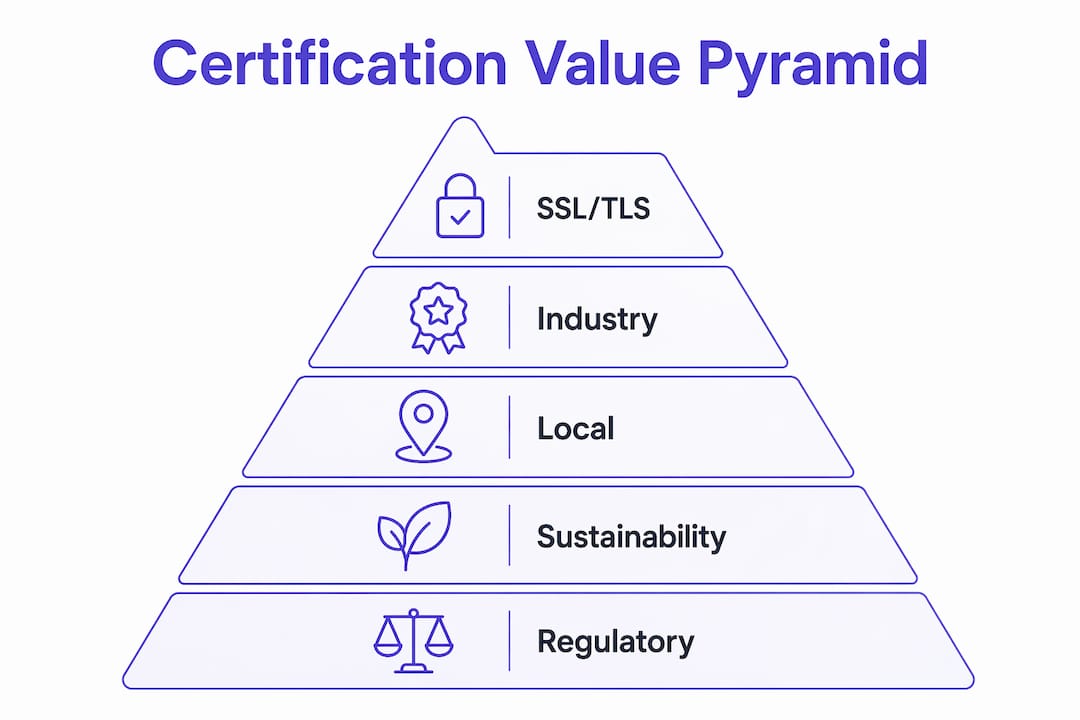
Technical security certificates
SSL/TLS certificates are the non-negotiable baseline for any local business website. They encrypt data, satisfy browser security requirements, and signal that your site is safe to use. Extended Validation (EV) certificates go further. EV certificates displaying your company name help sales teams neutralize security objections in B2B procurement, compressing the sales cycle. For local service businesses that sell to other businesses, an EV certificate is a closing argument, not just a technical checkbox.

Industry-specific credentials
Trade certifications like NATE certification for HVAC technicians, EPA Section 608 compliance for refrigerant handling, or state contractor licensing directly affect whether customers hire you. Certified local HVAC companies provide faster response, regional expertise, warranty protection, and personalized service that non-certified competitors cannot match. Certification also protects the customer’s equipment warranty, which is a concrete financial benefit they understand immediately.
Local and community-based certifications
International certifications are expensive. Community-based participatory guarantee systems build trust through transparency and grassroots endorsement, offering a real alternative to costly third-party audits. These systems work because local customers often trust their neighbors’ verification more than a distant accreditation body. A local chamber of commerce certification or a regional industry association credential can carry more weight in your specific market than a global standard your customers have never heard of.
Sustainability and regulatory certifications
Certifications aligned with environmental regulations or sustainability standards open doors to specific customer segments willing to pay more. Only 15–20% of global standards and certifications achieve enough market recognition to command consumer price premiums greater than 10%. That figure tells you to research whether your target customers actually recognize a certification before you invest in earning it.
| Certification type | Best for | Primary benefit |
|---|---|---|
| SSL/TLS | All local business websites | Browser trust, data security |
| EV certificate | B2B service providers | Sales cycle compression |
| Industry credential (NATE, EPA) | Trades and contractors | Warranty protection, expertise proof |
| Local/community certification | Neighborhood-focused businesses | Grassroots trust, lower cost |
| Sustainability certification | Eco-conscious markets | Price premium access |
How to evaluate and choose the right certifications
Choosing certifications without a framework wastes money and time. Businesses should evaluate certifications on five factors: market recognition, premium transmission, local auditor availability, mutual recognition, and regulatory alignment. Each factor filters out certifications that look good on paper but deliver no real return.
-
Market recognition. Ask whether your customers already know and respect the certification. A credential your customers have never seen does not shorten their decision process.
-
Premium transmission. Determine whether the certification lets you charge more or win contracts you would otherwise lose. If it does not affect your pricing or close rate, its value is limited.
-
Local auditor availability. Local certification bodies reduce ongoing costs by 35–50% compared to international auditors by eliminating travel fees and building local capacity. For small businesses, that cost difference determines whether certification is financially viable at all.
-
Mutual recognition. Check whether the certification is accepted in adjacent markets or by larger clients. A certification recognized only in one county limits your growth options.
-
Regulatory alignment. Confirm whether the certification satisfies a legal or insurance requirement. Regulatory-aligned certifications protect you from liability and often become mandatory over time.
Pro Tip: Before paying for any certification, call three of your best customers and ask whether they recognize it. Their answer tells you more than any industry report.
Understanding how to build trust online requires pairing the right certifications with the right display strategy. Earning a credential that sits in a filing cabinet produces no return.
How to display certifications to maximize trust and conversions
Earning a certification is only half the work. Where and how you display it determines whether it actually changes customer behavior.
Your website is the highest-leverage display location. Place certification badges on your homepage hero section, your contact page, and any service page where a visitor makes a purchase decision. Customers who reach your contact page are already interested. A visible certification badge at that moment removes the last objection before they submit their information. For local service businesses, the essential pages every local service site needs should each carry relevant trust signals, not just the homepage.
Combine certifications with testimonials for compounding credibility. A certification proves you meet a standard. A testimonial proves you delivered on it. Together, they address both rational and emotional objections. Place a certification badge directly next to a customer review that mentions quality or reliability.
Certificate hygiene matters as much as the certificate itself. An expired SSL certificate destroys trust faster than having no certificate at all. Browsers display bright red warnings for expired certificates. Set calendar reminders 60 days before any certificate expires and treat renewal as a non-negotiable business task.
- Display badges on homepage, service pages, and contact pages
- Pair certification logos with customer reviews that reference quality
- Use certifications in proposals and sales emails to preempt objections
- Renew SSL and technical certificates before expiration, not after
- List certifications in your Google Business Profile and local directory listings
Physical locations should display certification plaques and license numbers at the point of service. Customers who see credentials in your office or on your truck before work begins arrive at the job with higher confidence and lower price sensitivity.
Key Takeaways
Certifications build trust, reduce sales friction, and protect revenue. Local businesses that display verified credentials consistently convert more visitors into paying customers.
| Point | Details |
|---|---|
| SSL is non-negotiable | An expired or missing SSL certificate can cut demo requests by up to 42%. |
| Choose recognized credentials | Only 15–20% of certifications command price premiums; pick ones your customers already know. |
| Local certifiers cut costs | Local certification bodies reduce ongoing costs by 35–50% versus international auditors. |
| Display drives conversions | Badges placed on service and contact pages remove objections at the decision point. |
| Pair certs with testimonials | Combining certifications with reviews addresses both rational and emotional buyer concerns. |
Certifications are the cheapest trust you will ever buy
I have reviewed hundreds of local business websites over the years, and the pattern is consistent. Businesses that display clear, recognized certifications convert at a higher rate than those that do not, even when the design and copy are nearly identical. The certification does work that no headline can replicate.
The part most local owners miss is the technical side. They spend money on industry credentials and then let their SSL certificate expire. That sequence is backwards. Your website’s security certificate is the first trust signal any visitor encounters. It loads before your logo, before your headline, before your phone number. Getting that wrong cancels out everything else you have invested in.
I also see owners chase expensive international certifications when a local or regional credential would serve them better. A well-known regional association membership often carries more weight with local buyers than a global standard they have never encountered. The five-factor evaluation framework, specifically the market recognition and local auditor availability criteria, exists precisely to prevent that mistake.
The businesses I have seen grow fastest treat certifications as part of their sales infrastructure, not their compliance checklist. They display credentials on every page where a decision happens, they renew certificates proactively, and they reference credentials in every proposal. That approach turns a passive credential into an active conversion tool.
— Max
Your website should work as hard as your certifications do
You have earned your credentials. Your website should show them off clearly and convert the visitors who see them.
Cosmicdigitalstudios builds fast, secure websites for local businesses that are designed to turn visitors into booked calls and paying customers. Every site includes proper SSL implementation, visible trust signal placement, and conversion-focused page structures that put your certifications where they matter most. If your current site is not turning visitors into clients, your certifications are earning you less than they should. See what Cosmicdigitalstudios builds and get a site that makes your credentials count.
FAQ
Why do certifications matter for local business websites?
Certifications signal verified quality and operational competence to customers who do not yet know your business. They reduce purchase hesitation and shorten the time it takes a visitor to decide to contact you.
What happens if my SSL certificate expires?
An expired SSL certificate triggers browser security warnings that can cut demo requests and lead volume significantly. Treat SSL renewal as a fixed business task, not an optional maintenance item.
How do I choose between local and international certifications?
Evaluate each certification on market recognition and local auditor availability. Local certification bodies cut costs by 35–50% versus international auditors, making them the better starting point for most small businesses.
Do certifications actually improve local SEO?
Certifications improve trust signals and reduce bounce rates, both of which influence local search performance. Listing credentials in your Google Business Profile also adds relevant content that supports local visibility.
Where should I display certifications on my website?
Place certification badges on your homepage, service pages, and contact page. These are the locations where visitors make decisions, and a visible credential at that moment removes the final objection before they reach out.