
Getting traffic to your local service website is only half the battle. The real challenge is turning those visitors into booked customers. Most local service business owners build a website, throw up a few pages, and wonder why the phone isn’t ringing. The truth is, not all website pages are created equal. Some pages convert visitors into leads. Others just take up space. This guide breaks down exactly which pages your local service website needs, why each one matters, and how to prioritize them so every click has a clear path to becoming a paying customer.
Table of Contents
- How to evaluate website pages for your local service business
- Top must-have pages for a local service website
- Location pages vs. service area pages: What’s the difference?
- Trust and credibility pages: Reviews, About, and Privacy Policy
- Comparison guide: Which pages matter most for different local service models?
- The real secret to high-converting local service websites
- Upgrade your local service site for more leads
- Frequently asked questions
Key Takeaways
| Point | Details |
|---|---|
| Core page strategy | Focus on a mix of conversion, geo-targeted, and trust pages for best results. |
| Quality over quantity | Strong, unique pages beat many generic ones—use real local proof in your content. |
| Trust signals matter | Reviews, About info, and a Privacy Policy build credibility and boost conversions. |
| Adapt to your model | Prioritize your page set based on your business type and service reach. |
| Local elements drive results | Add NAP, maps, CTAs, and localized content to maximize page performance. |
How to evaluate website pages for your local service business
Before you start adding pages, you need a framework for deciding which ones actually earn their place on your site. The goal isn’t to have the most pages. It’s to have the right pages that work together to answer questions, reduce friction, and push visitors toward taking action.
According to Backlinko’s research on location pages, a high-performing local service website page set usually separates intent types into three core categories:
- Conversion-first service pages: These target visitors who already know what they want. They’re ready to book or request a quote. Your job is to make that action as easy as possible.
- Geo-targeted location and service area pages: These capture local search traffic. When someone types “roof repair in Austin,” a well-built location page is what gets you found and chosen.
- Trust and credibility pages: These include your About page, reviews, testimonials, and Privacy Policy. They answer the unspoken question every visitor has: “Can I trust this business?”
Each type serves a distinct purpose. Conversion pages close the deal. Location pages bring in the right traffic. Credibility pages remove doubt. When all three work together, you create a site that doesn’t just attract visitors. It converts them.
The biggest mistake local service businesses make is overcomplicating their site with too many pages that don’t serve a clear purpose. A cluttered site dilutes your message and confuses visitors. Fewer, stronger pages almost always outperform a bloated site with no clear direction. Focus on website conversion strategies that prioritize quality over volume.
Pro Tip: Before adding any new page, ask yourself: “Does this page answer a specific question, target a specific search, or move a visitor closer to booking?” If the answer is no, skip it.
Top must-have pages for a local service website
Now that the essential types are outlined, here are the individual must-have pages and what goes into each one. These are the pages that consistently drive leads and conversions for local service businesses across industries.
-
Home page: Your home page is your first impression. It needs to communicate what you do, where you serve, and why you’re the right choice within the first few seconds. Include a strong headline, a clear call to action (CTA), and trust signals like star ratings or years in business.
-
Services pages: One page per core service is the standard approach. Each page should target a specific keyword, explain the service in detail, address common customer concerns, and include a direct CTA. Vague, generic service descriptions don’t convert. Be specific.
-
Service area or location pages: These pages target specific cities, neighborhoods, or regions. Service area landing pages need unique localized content, strong CTAs, and NAP (name, address, phone number) plus map and reviews style trust elements to perform well. A page that just swaps out the city name won’t cut it.
-
Reviews and testimonials page: A dedicated page for customer reviews builds serious credibility. Reviews and testimonials integrated into the site experience improve credibility and conversions, and having a prominent testimonials page gives undecided visitors the social proof they need to take action.
-
Contact page: This sounds obvious, but a poorly designed contact page kills conversions. Include your phone number, a simple contact form, your service area map, and your business hours. Make it impossible for visitors to leave without knowing exactly how to reach you.
-
About page: People hire people, not businesses. Your About page is where you tell your story, introduce your team, and show the human side of your company. Include certifications, licenses, years of experience, and a photo of your team or owner. This page builds the personal connection that turns a visitor into a caller.
-
FAQ page: An FAQ page serves double duty. It answers common pre-sale questions that might be stopping visitors from booking, and it captures long-tail search traffic from people asking specific questions online. Cover pricing questions, service process, timelines, and guarantees.
-
Privacy Policy page: This is a compliance requirement, not optional. If your site collects any visitor data through forms or analytics, you need a Privacy Policy. It also signals professionalism and builds trust with privacy-conscious visitors.
Pro Tip: Add service area pages with real local proof. Use photos from actual jobs you’ve completed in that area, include reviews from local customers, and mention local landmarks or neighborhoods. Generic city pages get ignored. Authentic local pages get booked.
When building service pages, treat each one as a standalone landing page. Every service page should be able to stand on its own and convert a visitor who arrives directly from a Google search.
Location pages vs. service area pages: What’s the difference?
This is one of the most misunderstood distinctions in local SEO. Many business owners use these terms interchangeably, but they serve different purposes and require different approaches.
Location pages are for businesses with a physical address in that location. A plumbing company with an office in Dallas would have a Dallas location page. These pages can include the physical address, photos of the location, and local team information.
Service area pages are for businesses that travel to customers but don’t have a physical presence in every city they serve. An HVAC company based in Dallas that also serves Fort Worth and Arlington would create service area pages for those surrounding cities.
Here’s a quick comparison:
| Feature | Location page | Service area page |
|---|---|---|
| Physical address listed | Yes | No (or headquarters only) |
| Target audience | In-location searchers | Surrounding city searchers |
| Best for | Multi-location businesses | Mobile service businesses |
| Key content elements | Address, photos, local team | Local reviews, area-specific content |
| Google Maps integration | Full address pin | Service radius or city name |
Location pages function as local landing pages that convert local searchers and can also serve as landing pages for paid ads. That dual purpose makes them extremely valuable assets for your marketing budget.
The most common mistake? City page stuffing. This is when businesses create dozens of location pages that are nearly identical, just with the city name swapped out. City page stuffing without real differentiation can actually be counterproductive, hurting your rankings and wasting your budget.
When deciding which approach to take, consider:
- Do you have a physical office or storefront in that city? Use a location page.
- Do you drive to customers in that city but operate from elsewhere? Use a service area page.
- Are you creating pages for cities where you rarely get work? Skip them until you can add real local proof.
Focus on improving location pages with content that is genuinely specific to each area. Real photos, real reviews from that city, and real information about local conditions or regulations make a measurable difference.
Trust and credibility pages: Reviews, About, and Privacy Policy
Your location and service pages bring visitors in. Your trust pages are what convince them to stay and book. This is where many local service websites fall short. They focus entirely on selling and forget to build the credibility that makes the sale possible.
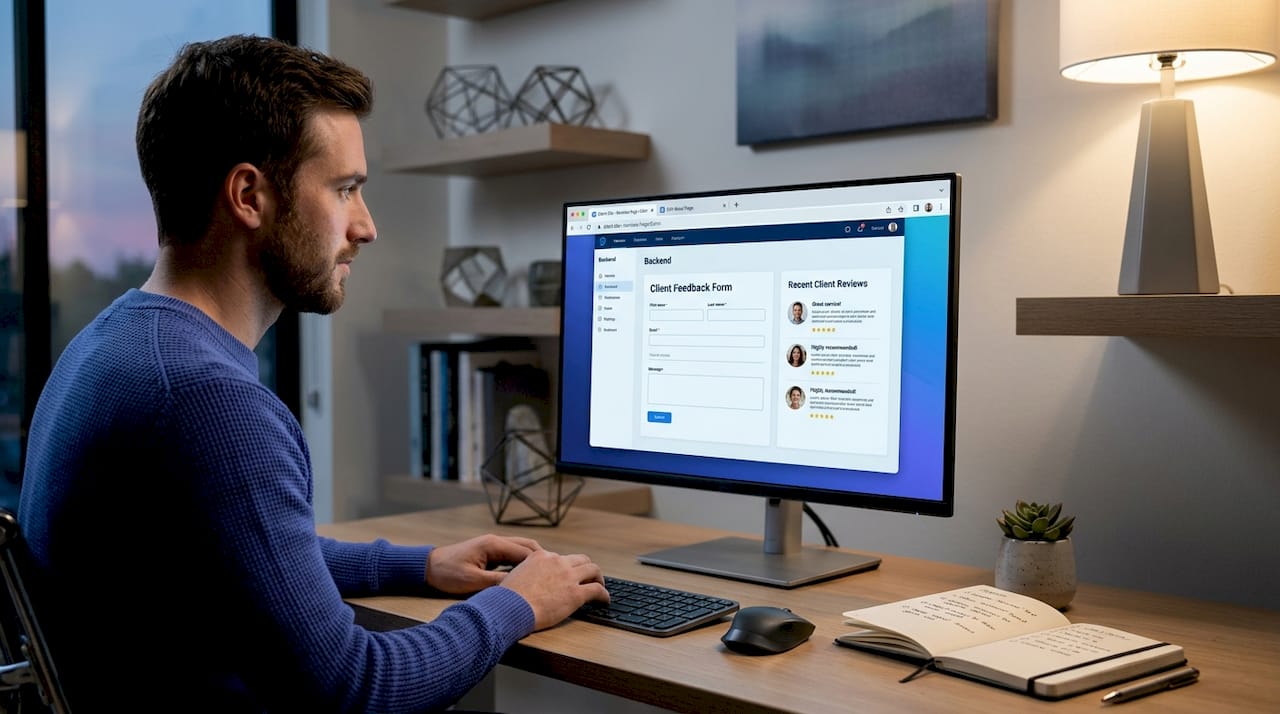
Reviews and testimonials are the single most powerful trust signal you can display. Testimonials integrated into the site experience improve credibility and conversions in a measurable way. Don’t just link to your Google reviews. Pull them directly onto your site. Feature specific, detailed reviews that mention the service performed, the location, and the outcome.
Your About page needs to do more than list your company history. It should tell a story. Why did you start this business? What do you stand for? Who is on your team? Include:
- A photo of the business owner or team
- Years in business and service area
- Certifications, licenses, and insurance details
- Any community involvement or awards
- A personal statement that shows your values
Your Privacy Policy is non-negotiable. A Privacy Policy is standard for compliance and its exact content depends on how your site collects data through forms and analytics. Even a simple contact form triggers the need for a Privacy Policy in most jurisdictions.
Here’s a summary of trust signals and where they should appear on your site:
| Trust signal | Home page | Service pages | Location pages | About page |
|---|---|---|---|---|
| Star ratings / review count | Yes | Yes | Yes | No |
| Customer testimonials | Yes | Yes | Yes | Optional |
| Certifications / licenses | Yes | Yes | Optional | Yes |
| Team photos | Optional | No | No | Yes |
| NAP information | Yes | Yes | Yes | Yes |
| Insurance / guarantees | Optional | Yes | Yes | Yes |
Key insight: Featuring even three to five detailed, authentic customer reviews on a service page can directly increase booking rates. Visitors need to see that real people in their area have already trusted you with the same job they need done.
Comparison guide: Which pages matter most for different local service models?
Not every local service business is built the same way. A solo plumber working one city has very different needs than a landscaping company serving fifteen suburbs. Here’s how to think about page priorities based on your business model.
| Business model | Must-have pages | Optional pages |
|---|---|---|
| Single location | Home, Services, Contact, About, Reviews, Privacy Policy | FAQ, Blog |
| Service area only | Home, Services, Service Area Pages, Contact, Reviews, Privacy Policy | About, FAQ |
| Multi-city provider | Home, Services, Location Pages per city, Contact, About, Reviews, Privacy Policy | FAQ, Blog, Resource pages |
If you can only build three to four pages right now, here’s how to prioritize:
- Home page first. This is your anchor. Everything else links back to it and flows from it.
- One strong service page. Pick your highest-value or most-requested service and build a conversion-optimized page around it.
- One location or service area page. Target your primary city or service area with real local proof.
- Contact page. Without a clear way to reach you, the other pages can’t convert.
Practitioner advice consistently warns against creating many low-uniqueness location pages. A hub-and-spoke model, where you build one strong regional page and link out to more specific area pages over time, is a smarter long-term strategy than flooding your site with thin city pages from day one.
Quality and relevance always beat quantity. Two pages that genuinely serve your ideal customer will outperform twenty pages that say nothing specific to anyone.
The real secret to high-converting local service websites
Here’s an opinion you won’t hear often: the page structure matters far less than most people think. What actually separates the local service websites that generate consistent leads from the ones that sit idle is authenticity.
We’ve seen businesses with technically perfect page structures get outranked and out-converted by competitors with simpler sites that showed real work, real people, and real results. The template approach almost always fails because templates are built to look good, not to reflect the specific business, community, and customers behind them.
The best local service websites share one thing in common. They show what we call “real local proof.” That means photos from actual jobs completed in the neighborhoods they serve. It means reviews that mention specific streets, projects, or outcomes. It means an About page that sounds like a real person wrote it, not a marketing agency trying to hit keyword targets.
City page stuffing without real differentiation is a trap that wastes time and budget. We’ve seen businesses spend months building out thirty city pages, only to see zero movement in rankings or leads. Meanwhile, a competitor with five well-crafted, locally authentic pages dominates the market.
The advice we give every client: invest your time and budget into fewer pages that you can make genuinely excellent. Use photos only your business can provide. Write copy that reflects your actual process and values. Feature reviews that tell a real story. That’s what builds trust, and trust is what drives bookings.
Storytelling and visuals that only your business can provide are your most powerful competitive advantage. No competitor can replicate your specific jobs, your specific customers, or your specific community presence. Lean into that. Learn from real service website lessons and prioritize authenticity over volume every time.
Upgrade your local service site for more leads
You now know exactly which pages your local service website needs and how to make each one work harder for your business. But knowing what to build and actually building it well are two different things.
At Cosmic Digital Studios, we specialize in building custom, conversion-focused websites for local service businesses. Every page we create is built with your specific service area, customer intent, and business goals in mind. No templates. No generic city pages. Just clean design, strong messaging, and real conversions. If you’re ready to turn your website into a lead-generating asset, get a high-converting site built by a team that understands what local service businesses actually need to grow.
Frequently asked questions
Do I need a separate service area page for every city I serve?
You don’t need a page for every city. Practitioner advice warns against low-uniqueness location pages and recommends fewer, stronger pages with real local proof for your core service areas.
Can I just use a Facebook or Google Business profile instead of building these pages?
A profile alone isn’t enough. Location pages built to rank and convert give you far more control over your message, better SEO performance, and the ability to run paid ads directly to targeted landing pages.
Do I need a Privacy Policy on my local service website?
Yes, it’s standard for compliance and user trust. A Privacy Policy’s exact content depends on how your site collects data, but any site with a contact form needs one.
What’s the fastest way to add credibility to my service website?
Feature real customer reviews prominently on your key pages. Reviews and testimonials integrated into the site experience deliver an immediate credibility boost and give hesitant visitors the social proof they need to take action.