
Conversion copywriting is writing engineered to drive a measurable action, such as a purchase, sign-up, or booked call, using data-backed research, persuasion psychology, and structured testing. Unlike brand copy, which builds awareness, or SEO copy, which chases rankings, conversion copy is judged by one metric: did the reader act? This discipline, also called direct response copywriting in its traditional form, sits at the intersection of behavioral science and clear communication. Cosmicdigitalstudios builds every website and funnel around these principles because messaging drives conversions more reliably than design alone.
What is conversion copywriting, and how does it differ from other copy?
Conversion copywriting is accountable in a way that most writing is not. Conversion rates are calculated as conversions divided by total visitors, multiplied by 100. That single number tells you whether the copy worked. Brand copy and general marketing copy carry no such test.
The distinction goes deeper than measurement. Brand copy prioritizes tone, identity, and emotional resonance over time. Conversion copy reduces doubt and increases clarity at the exact moment a visitor decides whether to act. It targets high-friction pages: pricing, checkout, demo requests, and landing pages.

General marketing copy often relies on hype, vague promises, and clever wordplay. Conversion copy does the opposite. It eliminates friction and anxiety by combining proof, specificity, and clarity so the next step feels safe and easy. That shift in intent changes everything about how the copy is written.
Here is how the three main types compare:
- Conversion copy: Drives a specific action. Judged by conversion rate. Rewritten if it underperforms.
- Brand copy: Builds recognition and emotional association. Judged by sentiment and recall.
- SEO copy: Attracts organic traffic. Judged by rankings and click-through rates.
Pro Tip: If your copy could run on a billboard without losing meaning, it is brand copy. Conversion copy only works in context, at the right moment, for a reader already considering a decision.
Core techniques used in effective conversion copy
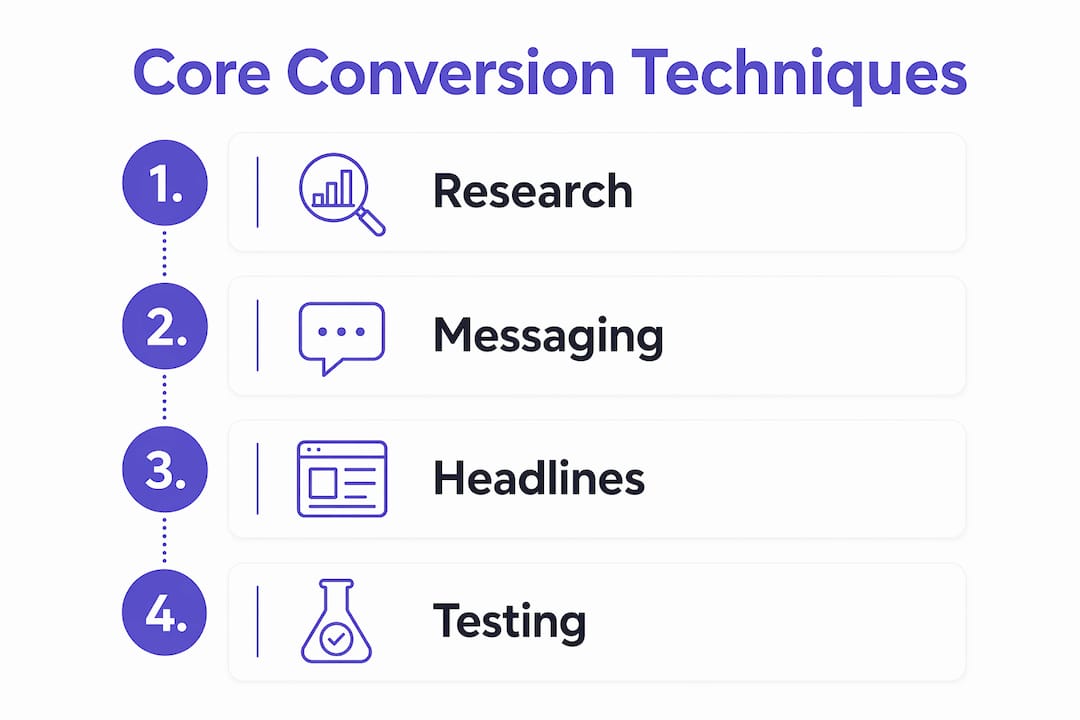
Conversion copywriting is an engineering discipline built on research and testing, not persuasion talent alone. The process follows a repeatable structure that any marketer or business owner can apply.
1. Voice-of-customer research
Voice-of-customer research mines exact customer language from reviews, support tickets, and sales calls. When your copy uses the phrases your customers already use to describe their problem, it reads as believable and specific rather than generic. This is the highest-leverage activity in conversion copywriting because it removes guesswork from word choice entirely.
2. Structured messaging framework
Clear conversion copy follows a six-part structure: name the buyer, state the outcome they want, provide proof, handle the main objection, clarify the next step, and make that step feel low-risk. Each element removes a reason not to act. Skipping any one of them leaves a gap that doubt fills.
3. Headline optimization
The headline carries roughly 80% of a page’s conversion performance. That makes it the single most impactful element to test first. Headline testing alone can produce conversion rate differences of 50%–300% for the same offer. Most marketers underestimate how much a single line of text controls the outcome of an entire page.
4. Single-element testing
Changing more than one element at a time in a test destroys attribution clarity. If you rewrite the headline and the call-to-action button simultaneously and conversions improve, you cannot know which change caused the lift. Test one element, measure the result, then move to the next.
5. Continuous iteration
Conversion copy is never finished. A version that beats the control today may underperform next quarter as your audience or offer changes. The discipline requires a permanent testing calendar, not a one-time rewrite.
“Conversion copywriting success is strictly defined by measurable conversion improvements, not subjective writing quality or cleverness. Copy is rewritten if it does not improve conversion rates.”
Where to apply conversion-focused writing across your marketing
Conversion copy works differently depending on where a visitor encounters it. The context of where copy appears, whether an ad, FAQ, or checkout page, determines how it should be written. A cold ad needs to earn attention. A checkout page needs to remove last-second doubt. The goal shifts, and the copy must shift with it.
| Channel | Visitor intent | Copy goal |
|---|---|---|
| Paid ad | Low awareness, browsing | Interrupt and create curiosity |
| Landing page | Moderate intent, evaluating | Persuade and build trust |
| Pricing page | High intent, comparing | Remove objections and clarify value |
| Checkout page | Ready to buy, hesitating | Eliminate anxiety and confirm the decision |
| Email sequence | Warm lead, nurturing | Deepen trust and move toward action |
| Product description | Researching, comparing | Highlight specific outcomes and proof |
Each stage of the buyer journey requires a different tone and structure. A visitor on a pricing page does not need to be sold on the category. They need their specific objection answered. A visitor reading a cold ad does not need pricing details. They need a reason to care.
Pro Tip: Map your copy to the buyer’s awareness level, not just the page type. A visitor who arrives from a referral link is warmer than one from a generic search ad. Write accordingly.
Micro conversions matter as much as the final sale. Getting a visitor to watch a demo video, click a pricing tab, or read a testimonial section are all conversion events. Website copywriting that guides visitors through these smaller steps builds momentum toward the primary conversion. Ignoring micro conversions leaves measurable value on the table.
Benefits of conversion copywriting for business growth
The measurable impact of conversion-focused writing separates it from every other form of marketing copy. Applying strategic conversion copywriting techniques has been documented to increase revenue by as much as 240% compared to non-optimized messaging. That figure reflects 11 specific copywriting changes applied systematically, not a single rewrite.
The core benefits for marketing professionals and business owners include:
- Higher revenue per visitor: Better copy converts more of the traffic you already have, without increasing ad spend.
- Lower cost per acquisition: When more visitors convert, each dollar spent on traffic goes further.
- Faster testing cycles: A structured testing process produces learnings that compound over time.
- Reduced reliance on discounting: Clear, specific copy communicates value so visitors do not need a price cut to act.
- Scalable improvements: Every winning test becomes a permanent baseline, and each new test builds on it.
A common misconception is that conversion copy means writing more aggressively or adding more urgency triggers. The opposite is true. Firms often mistake “more salesy” copy for conversion copy. True conversion copywriting reduces doubt with proof and clarity rather than pressure. Visitors who feel informed and confident convert at higher rates than visitors who feel pushed.
The accountability built into conversion copywriting also changes how marketing teams operate. When copy is tied to a conversion rate, every rewrite has a clear success condition. That removes subjective debates about what “sounds good” and replaces them with data. For business owners, that shift alone is worth the investment in learning the discipline.
Key Takeaways
Conversion copywriting is the most measurable form of writing in marketing because every word is tested against a single metric: did the reader take the intended action?
| Point | Details |
|---|---|
| Definition and accountability | Conversion copy is judged by conversion rate, not quality or creativity. |
| Voice-of-customer research | Mining real customer language produces copy that is specific, believable, and high-converting. |
| Headline priority | The headline drives roughly 80% of page performance and should be tested first. |
| Single-element testing | Change one copy element at a time to accurately measure what caused any improvement. |
| Revenue impact | Strategic conversion copywriting has been documented to increase revenue by up to 240%. |
Why most conversion copy fails before it is even tested
Most businesses treat conversion copywriting as a one-time task. They hire someone to rewrite the homepage, publish it, and move on. That approach misses the entire point of the discipline.
What I have seen consistently is that the copy itself is rarely the deepest problem. The real issue is that businesses write for themselves instead of for the visitor standing at a decision point. They use internal language, category jargon, and feature lists when the visitor is asking a single question: “Will this work for me?” Every word on the page either answers that question or creates noise.
The second mistake is skipping voice-of-customer research entirely. Marketers assume they know how customers describe their problem. They almost never do. The exact phrase a customer uses in a review or a support ticket carries more persuasive weight than anything a copywriter invents. I have seen a single phrase pulled from a customer interview outperform a professionally written headline by a wide margin. That is not luck. That is the customer’s own language doing the work.
Testing discipline is the third failure point. Businesses run one version of a page for months without testing anything. Then they rewrite everything at once based on a gut feeling and cannot measure what changed. A high-converting homepage is not built in one session. It is built through a series of controlled tests, each one producing a clear answer.
The businesses that win with conversion copywriting treat it as an ongoing process, not a project. They test headlines every quarter. They update proof elements as new results come in. They read customer reviews the way a researcher reads data. That mindset is what separates businesses that grow from businesses that wonder why their traffic does not convert.
— Max
How Cosmicdigitalstudios puts conversion copy into practice
Conversion copywriting only produces results when the copy lives inside a page built to support it. Weak structure, slow load times, and confusing layouts cancel out even the best-written copy.
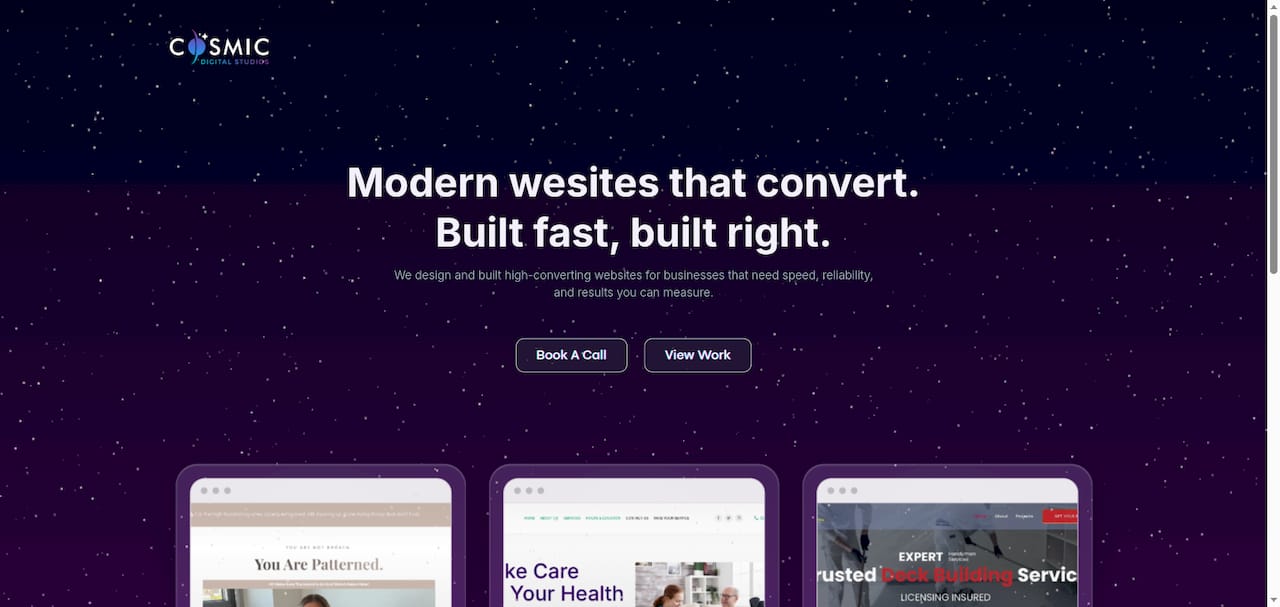
Cosmicdigitalstudios builds fast, modern websites designed around the same principles covered in this guide: clear messaging, structured persuasion, and copy that guides visitors toward a decision. Every page is built with the buyer’s awareness level and intent in mind. If you want to see how conversion copy and design work together in practice, the guide on turning visitors into clients is a strong next step. Clean design. Strong messaging. Real conversions.
FAQ
What is conversion copywriting in simple terms?
Conversion copywriting is writing designed to get readers to take a specific action, such as buying, signing up, or booking a call, using research, clear structure, and testing rather than creative instinct alone.
How does conversion copywriting differ from SEO copywriting?
SEO copywriting targets search rankings and organic traffic. Conversion copywriting targets the visitor already on the page and focuses on persuading them to act, measured by conversion rate rather than search position.
What is the most important element to test in conversion copy?
The headline is the single most impactful element, carrying roughly 80% of a page’s conversion performance. Testing headline variations first produces the largest measurable gains before moving to other elements.
How do I write conversion copy without sounding pushy?
Effective conversion copy reduces doubt through proof, specificity, and clarity rather than pressure tactics. Use real customer language, address the main objection directly, and make the next step feel low-risk.
How long does it take to see results from conversion copywriting?
Results depend on traffic volume and testing frequency. Pages with high traffic can produce statistically significant test results within two to four weeks. Lower-traffic pages require longer testing windows to reach reliable conclusions.