
Website copywriting is the strategic practice of planning, writing, and refining clear, persuasive text on a website to guide visitors toward specific actions. Those actions include booking a call, making a purchase, or subscribing to a list. Unlike general website content writing, which informs, copywriting persuades. It covers every word on your site: headlines, hero statements, service descriptions, about pages, calls-to-action, and landing pages. Tools like Grammarly help with clarity, but the real measure of good copy is whether visitors take action after reading it.
What is website copywriting and what does it actually involve?
Effective website copywriting sits at the intersection of business writing, user experience design, SEO, and persuasion. It is not about clever wordplay or stuffing keywords into paragraphs. It is about communicating the right message to the right person at the right moment in their decision process.
The structure of your messaging matters as much as the words themselves. A visitor who lands on your homepage has a question forming in their mind: “Is this for me?” Your copy answers that question within seconds or they leave. This is why strategic planning of your messaging hierarchy, from the headline down to the footer, directly affects how many visitors convert into leads or customers.

Good copywriting for websites also accounts for how people actually read online. Most visitors skim before they commit to reading. That means your copy must work in layers: a strong headline that captures attention, a subheading that reinforces the offer, and body text that closes the argument.
Here is what separates strong website copy from average page text:
- Clear value proposition: Visitors understand what you do and why it matters within the first few seconds above the fold.
- Audience-specific language: The words reflect how your customers describe their own problems, not how you describe your solutions.
- Friction reduction: Copy anticipates objections and answers them before the visitor has to ask.
- Scannability: Short paragraphs, bold key phrases, and bullet points let skimmers absorb the core message without reading every word.
- Consistent voice: Every page sounds like the same brand, building familiarity and trust across the full site.
Pro Tip: Before writing a single word of copy, write down the one action you want each page to drive. Every sentence on that page should support that single goal. Pages that try to do everything convert at the rate of pages that do nothing.
How does website copywriting drive conversions?
Calls-to-action are the most measurable element of any website copy strategy. A CTA is the specific phrase that tells a visitor what to do next: “Book a Free Call,” “Get Your Quote,” or “Start Your Free Trial.” The words you choose, the placement, and the context around the CTA all affect whether visitors click.
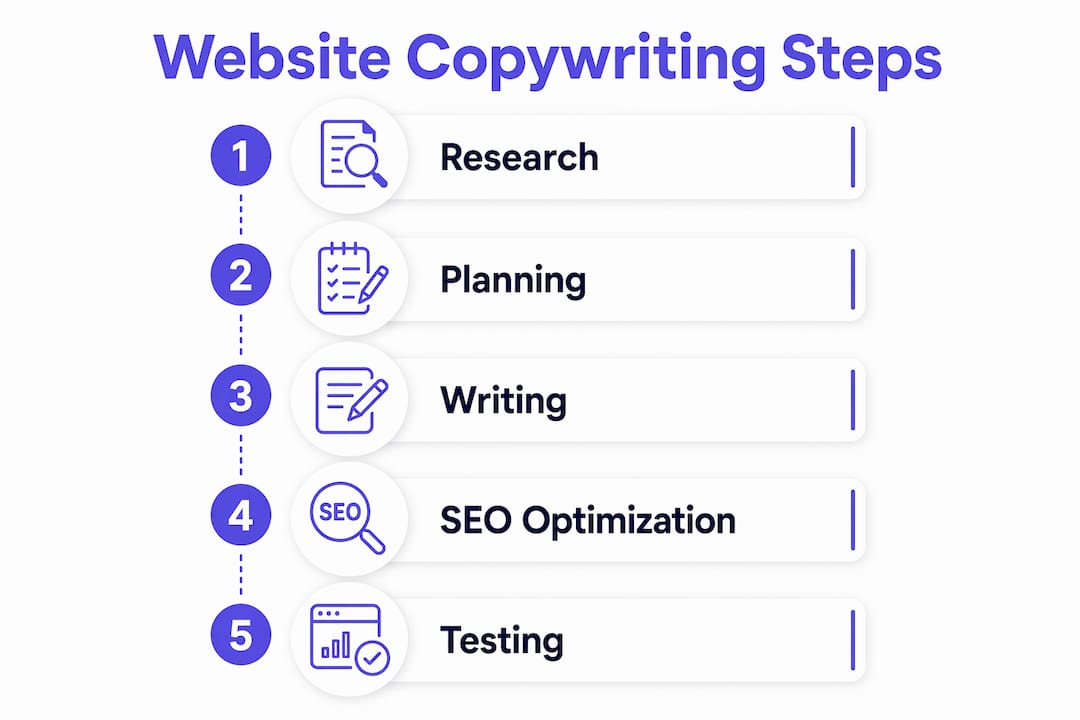
Personalized CTAs convert 202% better than generic ones, based on HubSpot’s analysis of 330,000 CTAs over six months. That number means a CTA written for a specific visitor segment, such as a first-time visitor versus a returning lead, dramatically outperforms a one-size-fits-all button. The implication for business owners is direct: generic copy costs you conversions every single day.
The way to find your best-performing copy is through A/B testing. Here is a practical process:
- Write two versions of your CTA. One is your current copy. The other changes one variable: the verb, the benefit statement, or the specificity of the offer.
- Split your traffic 50/50. Send half your visitors to version A and half to version B over the same time period.
- Measure the right metrics. Track click rate, form submissions, and downstream conversions, not just page views.
- Select the winner. After reaching statistical significance, keep the better-performing version and start the next test.
“Even small copy tweaks can greatly impact motivation and comprehension at decision points.” — HubSpot CTA testing guidance
This optimization loop of hypothesizing, testing, analyzing, and selecting is what separates businesses that grow their conversion rates from those that guess and hope. Copy is never finished. It is always a working draft.
Pro Tip: Test your CTA verb first. “Get Your Free Quote” consistently outperforms “Submit” or “Click Here” because it names the benefit, not the action. Start there before testing anything else.
What types of website pages need specialized copy?
Not every page on your site serves the same purpose, and your copy strategy must reflect that. Each page type sits at a different stage of the visitor’s decision process, and the messaging must match where they are mentally.
| Page type | Primary copy goal | Key copy element |
|---|---|---|
| Homepage | Communicate what you do and who you serve within seconds | Above-the-fold headline and value proposition |
| Service or product page | Persuade visitors that your offer solves their specific problem | Benefit-led descriptions and social proof |
| About page | Build trust and credibility with the people behind the brand | Story, credentials, and mission |
| Landing page | Drive one specific action with zero distraction | Single CTA with supporting proof points |
| FAQ page | Reduce friction and answer objections before they stall a decision | Direct, concise answers to real questions |
Above-the-fold copy on your homepage and landing pages must answer three questions immediately: what does this business do, who does it serve, and why should I care. Visitors do not scroll to find out if you are relevant. They decide in seconds based on what they see first.
Service pages carry a different weight. They need to go beyond listing features and translate those features into outcomes the visitor actually wants. “We build custom websites” is a feature. “You get a site that books clients while you sleep” is an outcome. The second version speaks to the visitor’s goal, not your process.
About pages are often underestimated. Visitors who land on your about page are already interested. They are doing due diligence. Copy here should build credibility through specifics: years of experience, types of clients served, and the reason the business exists. Vague mission statements do not convert. Specific, honest storytelling does.
How does website copywriting support SEO and user experience?
Website copy and SEO are not separate strategies. They work together or they work against each other. 68% of online experiences begin with a search engine, which means the words on your pages determine whether visitors find you at all. Copy that ignores search intent leaves organic traffic on the table.
Strong SEO copywriting starts with matching your headings and page text to the exact questions your audience types into Google. If someone searches “how to hire a web designer,” a page with that phrase in its H1 and answered clearly in the first paragraph will outperform a page that buries the answer in paragraph six. Search engines reward clarity and relevance, and so do readers.
Here is how to write copy that serves both SEO and the user experience simultaneously:
- Use clear, descriptive headings that reflect real search queries, not internal jargon or clever titles.
- Write short paragraphs of three to five sentences. Dense blocks of text increase bounce rates and reduce time on page.
- Place your primary keyword naturally in the first 100 words, in at least one subheading, and in the meta description.
- Write for visitor discovery and engagement first. Copy that reads naturally tends to rank better than copy that feels forced around keywords.
- Use internal links to guide visitors deeper into your site, which reduces bounce rate and signals content relevance to search engines.
The balance between SEO and human-focused messaging is not as difficult as it sounds. When you write copy that genuinely answers a visitor’s question in plain language, you are already doing most of what search engines reward. The technical layer, keyword placement, heading structure, and meta text, is a refinement on top of that foundation, not a replacement for it. For a deeper look at how copy and design work together, the guide on website UX for business owners covers the full picture.
Key takeaways
Website copywriting is the single highest-leverage element on your site because it determines whether visitors understand your offer, trust your brand, and take the action you need them to take.
| Point | Details |
|---|---|
| Copy is strategic, not decorative | Every word on your site should support a specific business goal or visitor action. |
| Personalized CTAs outperform generic ones | HubSpot data shows personalized CTAs convert 202% better than basic alternatives. |
| Each page type needs tailored messaging | Homepage, service, about, and landing pages each serve a different stage of the decision process. |
| SEO and copywriting work together | Aligning headings and text with search intent drives organic traffic and improves engagement. |
| A/B testing refines copy performance | Splitting traffic and measuring results is the only reliable way to know what copy actually works. |
Why most business owners underestimate their homepage copy
I have reviewed hundreds of websites for business owners who were spending real money on ads and getting almost no results. In almost every case, the problem was not the ad. It was the page the ad sent people to.
The above-the-fold section of your homepage is the single most important piece of copy your business owns. It is the first thing every visitor sees, and it either earns their attention or loses it. Most business owners treat it as a design element. It is actually a conversion gatekeeper.
The most common mistake I see is copy written from the business owner’s perspective instead of the visitor’s. “We are a full-service digital agency with 10 years of experience” tells me about you. “We build websites that turn visitors into paying clients” tells me what I get. The second version wins every time, and the difference is just a shift in perspective.
The second mistake is treating copy as a one-time task. The businesses I have seen grow their conversion rates consistently are the ones that test, measure, and refine their copy on a schedule. They treat their website like a sales tool that needs maintenance, not a brochure that gets printed once. Even changing a single word in a CTA, based on real data from persuasive copy frameworks, can move the needle more than a full redesign.
If you take one thing from this: write your homepage headline for the visitor’s outcome, not your own credentials. Then test it.
— Max
Ready to turn your website copy into a conversion engine?
At Cosmicdigitalstudios, we build websites where the copy and the design work together from day one. Every page is structured to communicate clearly, answer the right questions, and guide visitors toward booking a call or making a purchase.
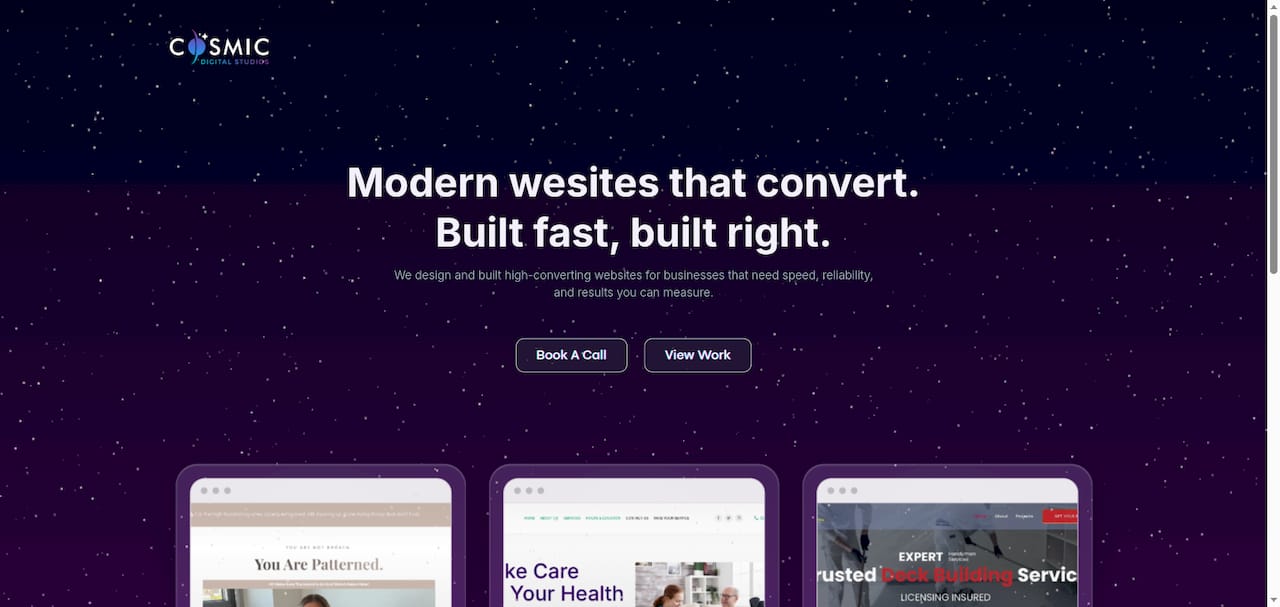
If your current site is getting traffic but not converting, the copy is almost always part of the problem. We can help you fix that with a custom-built website that reflects your brand and drives real results. You can also explore our guide on turning visitors into clients to see exactly how the process works. Clean design. Strong messaging. Real conversions.
FAQ
What is the difference between website copywriting and content writing?
Website copywriting is persuasion-focused writing designed to drive a specific action, such as a purchase or booking. Content writing, like blog posts or guides, is primarily informational and builds long-term authority.
How long should website copy be?
Page length depends on the page type and the visitor’s decision complexity. Landing pages with a single offer can convert with 300 words. Service pages that address complex buying decisions often need 600 to 1,000 words to answer objections fully.
Why do CTAs matter so much in website copy?
CTAs are the direct instruction that tells visitors what to do next. Personalized CTA copy converts 202% better than generic alternatives, making them the highest-leverage element to test and refine on any page.
How does website copy affect SEO rankings?
Copy that uses clear headings aligned with search queries, places keywords naturally, and answers visitor questions directly signals relevance to search engines. Since most online experiences start with a search engine, well-structured copy directly affects how much organic traffic your site receives.
How often should you update your website copy?
Review your core pages, homepage, service pages, and key landing pages, at least once per quarter. Use analytics and CTA testing data to identify which pages have high traffic but low conversions, and prioritize those for copy updates first.