
Your website has about three seconds to prove itself. After that, most visitors are gone. The benefits of fast-loading local websites go well beyond a good score in Google PageSpeed Insights. They show up in your call volume, your form submissions, and your monthly revenue. A 1-second delay can cut conversions by around 7%, and bounce rates climb steeply with every extra second a page takes to load. If you run a local service business, your site isn’t just a digital brochure. It’s your front door, and speed determines whether people walk in.
Table of Contents
- Key Takeaways
- 1. Benefits of fast-loading local websites start with the right metrics
- 2. How fast load times improve user experience
- 3. SEO and search visibility gains
- 4. Direct conversion and revenue impact
- 5. Practical strategies to make your local site faster
- My honest take on speed as a local business asset
- Ready to turn your local site into a faster, higher-converting asset?
- FAQ
Key Takeaways
| Point | Details |
|---|---|
| Speed directly cuts revenue | A single second of delay reduces conversions by ~7%, with bounce rates jumping from 9% to 38% as load time grows. |
| Core Web Vitals set the bar | Google’s 2026 standards require LCP ≤ 2.5s, INP ≤ 200ms, and CLS ≤ 0.1 to avoid ranking penalties. |
| Speed is a local SEO tiebreaker | When two competing local sites are otherwise equal, the faster one earns the ranking edge and the click. |
| Performance monitoring is ongoing | Google evaluates a 28-day rolling window of user data, so speed must be maintained, not just achieved once. |
| Balance speed with content depth | Stripping too much content for speed can hurt your credibility in AI-powered local search results. |
1. Benefits of fast-loading local websites start with the right metrics
Before you can improve speed, you need to know what “fast” actually means in 2026. The industry standard framework is Google’s Core Web Vitals, a set of three measurable signals that define how fast and stable a page feels to real users.
Here’s what each metric means and where you need to land:
- LCP (Largest Contentful Paint): Measures how quickly the main content of a page loads. Target: 2.5 seconds or under. This is usually your hero image or headline.
- INP (Interaction to Next Paint): Replaced FID in 2024 and measures how fast your page responds to user clicks and taps. Target: 200 milliseconds or under.
- CLS (Cumulative Layout Shift): Measures visual stability. Target: 0.1 or under. A page that jumps around as it loads destroys trust instantly.
Mobile performance matters more than desktop here. Google indexes the mobile version of your site first, so if your pages load slowly on a phone with a typical connection, your rankings and experience suffer regardless of how fast your desktop version runs.
Pro Tip: Use Google Search Console’s Core Web Vitals report alongside PageSpeed Insights to see real user data, not just lab test scores. Real user data from your actual visitors is what Google uses for rankings.
The best free tools to benchmark your site include Google PageSpeed Insights, Lighthouse, and DebugBear. Check them monthly, not just after a redesign.
2. How fast load times improve user experience
Speed is not a technical vanity metric. It is the single largest driver of whether someone stays on your page long enough to contact you.
Here’s the real picture on user behavior:
- Pages loading in 2 seconds average a 9% bounce rate. Pages taking 5 seconds average a 38% bounce rate. That gap costs local businesses real leads every day.
- 53% of mobile users abandon a site entirely if it takes more than 3 seconds to load. On mobile, where most local searches happen, this is a critical threshold.
- Delays beyond 10 seconds cause users to lose focus and abandon tasks completely. Getting someone to come back after that kind of experience is rare.
- Median mobile Total Blocking Time reached 1,916ms in 2025 across the web, meaning the average site makes users wait nearly two full seconds before they can interact with anything. Being faster than average is a real advantage.
“Good perceived performance requires interactions within approximately 100ms. After that threshold, users begin to notice delay. After 1,000ms, the mental flow of a task is broken.”
That quote reflects exactly what the INP metric is designed to capture. A fast initial load is not enough if your site then freezes when someone taps your phone number or tries to fill out a form. Interactivity speed matters just as much as visual load speed when you’re trying to convert a visitor into a customer.
For local businesses, a visitor who can’t tap your call button without a lag is a visitor who is about to call your competitor instead.

3. SEO and search visibility gains
Speed is a confirmed Google ranking signal, and it carries a specific kind of weight in local search.
| Factor | Slow site (LCP > 4s) | Fast site (LCP ≤ 2.5s) |
|---|---|---|
| Core Web Vitals status | Failing | Passing |
| Risk of ranking penalty | Yes | No |
| Crawl frequency by Googlebot | Lower | Higher |
| Competitive edge in local SERPs | None | Tiebreaker advantage |
| Click-through to calls/forms | Reduced | Improved |
Speed acts as a tiebreaker in local SEO. When two businesses are closely matched on proximity, reviews, and profile completeness, the faster site earns the click. That is a concrete, measurable advantage in competitive local markets like home services, healthcare, legal, and food.
There’s an important nuance worth knowing. Passing Core Web Vitals protects you from penalties, but it does not guarantee a ranking boost on its own. Your Google Business Profile accuracy, review quantity and quality, and content relevance remain the primary ranking factors. Speed amplifies those fundamentals. It does not replace them.
One area where site speed multiplies its SEO value is multi-location pages. If your business serves multiple neighborhoods or cities, faster crawling means Google indexes those pages more frequently and more completely. You can read more about structuring those pages correctly in this guide on building a multi-location site.
4. Direct conversion and revenue impact
This is where the local site speed benefits become impossible to ignore from a business perspective.
The math is straightforward. A 1-second improvement in load time produces roughly a 7% lift in conversions. If your site currently books 20 calls per week and you cut your load time by two seconds, that math points toward 3 to 4 additional weekly calls with no change in traffic, no additional ad spend, and no new content created.
Here’s what the conversion research actually shows:
- Faster sites generate significantly more call clicks, form fills, and direction requests from local visitors.
- Faster sites convey professionalism and reliability in a way that directly influences whether a visitor trusts you enough to reach out.
- Lightweight pages built for speed. Under 20KB pages can load in under 200ms on throttled 3G connections, dramatically improving time-to-interaction and CTA effectiveness.
- Speed improvements multiply conversion effects once local SEO basics are in place. Speed plus strong local fundamentals compounds your results.
Pro Tip: Pair your speed improvements with conversion tracking in Google Analytics or your CRM. When you integrate speed metrics with conversion data, you can see exactly which page improvements moved the needle on bookings or calls, and which ones were just score improvements with no revenue impact.
Speed without a clear call to action is still a missed opportunity. A fast page with a confusing layout or buried phone number will still underperform. Check out these conversion rate strategies that pair well with speed optimization for local pages.
5. Practical strategies to make your local site faster
Knowing the importance of quick-loading sites is one thing. Knowing where to start is another. Here’s where to focus your effort.
| Optimization tactic | Difficulty | Impact on speed | Impact on conversions |
|---|---|---|---|
| Compress and convert images to WebP | Low | High | High |
| Defer non-critical JavaScript | Medium | High | Medium |
| Enable browser caching | Low | Medium | Medium |
| Use a CDN (Content Delivery Network) | Medium | High | High |
| Reduce third-party scripts | Medium | High | High |
| Prioritize above-the-fold content | Medium | Very High | Very High |
The highest-leverage move is almost always focusing on critical path resources. This means the content your visitor sees first: your headline, your hero image, and your primary call to action. Loading those fast while deferring everything else produces the biggest LCP improvement with the least disruption to your site’s content.
One counterintuitive warning: stripping your pages down too aggressively in the name of speed can hurt you in AI-powered search. AI search tools and citation engines favor content depth. A page with real answers, service details, and local context will perform better in AI-generated search results than a nearly empty page that loads in 800ms. Balance is the goal.
Google also uses a 28-day rolling window of real user data to evaluate your site. A plugin update or a new third-party chat widget can quietly degrade your speed score over weeks. Monthly monitoring is not optional if you want to protect your ranking.
My honest take on speed as a local business asset
I’ve worked on enough local business sites to say this clearly: speed is misunderstood by most business owners and undervalued by most marketers.
The typical framing I see is that speed is a technical problem for developers to solve, then forget. That’s the wrong mental model. Speed is a business performance metric, the same way call volume or lead cost is. When your site slows down, your revenue leaks. It happens quietly, with no error message, no alert, and no obvious cause.
What I’ve learned is that the biggest gains don’t come from chasing a perfect PageSpeed score. They come from making the first three seconds of a visitor’s experience completely frictionless. Get the headline visible, get the phone number tappable, and get out of the visitor’s way. That’s where real conversion lift happens, not in shaving milliseconds off your server response time.
I also see a common misconception that passing Core Web Vitals will boost rankings dramatically. It won’t on its own. But failing them will hurt you. Think of it as the floor you have to stay above, not a ceiling you’re trying to hit.
The businesses I’ve seen get the best results combine a genuinely fast site with strong local SEO fundamentals: accurate business profiles, real reviews, and location-specific content that actually answers what people are searching for. Speed multiplies what you already have. It won’t save a site with weak fundamentals, but it will widen the gap between you and a competitor who has those fundamentals but a slow site.
Keep monitoring. Set a monthly reminder. It’s the one habit that consistently protects the performance gains you’ve worked for.
— Max
Ready to turn your local site into a faster, higher-converting asset?
At Cosmicdigitalstudios, we build websites specifically designed to load fast, look professional, and guide your visitors toward calling, booking, or buying. Every build we deliver is built with Core Web Vitals in mind from day one, not patched in after launch.
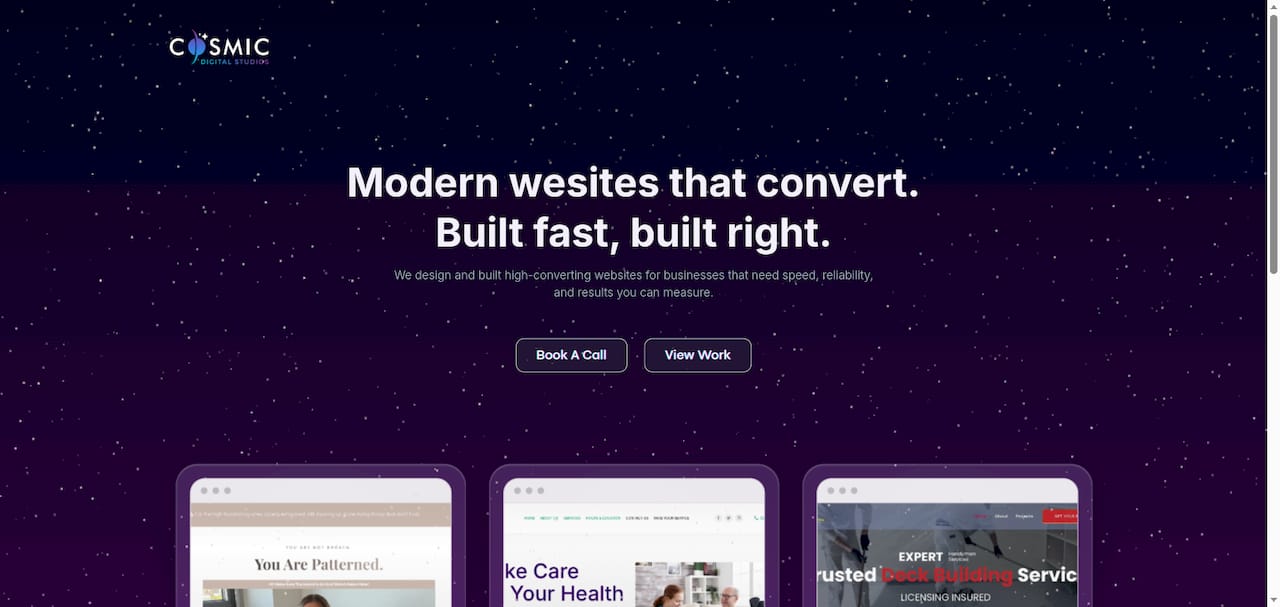
If your current site is slow, outdated, or just not converting the way it should, we can help. Whether you need a full website redesign or want to explore what a custom-built, performance-first local site looks like, Cosmicdigitalstudios is the place to start. Clean design, strong messaging, real conversions.
FAQ
How much does a slow site actually cost a local business?
A 1-second delay reduces conversions by approximately 7%, and bounce rates jump from around 9% at 2 seconds to 38% at 5 seconds. For a local business generating leads through its website, that represents real lost calls and bookings every week.
Does site speed directly boost my local search ranking?
Speed is a confirmed ranking signal, but it works as a tiebreaker rather than a primary factor. Strong local SEO fundamentals like your Google Business Profile and reviews remain more important, with speed amplifying those signals in competitive markets.
What Core Web Vitals scores should my local site hit in 2026?
Google’s 2026 thresholds for good performance are LCP ≤ 2.5s, INP ≤ 200ms, and CLS ≤ 0.1. Failing any of these puts your site at risk of ranking penalties and poor user experience signals.
How often should I check my site’s speed?
Monthly monitoring is recommended because Google evaluates a 28-day rolling window of real user data. Plugin updates, new scripts, and added media can degrade speed gradually without any visible warning.
Does a faster website help with mobile users specifically?
Yes. 53% of mobile users abandon sites that take longer than 3 seconds to load, and Google uses mobile performance as its primary indexing signal. For local businesses where most searches happen on phones, mobile speed is the most critical performance variable to get right.