
A coaching website fails when it does not clearly communicate value to prospective clients and places obstacles between interest and booking. This is the core problem behind most coaching business website problems, and it is more fixable than most coaches realize. The industry term for this is conversion path failure: the site attracts traffic but cannot turn visitors into paying clients. Poor messaging, hidden credentials, slow load times, and broken booking flows all compound the same root issue. Fix these, and your site becomes your best sales tool.
Why your coaching website fails to convert visitors
The most common coaching website mistakes are not about design taste. They are about missing the basics that build trust and reduce friction. Most coaching websites include vague service lists and inspirational images but lack a clear call to action, causing visitors to leave without booking. That means good traffic goes to waste because the site never tells the visitor what to do next.
Coaches often write for themselves instead of their clients. The headline talks about the coach’s philosophy, not the client’s problem. The services page lists session types without explaining outcomes. The booking process requires a contact form, a waiting period, and a follow-up email before anything gets scheduled. Every one of those steps loses people.
Here are the top coaching site design issues that cost you clients:
- Vague headline messaging that does not state who you help or what result they get
- Hidden or missing certifications that leave visitors unsure whether you are qualified
- No direct booking option forcing clients through a slow contact form process
- Walls of text on the About page with no clear path to the next step
- No client testimonials or social proof above the fold
- Outdated design that signals low professionalism before a word is read
- No blog or content to build authority and organic search visibility
Pro Tip: Rewrite your homepage headline using this formula: “I help [specific client] achieve [specific outcome] without [common obstacle].” Test it with three people outside your industry. If they cannot explain your offer back to you, rewrite it.
How do poor technical choices hurt coaching site performance?
Technical problems are silent conversion killers. Over 66% of internet traffic to coaching websites comes from mobile devices, making mobile site speed critical for first impressions. A site that loads slowly or breaks on a phone loses more than half its potential clients before they read a single word.

Design choices that feel premium in a mockup often destroy performance in the real world. Animated hero videos and parallax effects distract potential clients and slow down page load times, reducing conversion rates. Clients prioritize clear information and fast performance over visual style. A clean, fast page with a clear headline outperforms a visually complex page every time.
The technical checklist every coaching site needs:
- Mobile-first layout that works on a 375px screen without horizontal scrolling
- Page load time under 3 seconds tested with Google PageSpeed Insights
- No autoplay video on the homepage hero section
- Compressed images using formats like WebP to reduce file size without quality loss
- SSL certificate active so browsers do not flag your site as insecure
Pro Tip: Run your site through Google PageSpeed Insights right now. A score below 70 on mobile is costing you clients. Fix image sizes and remove unused scripts before touching anything else.
If you want a deeper look at how outdated design affects trust, the impact of outdated websites on client perception is well documented and worth reviewing before your next redesign.
Does showing credentials actually improve coaching bookings?
Yes, and the data is specific. 73% of coaching clients expect to see formal certifications prominently displayed to decrease buyer anxiety and improve lead generation. Clients report higher trust and a greater likelihood to book when credentials are visible above the fold, not buried in an About page footer.
Clients research credentials, reviews, and approaches online before engaging with a coach. No referral fully replaces what a well-designed site communicates. That means your website is doing the trust work that used to happen over coffee or through word of mouth. If it does not show proof of competence, clients move on.
| Credibility Element | Impact on Visitor Behavior |
|---|---|
| Certifications above the fold | Reduces buyer anxiety, increases booking intent |
| Client testimonials with full names | Builds social proof, increases time on page |
| Case studies with specific outcomes | Demonstrates results, differentiates from competitors |
| Professional headshot and bio | Creates personal connection, builds relatability |
| Media features or press mentions | Signals authority, increases perceived credibility |
Pro Tip: Place your top certification logo and one short client testimonial directly below your homepage headline. That combination addresses the two biggest objections, “Are you qualified?” and “Does this work?” before the visitor scrolls.
Building trust online follows predictable psychological patterns. Credentials and social proof are not optional extras. They are the minimum threshold for a coaching site to compete.
How to fix your coaching website’s booking flow for more clients
The contact form is the single biggest conversion leak on most coaching sites. Coaches using direct booking tools like Calendly or SavvyCal see approximately 25% higher conversion rates to paying clients compared to generic contact forms. The reason is simple: a contact form asks a client to wait. A booking tool lets them act immediately.
Most coaches misinterpret the contact form as a sufficient booking mechanism. Clients convert better when they can directly choose a time slot and pay immediately online. The psychology is straightforward. When someone is ready to commit, any delay gives doubt time to grow.
Here is how to build a frictionless booking flow:
- Choose a direct booking tool. Calendly, SavvyCal, and Acuity Scheduling all allow clients to pick a time and pay in one session.
- Embed the calendar on your site. Do not redirect to a third-party page. Keep the client inside your domain.
- Add a payment step at booking. Collect a deposit or full payment at the time of scheduling to reduce no-shows.
- Automate onboarding. Delayed manual processes in payment, onboarding forms, and program delivery increase client dropout. Set up automatic confirmation emails and intake forms to trigger immediately after booking.
- Place the booking button in three locations. Put it in the navigation bar, at the end of your services page, and at the bottom of your homepage.
Pro Tip: Label your booking button with a specific outcome, not a generic phrase. “Book Your Free Strategy Call” outperforms “Contact Me” because it tells the visitor exactly what they are getting.
How does SEO structure affect your coaching site’s visibility?
A coaching site that no one finds cannot convert anyone. SEO for coaching websites starts with page structure, not keyword density. A coaching website needs six essential pages: Home, About, Services, Booking, Blog, and Privacy Policy. Missing any one of these creates gaps in both the user journey and search engine indexing.
Each page serves a specific role in the client acquisition funnel. The Home page captures attention and states your offer. The About page builds personal trust. The Services page explains what clients get and at what investment. The Booking page removes all friction from the next step. The Blog builds topical authority over time and drives organic traffic from search.
| Page | Primary SEO Role | Key Conversion Goal |
|---|---|---|
| Home | Rank for your name and core offer | Direct visitor to services or booking |
| About | Rank for coach-specific searches | Build trust and personal connection |
| Services | Rank for problem-specific keywords | Move visitor to booking page |
| Blog | Rank for long-tail client questions | Build authority and capture cold traffic |
| Booking | Rank for “book a coach” intent | Convert visitor to paying client |
Keyword targeting works best when it matches client intent, not coaching industry language. Clients search for “how to stop procrastinating” or “career change coach for women,” not “transformational life coaching services.” Write your page titles and headings in the language your clients use when they are looking for help.
Key takeaways
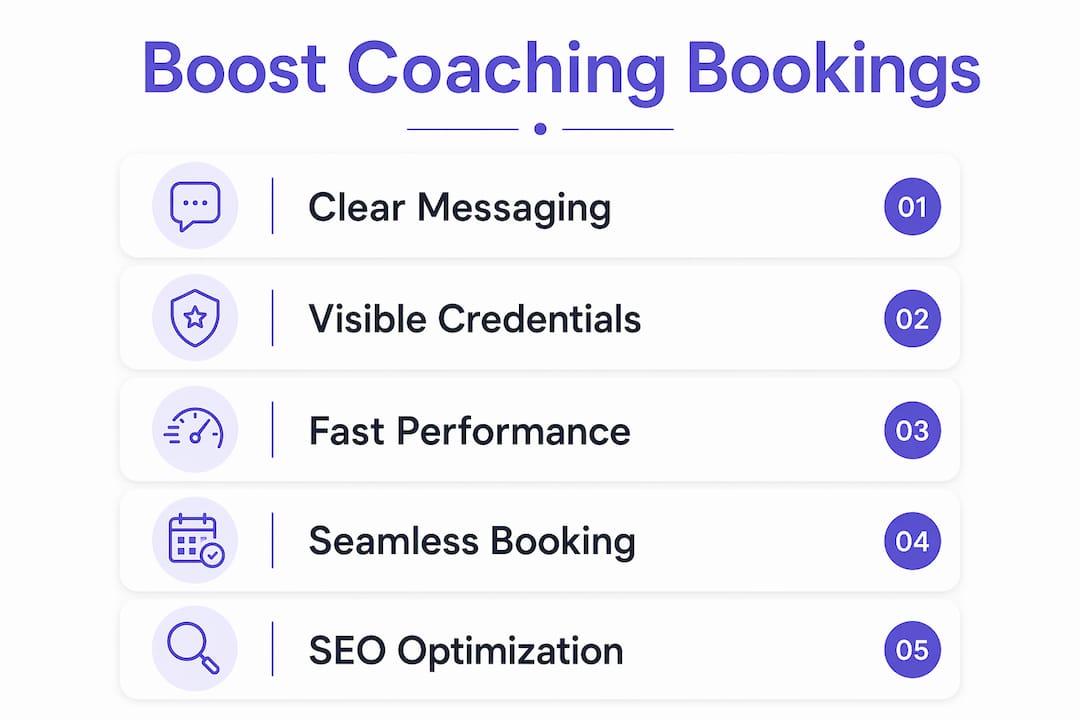
A coaching website converts clients only when it combines clear messaging, visible credentials, fast performance, and a direct booking path.
| Point | Details |
|---|---|
| Clear messaging comes first | Your homepage headline must state who you help and what result they get. |
| Credentials belong above the fold | 73% of clients expect visible certifications before they consider booking. |
| Direct booking tools outperform forms | Calendly or SavvyCal raise conversion rates by approximately 25% over contact forms. |
| Mobile speed is non-negotiable | Over 66% of coaching site traffic is mobile, so slow pages lose the majority of visitors. |
| Six pages are the structural minimum | Home, About, Services, Booking, Blog, and Privacy Policy cover the full client journey. |
What i’ve learned working on coaching websites
Most coaches come to us convinced their website needs a visual overhaul. They want a new color palette, a different font, or a fancier layout. In almost every case, the real problem is structural, not aesthetic.
The sites that consistently fail share three traits: no direct booking option, credentials buried where no one looks, and a homepage that talks about the coach instead of the client. These are not design problems. They are strategy problems. A beautiful site with those three issues will still fail.
The fix that moves the needle fastest is almost always the booking flow. Integrated booking systems that trigger payment processing, onboarding forms, and program access without manual intervention transform the post-click experience. Clients who book and pay in one session show up. Clients who fill out a contact form and wait for a reply often do not.
Mobile performance is the second most overlooked factor. Coaches build their sites on a desktop and never test the mobile version. Over half their visitors are on a phone, and the experience is broken. That is a fixable problem that takes an afternoon, not a full rebuild.
My honest advice: audit your site before you redesign it. Check your booking flow, test your mobile speed, and read your homepage headline out loud to someone who does not know you. Those three steps will tell you more than any analytics report.
— Max
Build a coaching website that actually books clients
If your site is losing clients at any of the stages covered in this article, the fix is not a minor tweak. It is a purposeful rebuild around conversion.
Cosmicdigitalstudios builds fast, modern coaching websites designed to communicate your value clearly and guide visitors straight to a booked call. Every build includes mobile-first design, direct booking integration, and SEO-ready page structure from day one. If you are ready to stop losing clients to a site that does not work, explore what a conversion-focused coaching site looks like. Or visit Cosmicdigitalstudios to see the full range of website and funnel solutions built for coaches and consultants.
FAQ
Why do most coaching websites fail to get bookings?
Most coaching sites fail because they lack a clear call to action and use a contact form instead of a direct booking tool. Coaches using tools like Calendly see approximately 25% higher conversion rates than those relying on generic forms.
How many pages does a coaching website need?
A coaching website needs at least six pages: Home, About, Services, Booking, Blog, and Privacy Policy. Missing any of these creates gaps in the client journey and reduces SEO effectiveness.
Where should i display my coaching certifications?
Display certifications above the fold on your homepage, not buried in your About page. Research shows 73% of coaching clients expect to see credentials prominently before they consider booking.
Does mobile design really affect coaching site conversions?
Yes. Over 66% of traffic to coaching websites comes from mobile devices. A site that loads slowly or displays poorly on a phone loses the majority of its visitors before they engage with any content.
What is the fastest fix for a failing coaching website?
Replace your contact form with a direct booking tool like Calendly or SavvyCal and rewrite your homepage headline to state clearly who you help and what outcome they get. These two changes address the most common conversion failures immediately.