
Your contractor website is your hardest-working salesperson. It’s live 24/7, fielding inquiries from homeowners who are ready to spend money. But common contractor website design mistakes quietly drain that pipeline every single day. Missed mobile visitors, buried phone numbers, no local SEO presence. These aren’t small issues. They’re revenue leaks. This article breaks down the exact website design errors for contractors that cost jobs and explains what to do about each one so your site actually works in 2026.
Table of Contents
- Key takeaways
- 1. Common contractor website design mistakes start with mobile failure
- 2. Outdated design signals that your business isn’t open
- 3. Weak or missing CTAs that confuse ready buyers
- 4. Local SEO neglect that makes you invisible in your own market
- 5. Missing social proof that leaves visitors unconvinced
- 6. Complicated navigation that drives visitors away
- My take: contractors are building websites, not lead machines
- Ready to fix your contractor website?
- FAQ
Key takeaways
| Point | Details |
|---|---|
| Mobile design is non-negotiable | Poor mobile usability drives 60–70% of potential leads away before they ever contact you. |
| Outdated design destroys trust | 67% of prospects assume an outdated site means an unprofessional or inactive business. |
| CTAs must be clear and prominent | Weak or missing calls-to-action cause 40–50% of visitors to leave without reaching out. |
| Local SEO is a separate discipline | Missing Google Business Profile optimization removes you from 76% of high-intent local searches. |
| Social proof converts skeptics | Testimonials, reviews, and project photos can boost contractor conversions by up to 60%. |
1. Common contractor website design mistakes start with mobile failure
Poor mobile usability drives between 60 and 70% of potential leads away from contractor sites. That’s not a rounding error. That’s the majority of people visiting your site on their phone and leaving because it doesn’t work properly.
The most frequent mobile failures include:
- Horizontal scrolling caused by oversized images or fixed-width layouts
- Buttons that are too small to tap accurately on a touchscreen
- Text that requires pinching and zooming to read at all
- Forms that break or overlap on smaller screen sizes
- Phone numbers that aren’t clickable so users can’t tap to call
Every one of these issues has a fix. Most require a responsive design framework and a round of actual mobile testing on real devices, not just a browser simulator.
Pro Tip: Use Google’s free Mobile-Friendly Test tool and also pull up your own site on three different phones. What you find in 60 seconds will likely surprise you.
Beyond layout, speed is just as critical. 53% of mobile visitors abandon a site that takes more than 3 seconds to load. Every extra second after that costs you conversions. Large uncompressed images are the most common culprit. After that, it’s cheap shared hosting and bloated page builders that add unnecessary code.
Compress every image before uploading, use a content delivery network, and choose hosting built for performance. These aren’t advanced moves. They’re contractor site design best practices that any decent developer will implement by default.
2. Outdated design signals that your business isn’t open
First impressions happen in under a second online. When someone lands on a site with an old font stack, a Flash element that won’t load, or a layout that looks like it was built in 2010, they don’t think “this contractor is experienced.” They think “this contractor is out of business.”
67% of prospects assume that outdated website quality equals outdated service quality. That’s a credibility problem, not an aesthetic one. Common signs your site has aged badly include:
- Cluttered layouts with too many columns and competing visual elements
- Stock photos from a decade ago featuring people in outdated clothing
- Old project photos with low resolution or poor lighting
- A blog section with the last post dated two or more years ago
- Colors and typography that no longer match how professional trades businesses present themselves
Improving contractor website usability starts with a visual audit. You don’t need a full rebrand to fix this. A cleaner layout, updated photography, and a refreshed color palette can modernize a site significantly. For deeper context on why stale design erodes trust over time, the guide on outdated websites losing trust covers the mechanics in detail.
The rule going forward: review your site’s design and content at least once a year. Update project photos every season. Publish new content regularly. A site that looks active tells visitors your business is active.

3. Weak or missing CTAs that confuse ready buyers
Missing strong CTAs causes 40 to 50% of visitors to leave without ever reaching out. Think about what that means. Half the people who find your site and are genuinely interested in hiring someone walk away because your site didn’t tell them what to do next.
The most common CTA mistakes on contractor websites:
- Vague button text like “Learn More” or “Click Here” instead of “Get a Free Estimate”
- A single CTA only on the homepage while service pages have none
- Contact forms buried three scrolls down the page with no visual cue
- Phone numbers placed only in the footer where visitors rarely look first
- Forms with too many required fields that feel like a time commitment
Your phone number should be in the header on every page, formatted as a clickable tap-to-call link. Your CTA button should appear above the fold on every service page. Keep contact forms short. Name, phone, project type, and a message field is enough to start a conversation.
Pro Tip: Test two versions of your CTA button text using A/B testing. “Request a Free Quote” consistently outperforms generic alternatives on contractor sites because it names the value the visitor gets for clicking.
Clear CTAs are one of the highest-return fixes available to you. No redesign required. Just honest, direct language that tells the visitor exactly what happens when they take action.
4. Local SEO neglect that makes you invisible in your own market
A contractor in Dallas or Denver with no local SEO presence isn’t competing for online leads. They’re invisible to the majority of people searching for their services. 76% of local high-intent searches convert through Google Map Pack interactions. If you’re not in the Map Pack, you’re losing those leads to competitors who are.
The key local SEO elements most contractor sites are missing:
- An unclaimed or incomplete Google Business Profile
- Inconsistent NAP (name, address, phone number) across directories
- No location-specific landing pages for each city or service area served
- Missing local schema markup in the site’s code
- All services crammed onto one page instead of individual service pages
That last point deserves more attention. Listing all services on a single page limits your SEO potential. Each service you offer should have its own dedicated page, written with local keywords that reflect how people in your market actually search. “Bathroom remodel contractor in Phoenix” performs far better as a standalone page than as one paragraph buried inside a generic “Services” page.
A useful starting resource for covering these fundamentals is the local service website checklist from Cosmicdigitalstudios, which walks through Google Business Profile setup and Map Pack visibility step by step. For a deeper look at the technical side of local search, Big Fin SEO’s resource on local search optimization covers citation building and ranking signals in practical terms.
A contractor website is fundamentally a local search marketing project, not just a digital business card. Build it that way.
5. Missing social proof that leaves visitors unconvinced
You could have a beautiful site, fast load times, and clear CTAs. But if a homeowner lands on your site and sees no reviews, no testimonials, and no project photos, they’re going to hesitate. Hiring a contractor is a high-stakes decision. People want evidence before they commit.
Lack of social proof reduces contractor conversions by 45 to 60%. That’s a significant swing you can fix with content you likely already have.
Here’s a quick comparison of social proof types and their impact:
| Social proof type | Trust impact | Difficulty to add |
|---|---|---|
| Google review widget | High | Low |
| Named testimonials with photos | Very high | Low |
| Project before/after gallery | Very high | Medium |
| Video testimonials | Highest | Medium |
| Third-party badges (BBB, licensed) | Moderate | Low |
Place testimonials on your homepage, your service pages, and your contact page. A project gallery should be easy to find from the main navigation. Don’t hide this content in a separate “Reviews” tab that visitors rarely click into.
6. Complicated navigation that drives visitors away
Complex menus are one of the frequent mistakes in contractor web design that designers and business owners overlook because they’re the ones who built the site and already know where everything is. Visitors don’t have that context. They need to find what they need in two or three clicks, or they leave.
Complicated navigation frustrates 55 to 65% of contractor website visitors. The fix is simpler than most people expect. Limit your top-level navigation to five or six items maximum. Use plain language: Services, Projects, About, Contact. Avoid dropdown menus with more than five options per column. And make sure the mobile menu works with a single tap and doesn’t require pinching or scrolling to find the right link.
Every page on your site should have a clear path back to your main service offerings and to your contact page. Visitors should never feel stuck or unsure where to go next. Think of your navigation as a system that guides people toward making contact, because that’s exactly what it is.
Understanding which pages your visitors actually need can help you build a better structure. The guide on essential pages for local service businesses is worth reading before you touch your navigation menu.
My take: contractors are building websites, not lead machines
I’ve worked with a lot of contractors who invested real money into a professional-looking site and then wondered why the phone wasn’t ringing. The design was clean, the photos were good, and the layout looked sharp. But the SEO data before redesign was never audited, the service pages had no local keywords, and the CTAs were vague. The site looked like a brochure because it was built like one.
The biggest contractor website design pitfall I see isn’t any single technical error. It’s hiring someone who knows design but doesn’t understand local search or the contractor buyer journey. A web designer who doesn’t do keyword research before architecture is building you a site that looks good in a portfolio but doesn’t rank for anything. You need someone who treats your website as a lead generation system first and a visual presentation second.
My honest advice: before you redesign anything, pull your analytics. Know which pages are already ranking. Know where your current traffic comes from. Then build around what works, fix what doesn’t, and make sure every page has a job to do. Beauty without function isn’t a contractor website. It’s a digital brochure nobody finds.
— Max
Ready to fix your contractor website?
If you recognized more than a couple of these mistakes in your own site, you’re not alone. Most contractor websites were built to exist, not to convert. Cosmicdigitalstudios builds fast, mobile-first websites specifically designed to bring in leads for trade and construction businesses.
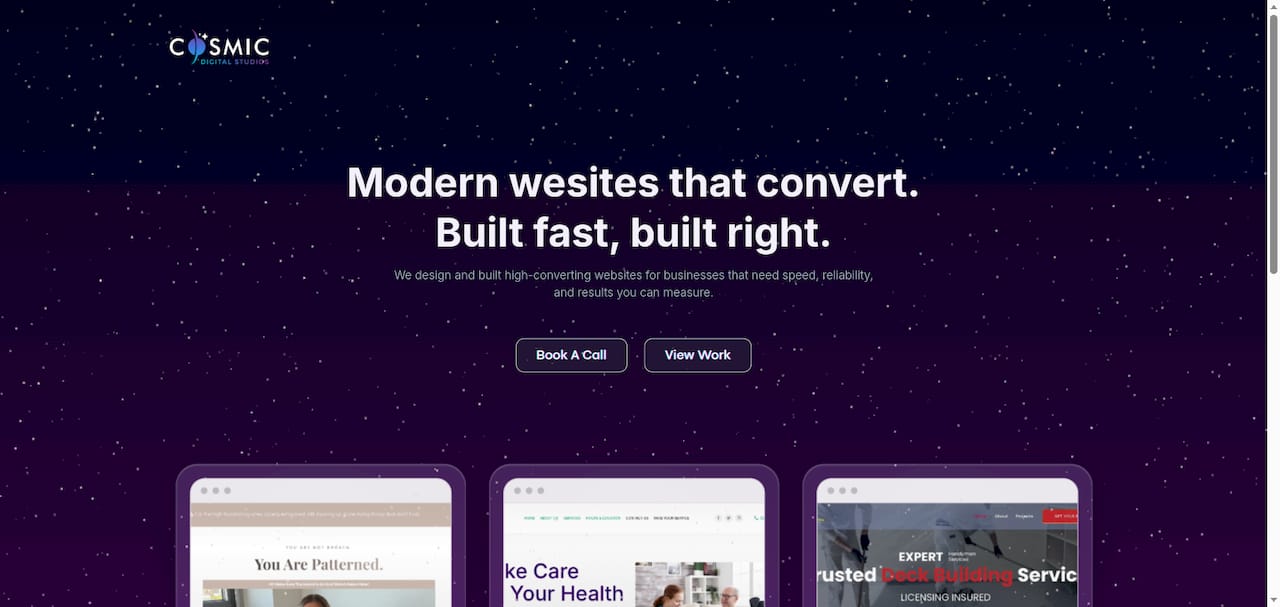
Every site built by Cosmicdigitalstudios includes local SEO integration, clear CTAs built into every page, modern UI/UX designed around the contractor buyer journey, and social proof placement that builds trust from the first scroll. If you’re ready to turn your site into a real lead generation tool, start at cosmicdigitalstudios.com. Or if you’re still deciding whether a redesign makes sense, the small business redesign guide is a good place to get clarity before committing.
FAQ
What are the most common contractor website design mistakes?
The most common mistakes include poor mobile responsiveness, slow load times, weak CTAs, missing local SEO, and no social proof. Each one directly reduces the number of leads your site generates.
How does mobile design affect contractor lead generation?
Poor mobile usability drives 60 to 70% of leads away. Most people searching for contractors do so on their phones, so a site that doesn’t work well on mobile loses the majority of its potential customers before they ever reach out.
Why is local SEO so important for contractor websites?
76% of high-intent local searches convert through the Google Map Pack. Without proper local SEO, including an optimized Google Business Profile and location-specific service pages, your site won’t appear where buyers are looking.
How often should a contractor update their website?
Review your design and core content at least once a year. Update project photos each season and publish new content regularly. Stale content signals inactivity and reduces visitor trust significantly.
What should a contractor CTA actually say?
Use specific, benefit-driven language like “Get a Free Estimate” or “Request Your Free Quote” rather than vague phrases like “Learn More.” Specific CTAs tell the visitor exactly what they get for clicking and consistently outperform generic alternatives.