
Pricing consulting services on a website is defined as the practice of selecting a fee structure, calculating competitive rates, and presenting those rates online so prospective clients can evaluate cost and value before reaching out. Business owners who research online consulting pricing before hiring make faster, more confident decisions. The right approach combines three elements: a pricing model that fits your engagement type, a rate that covers all costs including non-billable time, and a website presentation that builds trust without creating friction. This article walks through each element with 2026 benchmarks and practical frameworks you can apply today.
What are the main consulting pricing models and how do they work?
Consulting fees fall into four primary models: hourly, project-based, retainer, and value-based. Each model suits a different type of engagement, and using a single model for all clients is one of the most common pricing mistakes consultants make. Matching the model to the engagement type protects both your margins and your client’s expectations.
Hourly pricing charges a set rate for each hour worked. It works best when the project scope is unclear at the start, because it limits financial risk for both sides. The downside is that it caps your earning potential and rewards slow work over expert efficiency.

Project-based pricing sets a fixed fee for a defined deliverable. A brand audit, a go-to-market plan, or a website copy overhaul all fit this model well. Clients prefer it because the total cost is known upfront, and you benefit because working faster increases your effective hourly rate.
Retainer pricing charges a recurring monthly fee for ongoing access or advisory support. Retainer fees typically range from $2,000 to $10,000+ per month for experienced consultants. That predictability makes retainers attractive for both fractional leadership roles and long-term strategy work.
Value-based pricing ties your fee directly to the outcome you deliver for the client. Consulting Success research shows that value-based pricing prevents the income ceiling that hourly billing creates. It is the most effective model for experienced consultants who can quantify the business impact of their work.
| Model | Best for | Key advantage | Main risk |
|---|---|---|---|
| Hourly | Undefined scope | Low commitment barrier | Caps earning potential |
| Project-based | Clear deliverables | Predictable cost for client | Scope creep eats margin |
| Retainer | Ongoing support | Recurring, stable revenue | Requires clear scope boundaries |
| Value-based | High-impact engagements | Fees scale with client results | Harder to justify without track record |
Pro Tip: Start with project-based pricing for new client relationships. It gives both sides a defined outcome to evaluate, which makes the transition to a retainer or value-based arrangement much easier to negotiate.
How to calculate competitive consulting rates
Consulting rates are not arbitrary. They reflect experience, market demand, and the full cost of running a consulting practice, including time that never appears on a client invoice.
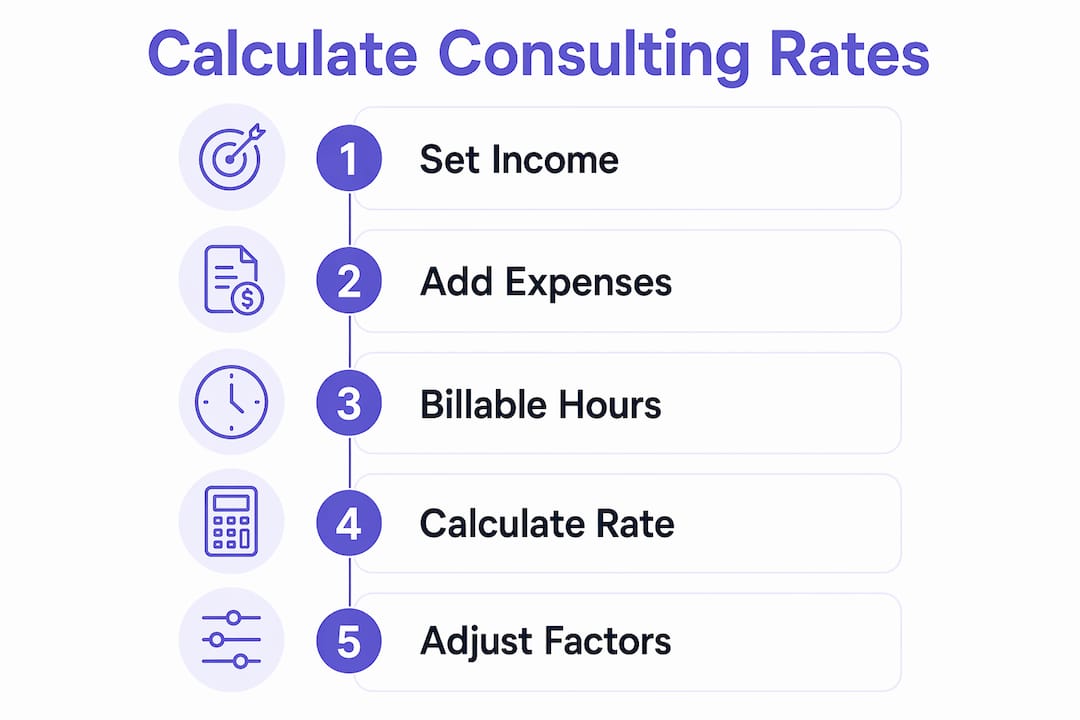
Consultants spend 40%–50% of their time on non-billable activities such as business development, administration, and client management. That means a consultant targeting $150,000 in annual income cannot simply divide that number by 2,080 working hours. The actual billable hours are far fewer, and the rate must compensate for the gap.
A straightforward formula works like this: add your target annual income to your annual business expenses, then divide by your realistic billable hours per year. If you bill 1,000 hours annually and need $120,000 in income plus $20,000 in expenses, your minimum viable rate is $140 per hour. That floor tells you where to start, not where to stop.
Independent consultant hourly rates vary by experience from $50 to over $1,000 per hour in 2026. The table below shows typical ranges by experience level.
| Experience level | Typical hourly rate |
|---|---|
| New consultant (0–2 years) | $50–$100 |
| Established consultant (3–7 years) | $100–$250 |
| Senior consultant (8–15 years) | $200–$450 |
| Expert or specialist (15+ years) | $400–$1,000+ |
Rates also vary by industry. Business strategy consultants, IT specialists, and financial advisors consistently command the upper end of these ranges. Marketing and operations consultants typically fall in the mid-range, though niche expertise pushes rates higher regardless of industry category.
- Calculate your minimum viable rate before quoting any client.
- Add a 20%–30% overhead factor to cover non-billable time.
- Research market rates in your specific niche, not just general consulting averages.
- Revisit your rates at least once per year as your experience and client outcomes grow.
Pro Tip: Hourly rates often serve as internal benchmarks rather than final client prices. Use your hourly floor to sanity-check project and retainer quotes, but present clients with packaged fees whenever possible.
How to present consulting pricing on your website
Publishing your fees online is a deliberate choice, and pricing transparency reduces buyer friction and builds client confidence. Visitors who find clear pricing information spend less time in indecision and more time deciding whether you are the right fit.
The most effective website pricing strategy avoids raw hourly rates. Presenting fees as packaged services or project prices shifts the client’s focus from “how much per hour?” to “what do I get and what is it worth?” That shift prevents commoditization and positions your expertise as the product, not your time.
Structuring your pricing page well matters as much as the numbers themselves. A well-organized consulting website navigation guides visitors from your services overview directly to pricing without confusion. Clarity at every step reduces drop-off and increases the rate at which visitors book a call.
A strong consulting pricing page includes:
- Package names that describe the outcome, not the process (e.g., “90-Day Growth Plan” rather than “Strategy Consulting Hours”).
- What’s included for each package, written in plain language with specific deliverables listed.
- A starting price or range so visitors can self-qualify before contacting you.
- A FAQ section addressing common objections like payment terms, revision policies, and what happens if scope changes.
- A single, clear call to action on each pricing tier, such as “Book a discovery call.”
Avoid listing every edge case or exception on the pricing page itself. Those details belong in your proposal or contract. The goal of the page is to create enough clarity and confidence that the right client takes the next step.
Pro Tip: If you are not ready to publish fixed prices, publish a “starting from” figure. Even a floor price filters out poor-fit inquiries and signals that your work has real market value.
How to evaluate a consulting pricing proposal
Evaluating a consulting proposal requires more than comparing the total fee to your budget. The right question is not “Is this cheap?” but “Does the expected return justify the cost?”
Start with scope clarity. A well-priced proposal defines exactly what is delivered, by when, and what falls outside the agreement. Vague scope language is a red flag regardless of the price. If the deliverables are not specific, the final cost will almost certainly exceed the quoted figure.
- Confirm the pricing model matches the engagement. A fixed fee makes sense for a defined project. An hourly rate for an open-ended advisory role is reasonable. A retainer for a one-time deliverable is not.
- Calculate the cost per outcome, not just the total fee. If a consultant charges $15,000 to build a sales funnel that generates $80,000 in new revenue, the ROI is clear. If the deliverable is a report with no defined business impact, the value is harder to defend.
- Ask about revision and change-order policies. These terms reveal how the consultant handles scope creep and whether the quoted price is the real price.
- Check the timeline against your business needs. A lower fee with a six-month delivery window may cost more in lost opportunity than a higher fee with a four-week turnaround.
- Compare the proposal against market benchmarks. Use the rate table above as a reference. A senior consultant quoting $75 per hour is either underpriced or has undisclosed limitations.
When clients accept proposals immediately without negotiating, that is a signal the fee is too low, not a sign of a good deal. Strong consultants price to their value, and a quick acceptance often means you left money on the table or selected a consultant who undervalues their own work.
Pro Tip: Negotiate scope before negotiating price. Asking a consultant to reduce their fee without reducing deliverables damages the relationship and signals that you do not respect the value of their work. Instead, ask what can be removed or phased to fit your budget.
| Evaluation criterion | What to look for |
|---|---|
| Scope definition | Specific deliverables with clear boundaries |
| Pricing model fit | Model matches engagement type and duration |
| ROI potential | Measurable business outcome tied to the fee |
| Change-order terms | Clear policy for scope additions and cost adjustments |
| Market rate alignment | Fee consistent with experience level benchmarks |
Key Takeaways
Pricing consulting services effectively requires matching your fee model to the engagement type, calculating rates that cover all costs including non-billable time, and presenting fees on your website in a way that builds trust and drives conversions.
| Point | Details |
|---|---|
| Match model to engagement | Use hourly for undefined scope, fixed fees for deliverables, retainers for ongoing work. |
| Cover non-billable overhead | Consultants spend 40%–50% of their time on non-billable work; rates must account for this. |
| Use market benchmarks | Rates range from $50 to $1,000+ per hour depending on experience level and specialty. |
| Publish packaged pricing | Present fees as outcomes, not hours, to shift client focus to value rather than cost. |
| Evaluate proposals on ROI | Compare the total fee against the measurable business outcome, not just the budget ceiling. |
Why pricing clarity is the most underrated business decision
Most business owners treat consulting fees as a negotiation problem. They focus on getting the number down. What I have found, after working with dozens of service businesses, is that the real problem is almost never the price. It is the absence of a clear value story around that price.
When a consultant publishes a $5,000 project fee with no context, the number feels arbitrary. When that same fee is presented as “a 30-day brand positioning sprint that gives you a clear message, a defined audience, and a homepage that converts,” the number feels like a decision, not a gamble. The fee did not change. The framing did.
The same principle applies when you are the buyer. If you are evaluating a consulting proposal and the pricing feels high, ask yourself whether the deliverables are clearly defined and whether the expected outcome is measurable. If both answers are yes, the price is probably fair. If the deliverables are vague, no fee is low enough to make the engagement safe.
One more thing worth saying directly: quick proposal acceptance signals underpricing, not a bargain. If a consultant accepts your first counteroffer without hesitation, that tells you something about how they value their own work. The best consultants hold their fees because they know what their outcomes are worth. That confidence is part of what you are paying for.
— Max
How Cosmicdigitalstudios helps you present pricing that converts
Your consulting fees only work as hard as the website presenting them. A confusing pricing page loses clients before they ever contact you, no matter how competitive your rates are.
Cosmicdigitalstudios builds custom websites and conversion-focused funnels designed to present your services clearly and guide visitors toward booking a call. From packaging your offers to structuring your pricing page for maximum trust, every build is tailored to your business goals. If your current site is not turning visitors into clients, that is a fixable problem. Visit Cosmicdigitalstudios to see how a purpose-built consulting website can make your pricing work for you.
FAQ
What is the best pricing model for consulting services?
Value-based pricing is the most effective model for experienced consultants because it ties fees to client outcomes rather than hours worked. For new consultants or undefined-scope projects, project-based or hourly pricing is more practical.
How much do consulting services typically cost in 2026?
Consulting rates range from $50 to over $1,000 per hour depending on experience level and specialty. Retainer arrangements typically run $2,000 to $10,000+ per month for established consultants.
Should I publish my consulting prices on my website?
Yes. Publishing pricing online reduces buyer friction and builds trust with prospective clients. Even a starting price or price range helps visitors self-qualify and reduces time spent on poor-fit inquiries.
How do I know if a consulting proposal is fairly priced?
Compare the quoted fee against market benchmarks for the consultant’s experience level, then assess whether the deliverables are specific and the expected business outcome is measurable. A fair price is one where the ROI is clear, not simply one that fits your budget.
Why do consultants charge so differently for similar services?
Rate differences reflect experience, niche specialization, non-billable overhead costs, and the value of outcomes delivered. A consultant who spends 40%–50% of their time on non-billable work must price billable hours higher to meet the same income target as a salaried employee.