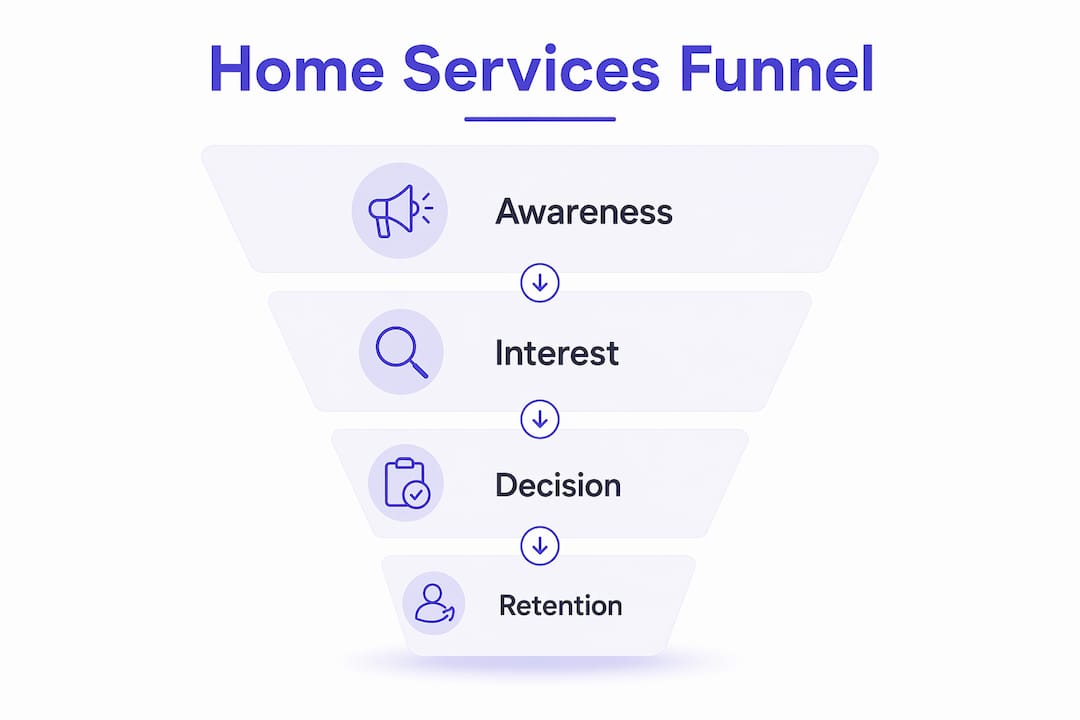
A home services funnel is a structured customer journey that moves a local homeowner from first discovering your business to booking a job, then returning for more. The goal is simple: reduce friction at every step so qualified leads become paying customers, and paying customers become repeat clients. Without a funnel, most of your marketing spend generates awareness that never converts. With one, every touchpoint has a job to do.
Pro Tip: Replace vague CTAs like “Contact Us” with specific ones like “Schedule a free 30-minute estimate, available Monday–Friday 9–5.” Specific CTAs reduce hiring anxiety and consistently produce more qualified bookings.
Table of Contents
- What are the stages of a home services funnel?
- How to build a home services funnel step by step
- How do you measure funnel performance and fix leaks?
- What does it cost and how long does it take to build a funnel?
- CTA templates and conversion copy that actually work
- Key Takeaways
- What most home services businesses get wrong about funnels
- Cosmicdigitalstudios builds funnels that turn local traffic into booked jobs
- Useful sources and tools to explore next
What are the stages of a home services funnel?
A service business funnel typically runs through four stages: Awareness, Interest, Decision, and Retention. Each one demands different tactics, and home services businesses often skip the last two entirely.
Awareness: getting found locally
This is where homeowners discover you exist. The primary channels are Google Business Profile (GBP), local organic search, and paid local search ads. A plumber targeting emergency callouts needs a GBP listing with accurate hours, photos, and a click-to-call button. An HVAC company selling annual tuneup plans needs optimized service pages that rank for “AC maintenance city].” [Local SEO for trades means owning those high-intent searches before a competitor does.
Interest: building credibility and capturing leads
Once someone lands on your site or profile, they need a reason to stay. Reviews, before-and-after photos, and clear service descriptions do the heavy lifting here. A roofing company might display a high star rating and numerous reviews as a trust signal above the fold. A landscaping business could offer a free lawn assessment form to capture contact details before the homeowner calls three competitors. This stage is where lead generation website design pays off directly.

Decision: estimates, booking flows, and conversion
The homeowner is ready to hire. Your job now is to make booking frictionless. That means a focused landing page with one clear CTA, a calendar booking tool or click-to-call button, and a short estimate request form. For HVAC and plumbing, phone is still the dominant conversion channel. For landscaping and cleaning services, online booking forms often outperform phone. Tailor the booking flow to how your trade’s customers actually prefer to hire.

Retention: maintenance agreements and referrals
Most home services businesses stop at the first job. That’s a costly mistake. A post-service SMS sequence asking for a Google review, followed by a 90-day email offering a discounted seasonal tuneup, turns a one-time job into recurring revenue. HVAC companies selling annual maintenance agreements, lawncare businesses offering monthly subscriptions, and cleaning companies running loyalty discounts all use this stage to build predictable income.
How to build a home services funnel step by step
Scoping your funnel narrowly to one service type and one conversion path is the fastest way to launch and validate. Here’s the build sequence:
-
Define your ideal job type. Pick one service (e.g., HVAC tune-ups, gutter cleaning, kitchen plumbing) and one target zip code. Trying to funnel every service at once dilutes everything.
-
Claim and optimize your Google Business Profile. Add accurate hours, service categories, photos, and a booking link. This is your highest-ROI top-of-funnel asset, and it costs nothing but time. Organic lead generation tactics like GBP optimization and review generation consistently outperform paid ads on cost-per-lead for local trades.
-
Build a focused service landing page. One service, one CTA, one conversion goal. Include your service area, a short list of what’s included, pricing transparency (even a range), and trust signals like reviews and license numbers. See home service website layouts for proven page structures.
-
Add a booking flow with micro-conversions. Options include:
- Click-to-call button (above the fold, mobile-first)
- “Request a free estimate” form (3 fields max: name, phone, service needed)
- Calendar booking widget for free consults
- Price-range selector to qualify leads before they call
-
Set up post-lead automation. A basic 3-touch sequence works well:
- Text 1 (within 5 minutes of form submit): “Hi [Name], this is [Company]. We got your request and will call you within the hour. Questions? Reply here.”
- Email 1 (same day): Confirmation with what to expect, your license number, and a link to your reviews.
- Email 2 (3 days later, if no booking): A follow-up with a specific offer: “Still need [service]? Book this week and get a free.”
-
Launch paid local search (after organic is live). Google Local Services Ads (LSAs) and Google Search Ads targeting “[service] near me” are the most direct paid channels for home services. Don’t run ads to your homepage. Run them to your focused landing page.
-
Activate your retention sequence. After every completed job, trigger a review request SMS within 24 hours, then a seasonal follow-up email at 60–90 days. For trades with recurring needs (HVAC, pest control, lawncare), pitch a maintenance plan in that second email.
Implementation timeline:
- Week 1: GBP optimization, click-to-call live, basic landing page published
- Month 1: Booking form active, post-lead SMS sequence running, review request automated
- Month 2: Paid ads live, retention email sequence active, first metrics review
How do you measure funnel performance and fix leaks?
Tracking the right numbers tells you exactly where leads are dropping off. The table below maps each funnel stage to its core KPI, recommended tracking method, and primary data source.
| Funnel Stage | KPI | Tracking Method | Data Source |
|---|---|---|---|
| Awareness | Organic visits by channel | UTM parameters, GBP Insights | GA4, Google Search Console |
| Interest | Click-to-call rate, form view-to-submit | Call tracking number, GA4 events | CallRail, GA4 |
| Decision | Estimate-to-book rate | CRM pipeline stage tracking | HouseCall Pro, Jobber, or similar CRM |
| Retention | Repeat job rate, review count | CRM tags, GBP review count | CRM, GBP dashboard |
| Overall | Cost-per-booked-job | Ad spend ÷ booked jobs | Google Ads + CRM |
CRM and appointment automation closes the gap between a submitted lead and a confirmed booking by reducing the manual follow-up window. The faster you respond, the higher your conversion rate.
Troubleshooting common funnel leaks
- High traffic, low form submissions: Your CTA is too vague or your form has too many fields. Test a shorter form (name + phone only) and a more specific CTA headline.
- High form submissions, low bookings: Your follow-up is too slow or too generic. Automate the first response to go out within 5 minutes.
- Low repeat rate: You have no retention sequence. Add a 60-day follow-up email for every closed job.
- Low estimate-to-book rate: Pricing transparency is missing. Add a “starting from $X” range to your landing page.
- Poor mobile performance: Run Google’s PageSpeed Insights on your landing page. A slow mobile load kills conversions before the visitor even reads your CTA.
What to A/B test first: CTA specificity (“Get a Free Estimate” vs. “Schedule a 30-Minute Estimate, Mon–Fri”), form field count (3 fields vs. 5), and headline framing (benefit-led vs. urgency-led). Run one test at a time for at least two weeks before drawing conclusions.
What does it cost and how long does it take to build a funnel?
Timeline and budget depend heavily on how much you build yourself versus how much you delegate.
- MVP funnel (1–4 weeks): GBP optimization, one landing page, click-to-call, and a basic form. DIY cost is mostly time; using a freelancer or studio typically runs a few hundred to a few thousand dollars for setup.
- Full funnel with automation (1–3 months): Adds paid ads, CRM integration, booking software, and email/SMS sequences. Monthly tool costs for software like Jobber, CallRail, and an email platform can range from $100–$400/month depending on your plan tier.
- Ongoing optimization (continuous): Ad management, A/B testing, and content updates. Agency retainers for home services digital marketing vary widely; clarify scope, deliverables, and reporting cadence before committing to any ongoing agreement.
Budgeting priority order:
- First: booking flow and landing page (highest direct impact on conversions)
- Second: GBP optimization and review generation (free, high ROI)
- Third: post-job automation (low cost, high lifetime value impact)
- Fourth: paid ads (only after the above are converting)
Spending on ads before your landing page and booking flow are solid is one of the most common and expensive mistakes in home services marketing.
CTA templates and conversion copy that actually work
The single highest-leverage change most home services pages can make is replacing a generic CTA with a specific one. Effective CTAs state what happens next, who the offer is for, and how long it takes.
The CTA formula that works: “[Action verb] + [what they get] + [time or availability].” Example: “Schedule a free 30-minute estimate, available Monday–Friday, 9 AM–5 PM.” That one line answers the three questions every hesitant homeowner is asking: What happens? Is it free? When can I do it?
Ready-to-use CTA templates:
- Booking page headline: “Get a Free [Service] Estimate with quick turnaround, No Obligation”
- Click-to-call label: “Call Now, We Answer Daily”
- Form submit button: “Request My Free Estimate” (not generic wording)
- Confirmation page: *“You’re all set. [Name] from our team will contact you promptly to confirm your appointment.”
Microcopy for reducing hiring anxiety:
- Below the phone number: “Licensed, insured, and background-checked technicians”
- Near the form: “We respond within 60 minutes during business hours”
- On the estimate page: “No surprise fees. We walk you through pricing before any work begins.”
A/B test ideas for your booking page:
- Headline: benefit-led (“Save $200 on Your HVAC Tune-Up This Month”) vs. specificity-led (“Schedule Your HVAC Tune-Up in 2 Minutes”)
- CTA button color and placement (above the fold vs. sticky footer on mobile)
- Social proof placement: reviews above the CTA vs. below it
For urgency messaging on service pages, specificity beats pressure every time. “3 slots left this week in [City]” outperforms “Act fast!” because it’s verifiable and relevant.
Pro Tip: Add a “What to expect” section directly below your booking form. Three bullet points covering what happens after submission, when you’ll hear back, and what the estimate process looks like will reduce no-shows and increase form completions.
Key Takeaways
A home services funnel works when every stage, from local visibility to post-job follow-up, has a clear owner, a specific CTA, and a metric attached to it.
| Point | Details |
|---|---|
| Start narrow | Scope your first funnel to one service and one conversion path to launch fast and validate quickly. |
| Prioritize booking flow first | Build your landing page and click-to-call before spending on paid ads. |
| Automate follow-up within 5 minutes | A fast first response to form submissions is the single biggest driver of estimate-to-book rate. |
| Track estimate-to-book rate | This metric tells you more about funnel health than traffic or lead volume alone. |
| Cosmicdigitalstudios builds these funnels | The studio designs conversion-focused landing pages, booking flows, and post-lead sequences built specifically for home services businesses. |
What most home services businesses get wrong about funnels
The conventional wisdom says you need a complex, multi-channel funnel before you can compete. That’s backwards. The businesses I see convert best start with the simplest possible path: one service page, one CTA, one phone number that’s answered. They fix the leak before they turn up the tap.
What gets overlooked is the middle of the funnel. Most home services owners obsess over getting more traffic (top of funnel) or closing more estimates (bottom of funnel). The real money is in the consideration stage: the 48 hours after a lead submits a form or calls but hasn’t booked yet. That window is where most jobs are lost, and it’s almost entirely fixable with a fast automated response and a clear “here’s what happens next” message.
The other thing worth saying plainly: a funnel isn’t a website. A website is a brochure. A funnel is a process. You can have a beautiful site and a broken funnel. The difference is whether every page has a single, specific next step and whether your follow-up system actually fires. Most don’t.
Cosmicdigitalstudios builds funnels that turn local traffic into booked jobs
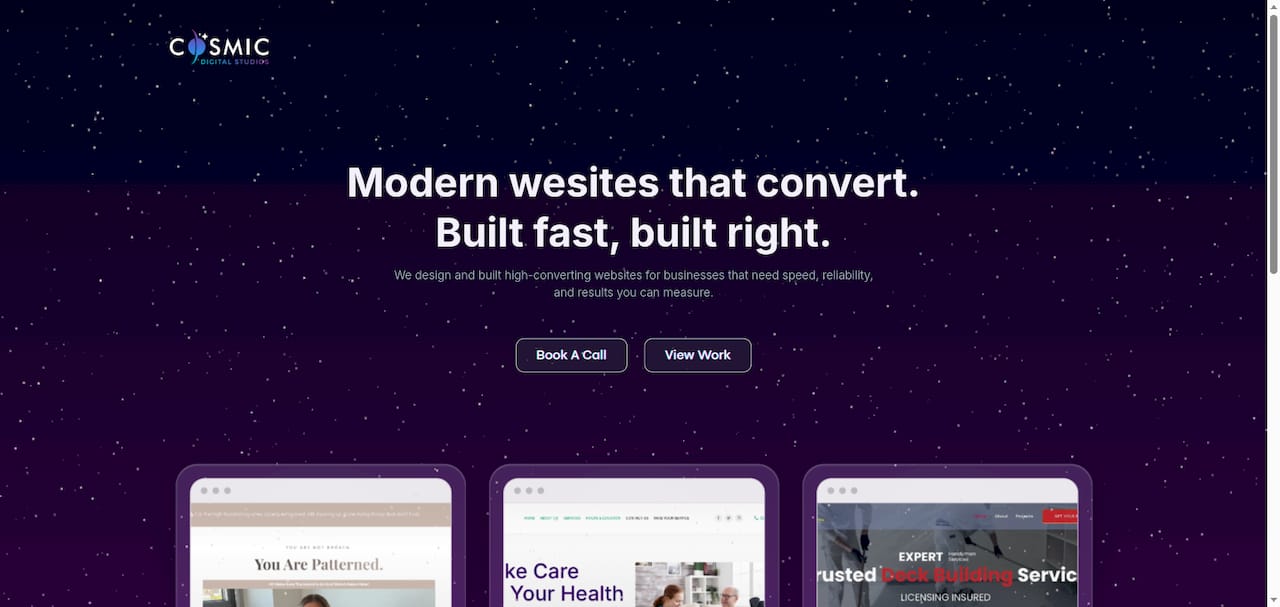
If you’ve read this far and realized your current setup is closer to a brochure than a funnel, that’s exactly the problem Cosmicdigitalstudios solves. The studio builds custom landing pages, booking flows, and post-lead automation sequences designed specifically for home services businesses. No generic templates, no duct-taped tools. Every build is scoped to your service type, your market, and the conversion path your customers actually use.
The difference between a site that gets traffic and one that books jobs comes down to three things: a focused landing page, a frictionless booking flow, and a follow-up sequence that fires automatically.
Cosmicdigitalstudios handles all three. Whether you need a full funnel build or just want to turn your existing visitors into clients, the studio can scope a project that fits your budget and timeline. Get your free funnel audit and find out exactly where your current setup is losing jobs.
Useful sources and tools to explore next
Further reading:
- Home Services Marketing Funnel Stages — a practical breakdown of funnel stages for local service businesses
- How to Build a Sales Funnel for Home Services — tactical guide from a home services marketing publisher
- Marketing for Plumbers: Strategies That Work — trade-specific funnel and lead generation tactics
- Scaling with Data-Driven Marketing — how to use metrics to grow a home services business
Tool categories to evaluate:
- CRM and job management: HouseCall Pro, Jobber (field service CRMs with built-in booking and follow-up)
- Call tracking: CallRail (tracks which campaigns and pages drive phone calls)
- Calendar booking: Calendly, Acuity Scheduling (for free estimate booking flows)
- Email and SMS automation: Mailchimp, ActiveCampaign, or your CRM’s built-in sequences
- Local SEO and GBP: Google Business Profile Manager, Google Search Console, GA4
Studio resources:
- Home service website layouts that drive leads — page structure templates from Cosmicdigitalstudios
- Local business homepage checklist — conversion-focused homepage components for service businesses