
A thank you page is the webpage a visitor sees immediately after completing a purchase, form submission, or sign-up. It confirms the action succeeded and serves as one of the highest-leverage moments in your entire marketing funnel. Most marketers treat it as a formality. The ones who treat it as a marketing asset see measurably better results. Post-conversion engagement rates can run 5–10 times higher than on cold traffic pages. That single fact should change how you think about this page.
What is a thank you page and why does it matter?
A thank you page, also called a post-conversion confirmation page, is the dedicated webpage displayed after a visitor takes a specific action on your site. That action could be buying a product, downloading a lead magnet, booking a call, or filling out a contact form. The page does two things at once: it confirms the action was successful, and it gives you a direct line to a visitor who is already engaged.
The confirmation function matters more than most marketers realize. A visitor who just submitted a form has a brief window of peak trust and attention. Without a clear confirmation message, that visitor may refresh the page, resubmit the form, or simply leave confused. A well-designed confirmation page closes that loop immediately and keeps the experience clean.

The marketing function is where the real opportunity lives. Many businesses fail to use thank you pages to maintain momentum after conversion. That is a missed opportunity, because the visitor’s intent and attention are at their highest point right now. A focused next step placed on this page costs nothing extra in ad spend and can generate real incremental revenue.
What are the essential elements of an effective thank you page?
An effective thank you page must contain three core elements: a clear confirmation message, specific instructions on what happens next, and a single well-defined call-to-action. Each element serves a distinct purpose, and removing any one of them weakens the page.
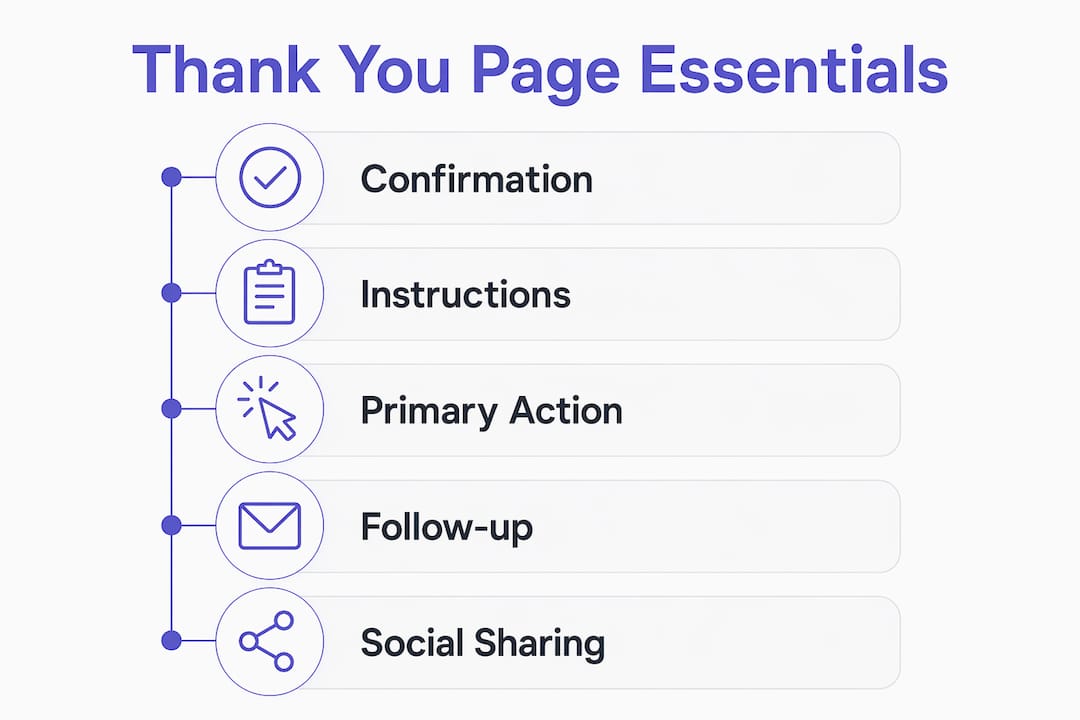
The confirmation message should be direct and specific. “Your order is confirmed” or “You’re on the list” works far better than a vague “Thank you for your submission.” Specificity reduces anxiety and builds trust.
The “what happens next” section sets expectations. Tell the visitor when they will receive their download, when their order ships, or when they can expect a follow-up call. This one addition dramatically reduces support inquiries and builds goodwill before the relationship even begins.
The call-to-action should be singular and focused. Here is what to include on a strong thank you page:
- Confirmation headline: Clear, specific, and reassuring
- Next steps: A brief explanation of what the visitor should expect
- One primary CTA: Aligned with the next logical step in your funnel
- Optional social proof: A short testimonial or benefit statement to reinforce the decision
- Brand-consistent design: Colors, fonts, and tone that match the rest of your site
Pro Tip: Keep the page to one primary action. A visitor who just converted is primed to act again, but only if you give them one clear direction. Two competing CTAs split attention and reduce the chance either gets clicked.
How does a thank you page fit into the marketing funnel?
A thank you page sits at the handoff point between acquisition and retention. Your funnel brought the visitor in, the landing page converted them, and now the confirmation page determines what happens next. Thank you pages serve as this handoff between acquisition and retention phases, offering logical next steps such as upsells or resource downloads.
The psychology behind this is straightforward. When someone completes an action, they experience a brief state of commitment. They have already said yes once. Asking them to take a related, low-friction next step at this moment is far more effective than asking a cold visitor to do the same thing. This principle, known as commitment and consistency, is one of the most reliable drivers of follow-on behavior in marketing.
“The moment after conversion is the single most underused marketing opportunity in most funnels. The visitor is warm, they trust you, and they are paying attention. A well-placed next step here can outperform an entire retargeting campaign.”
Effective strategies that work well at this stage include:
- Upsell or cross-sell offers: A related product or service at a discounted rate
- Social sharing prompts: Invite the visitor to share the resource or offer with their network
- Referral invitations: Offer an incentive for bringing in a friend or colleague
- Content upgrades: A bonus resource that deepens the value of what they just received
- Community invitations: A link to a private group, forum, or membership area
Each of these options extends the relationship without requiring additional ad spend. The key is choosing one that aligns with where the visitor is in their journey. Trying to do all five at once defeats the purpose.
What are best practices for designing and writing thank you pages?
Design and messaging on a confirmation page follow the same rules as any high-converting page, with one added constraint: the visitor already converted, so the job is to maintain trust, not rebuild it.
-
Keep brand consistency. Brand consistency on thank you pages increases trust and reduces user friction. A jarring design shift between your landing page and your confirmation page signals a disconnect. Use the same color palette, typography, and tone throughout.
-
Limit your CTAs. Multiple competing CTAs confuse visitors and reduce the effectiveness of the page. One primary action, and at most one secondary option, is the right structure.
-
Write benefit-oriented copy. Instead of “Download your guide,” write “Get the exact framework we use to double lead quality.” The second version tells the visitor what they gain, not just what they do.
-
Set up social sharing correctly. Social sharing buttons on thank you pages should link back to the original landing page, not the confirmation page itself. Linking to the thank you page bypasses your lead capture form and reduces lead quality from referral traffic.
-
Use clear, plain language. Avoid filler phrases. “We’ll be in touch within 24 hours” is better than “Our team will reach out to you at the earliest opportunity.”
Pro Tip: If your CTA links to a piece of content, set it to open in a new tab. This keeps the visitor on your confirmation page while they consume the content, which preserves the session and reduces drop-off.
How can businesses use thank you pages to drive real results?
The business case for a well-built confirmation page is concrete. A B2B SaaS company generated approximately $804 in monthly recurring revenue through an upsell offer placed directly on their thank you page. That revenue required no additional ad spend. It came entirely from visitors who had already converted.
The table below shows the most common thank you page applications and their primary business impact:
| Application | Primary Business Impact |
|---|---|
| Upsell or order bump | Increases average order value immediately |
| Email sequence trigger | Starts lead nurturing without manual follow-up |
| Referral offer | Reduces cost per acquisition on new leads |
| Content download | Increases time on site and brand authority |
| Booking CTA | Converts leads directly into scheduled calls |
Integrating thank you pages with email autoresponder sequences enhances lead nurturing and increases reconversion rates. The confirmation page and the follow-up email work together to maintain momentum. The page captures the immediate action; the email sequence sustains the relationship over time.
Practical steps to implement this well include:
- Connect your form to an email platform so the confirmation triggers an automated welcome sequence
- Use the thank you page to set expectations for that email sequence (“Check your inbox for your free guide”)
- A/B test your primary CTA every 30–60 days to find what drives the most follow-on conversions
- Track the page in Google Analytics as a separate goal to measure its contribution to revenue
For marketers focused on turning visitors into clients, the confirmation page is one of the fastest places to see a measurable lift without rebuilding the entire funnel.
Key Takeaways
A thank you page is a post-conversion asset that, when built correctly, extends the customer relationship, increases revenue, and improves lead quality without additional ad spend.
| Point | Details |
|---|---|
| Define the page clearly | A thank you page confirms a completed action and sets expectations for what comes next. |
| Use three core elements | Every confirmation page needs a confirmation message, next steps, and one focused CTA. |
| Leverage peak engagement | Post-conversion visitors engage at rates 5–10 times higher than cold traffic. |
| Keep social sharing links correct | Link share buttons to your landing page, not the thank you page, to protect lead quality. |
| Connect to email sequences | Pair your confirmation page with an automated follow-up to sustain momentum and reconvert leads. |
Why most thank you pages are a wasted opportunity
Most confirmation pages I see are an afterthought. They say “Thanks, we’ll be in touch” and nothing else. That is the equivalent of closing a sale and then immediately leaving the room. The visitor is still there. They are still paying attention. And you just walked away.
The businesses that treat their confirmation page as a real part of the funnel consistently outperform those that do not. I have seen a single well-placed upsell on a thank you page generate more monthly revenue than an entire retargeting campaign. The math is simple: the visitor already said yes. Asking them to say yes again, to something relevant and valuable, is not pushy. It is good service.
The other thing most marketers skip is testing. Your landing page probably gets A/B tested regularly. Your confirmation page almost certainly does not. That is a gap worth closing. Even small copy changes on the CTA or the headline can move conversion rates significantly. Treat this page the same way you treat any high-converting page on your site. Build it with intention, measure it consistently, and refine it over time.
The thank you page is not the end of the funnel. It is the beginning of the next one.
— Max
How Cosmicdigitalstudios builds funnels that work beyond the click
Your thank you page does not exist in isolation. It is one piece of a conversion system that includes your homepage, landing pages, and follow-up sequences. When those pieces are designed to work together, the results compound.
Cosmicdigitalstudios builds custom websites and funnels that guide visitors from first click to booked call or completed sale. Every page in the system, including your confirmation page, is designed with a clear purpose and a measurable next step. If your current site is leaving conversions on the table, Cosmicdigitalstudios can help you identify exactly where and fix it. Reach out to get a site that works as hard as you do.
FAQ
What is the thank you page meaning in marketing?
A thank you page is the post-conversion confirmation page a visitor sees after completing a purchase, form submission, or sign-up. In marketing, it functions as both a trust signal and a re-engagement tool.
What should be on a thank you page?
Every thank you page needs a clear confirmation message, a brief explanation of what happens next, and one focused call-to-action. Adding a testimonial or social proof element strengthens the page further.
How does a thank you page fit into the funnel?
The confirmation page sits at the handoff between acquisition and retention. It captures visitors at their highest point of intent and directs them toward the next logical step in the customer journey.
Why should social share buttons link to the landing page?
Linking share buttons to the thank you page allows new visitors to bypass your lead capture form. Linking back to the original landing page preserves lead quality from all referral traffic.
Can a thank you page generate revenue directly?
Yes. A B2B SaaS company generated approximately $804 in monthly recurring revenue through an upsell offer placed on their thank you page, with no additional ad spend required.