
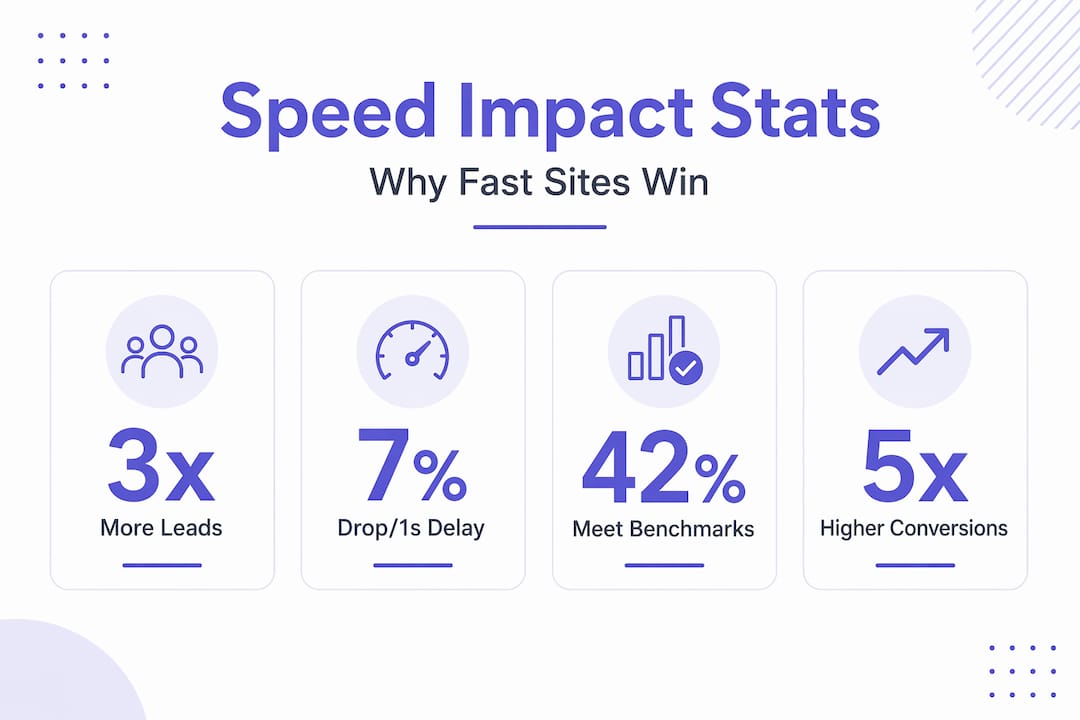
Your website might be losing leads right now, and you’d never know it. That’s the uncomfortable reality behind why website speed affects leads more than most small business owners realize. A slow site doesn’t just frustrate visitors. It sends them directly to a competitor before your page even finishes loading. Studies show that conversion rates drop 7% for every single second of delay. For a business spending real money on ads, SEO, or social traffic, that’s not a performance issue. It’s a revenue leak hiding in plain sight.
Table of Contents
- Key takeaways
- Why website speed affects leads more than you think
- Speed’s impact on your marketing budget
- Core Web Vitals and technical benchmarks
- Practical steps to speed up your site
- Real business results from speed improvements
- My take on speed as your top lead priority
- Build a faster, higher-converting website with Cosmicdigitalstudios
- FAQ
Key takeaways
| Point | Details |
|---|---|
| Speed kills or converts | A 1-second delay drops conversions by 7%, compounding rapidly with each additional second of load time. |
| Mobile users have zero patience | Over half of mobile visitors leave after 3 seconds, making mobile speed a non-negotiable priority. |
| Speed lowers your ad costs | Faster pages improve Google Ads Quality Score, which directly reduces your cost per click and cost per acquisition. |
| Core Web Vitals are now table stakes | Only 42% of sites meet Google’s current benchmarks, giving fast sites a measurable SEO and ranking advantage. |
| Quick wins exist and compound | Image compression, caching, and better hosting alone can meaningfully improve load time and lead performance. |
Why website speed affects leads more than you think
Speed is not a technical nicety. It is directly connected to whether a visitor stays long enough to become a lead. And the numbers are not subtle about it.
Pages loading in 1 second convert at three times the rate of pages that take 5 seconds, and five times the rate of pages taking 10 seconds. That gap exists because user patience does not scale with load time. Every second that ticks by erodes trust and increases the probability that someone clicks away before seeing your offer, your form, or your phone number.
The drop-off is not linear either. A delay from 2 to 3 seconds causes a 17.1% reduction in conversions, which is steeper than the same jump from 1 to 2 seconds. So that last second your site is loading can be the most expensive one.
Mobile behavior makes this even more urgent. 53% of mobile users abandon a site that takes more than 3 seconds to load, and a 5-second load time increases bounce probability by 90% compared to a 1-second experience. With mobile traffic now representing the majority of web visits for most local businesses, this is not a marginal problem.
There is also a hidden loss that most business owners never see. Some visitors abandon before analytics scripts fire, which means they never appear in your bounce rate, session data, or conversion reports. Your numbers look fine. Your leads are quietly disappearing. This invisible drop-off is one of the most underestimated problems in lead generation.
- Slow initial load delays the visibility of your headline, offer, and call-to-action
- Users form a trust judgment within the first few seconds, and a slow load creates doubt
- Mobile users on cellular networks are especially sensitive to even half-second delays
- A frustrating first visit makes return visits less likely, reducing lifetime lead value
Speed’s impact on your marketing budget
Here is where the financial case for a fast website gets hard to ignore. Speed does not just affect how site speed influences leads. It directly changes how much you pay to acquire each one.
Google evaluates your landing page experience as part of its Ads Quality Score. Faster pages earn higher scores. And Core Web Vitals improvements alone have produced documented reductions in cost per click of 20 to 25%. That means for the same ad spend, you get more clicks at a lower rate per click, and more of those clicks convert.
The compounding effect is significant. On a $50,000 monthly ad budget, a 1-second improvement in load time can yield hundreds of additional conversions at a substantially lower cost per acquisition. That is not a rounding error. That is a meaningful shift in marketing ROI from one technical change.

There is also an emerging factor most marketers are not tracking yet. AI crawlers largely cannot render JavaScript, which means slow or JavaScript-heavy pages get less visibility in AI-powered search results and generate weaker ad headlines when platforms auto-generate creatives. As AI-driven search and advertising expand, a slow site costs you more than just human visitors.
Pro Tip: Before running any paid campaign, check your landing page load time with Google PageSpeed Insights. If it scores below 70 on mobile, fix that before spending a dollar on ads. Your Quality Score will improve and your cost per lead will drop.
- Faster pages earn better Quality Scores, reducing cost per click
- Lower CPC means your existing budget delivers more traffic
- Higher conversion rates mean more of that traffic becomes leads
- Reduced cost per acquisition compounds across every campaign you run
- Speed optimization is one of the few improvements that simultaneously lowers costs and raises revenue
Core Web Vitals and technical benchmarks
Google does not guess at your site’s quality. It measures it. And the measurements it uses are called Core Web Vitals. Understanding these three metrics will change how you think about the importance of a fast website.
- Largest Contentful Paint (LCP): Measures how quickly the largest visible element loads. Google’s threshold is under 2.5 seconds. This is the metric most directly tied to perceived speed.
- Interaction to Next Paint (INP): Measures how fast your page responds to user input like clicks or form entries. Anything under 200 milliseconds is considered good.
- Cumulative Layout Shift (CLS): Measures visual stability. A high CLS score means elements jump around as the page loads, breaking trust and causing accidental clicks.
Here is the opportunity: only 42% of websites currently meet all three of these benchmarks. That means if your site does, you have a real competitive edge in organic rankings and user experience. If it does not, you are in the majority but you are also behind.
| Metric | Good Threshold | Common Culprit |
|---|---|---|
| LCP | Under 2.5 seconds | Unoptimized images, slow hosting |
| INP | Under 200ms | Heavy JavaScript, third-party scripts |
| CLS | Under 0.1 | Missing image dimensions, late-loading ads |
Sites loading under 1.5 seconds typically achieve stronger organic rankings and better engagement metrics across the board, and the average first-page Google result loads around 1.65 seconds. That is the target you should be aiming for.
Pro Tip: Use Google’s free PageSpeed Insights and GTmetrix together. PageSpeed gives you Core Web Vitals data. GTmetrix shows you a waterfall chart of exactly which files are slowing your load. Use both.
Practical steps to speed up your site
You do not need to rebuild your entire site to see meaningful improvements. Several high-impact changes can be made without a full redesign, and each one moves the needle on lead performance.
Start by measuring your current baseline. Run your site through Google PageSpeed Insights or GTmetrix and note your scores on mobile and desktop separately. Mobile is the priority. Check your local service business website against these benchmarks before anything else.
From there, work through these quick wins first:
- Compress images before uploading. Large image files are the single most common cause of slow load times. Use tools like Squoosh or TinyPNG to reduce file size without visible quality loss.
- Enable browser caching. Caching stores parts of your page locally on a visitor’s device so repeat visits load much faster.
- Minimize third-party scripts. Every chat widget, tracking pixel, and pop-up tool adds load time. Audit what is actually necessary and remove the rest.
- Use a Content Delivery Network (CDN). A CDN serves your site from servers closer to your visitor’s physical location, cutting latency on a global or even regional scale.
- Upgrade your hosting. Shared hosting plans often place dozens of sites on one server. A managed WordPress host or a VPS plan gives your site dedicated resources and consistently faster response times.
For sites that need a more thorough overhaul, server-side rendering can dramatically reduce the time to first byte, especially on JavaScript-heavy builds. This is where working with a developer or a website redesign specialist pays off. The goal is a site that loads fast by design, not one that has speed bolted on afterward.
Balancing speed with design is a real consideration, but it is not a tradeoff. A well-built site can look great and load in under two seconds. The problems arise when design decisions are made without any attention to performance, loading custom fonts from four sources, adding autoplay video backgrounds, or stacking plugin after plugin without testing the cumulative effect.
Real business results from speed improvements
The data on speed improvements and conversion lifts is specific enough to inform real business decisions.
A 0.1 second improvement in load time increases conversion rates by 8.4% in retail and 10.1% in travel. Those are not massive technical overhauls. That is a tenth of a second producing measurable, statistically significant revenue growth.
“Speed has no tradeoff. It improves conversion rates while simultaneously lowering advertising costs through better Quality Score.” — Foundry CRO, 2026
Speed also affects lead quality, not just lead volume. Visitors who arrive at a fast, polished site tend to engage more deeply, complete forms more thoroughly, and return more often. Speed benefits extend to brand perception and customer loyalty, creating a multiplier effect across your entire marketing investment. A lead from a fast site is often a better lead because the visitor had a higher-quality first experience.
One misconception worth addressing: many business owners think their site is fast because it “looks fine” on their office computer using a hardwired connection. That experience is not what your mobile visitor in the field has. Test your site on a throttled mobile connection and you will often see a dramatically different result.
My take on speed as your top lead priority
I’ve worked with enough businesses to see the same pattern repeat. They’ll spend thousands on new ad campaigns, rebrand their logo, and debate color schemes for weeks. Meanwhile, their site loads in 6 seconds and they’re hemorrhaging leads before any of that other work even gets a chance to matter.
In my experience, speed improvements offer better ROI than most marketing tactics, and they do it faster. A site that loads in under 2 seconds does not need as much ad spend to produce the same number of leads. It does not need as much SEO effort to rank. It just works better across every channel, every campaign, and every visitor.
The hidden cost of ignoring speed is not just lost leads. It’s the compounding waste across your entire marketing budget. Every dollar you spend driving traffic to a slow site is a dollar working at reduced capacity.
My advice: treat speed like a baseline requirement, not a bonus feature. Run a speed audit now. Fix the biggest issues. Then build speed into every future update. It’s not a one-time project. It’s an ongoing standard.
— Max
Build a faster, higher-converting website with Cosmicdigitalstudios
If your site is losing leads because of slow load times, the fix is not just technical. It’s architectural. At Cosmicdigitalstudios, we build custom websites and conversion-focused funnels that are fast by design, not as an afterthought.
Every site we build is optimized for Core Web Vitals, mobile performance, and the lead generation outcomes your business actually needs. Whether you need a full website redesign or a targeted speed and UX overhaul, we make sure your site works as hard as your marketing does. You can also explore conversion rate optimization strategies to pair with your speed improvements. Fast load times, clean design, and clear calls to action. That is how you turn traffic into booked calls and paying clients.
FAQ
How much does website speed affect lead generation?
Significantly. Pages loading in 1 second convert at three times the rate of pages taking 5 seconds, meaning speed improvements often produce more leads than new traffic campaigns alone.
What load time should I aim for?
Target under 2 seconds for desktop and under 3 seconds for mobile. Sites loading under 1.5 seconds consistently rank higher and convert better than the average.
Does website speed affect my Google Ads performance?
Yes. Google uses page experience as part of your Ads Quality Score. Faster pages earn higher scores, which directly reduce your cost per click and cost per acquisition.
What is the fastest way to improve site speed?
Start with image compression and removing unnecessary third-party scripts. These two changes alone often produce significant load time reductions without any code changes.
Does a slow website hurt my SEO rankings?
It does. Site speed is a confirmed Google ranking factor, and only 42% of sites currently meet Core Web Vitals benchmarks. A fast site has a measurable advantage in organic search results.