
Launching a website feels straightforward until you realize it is not. For local service businesses, getting it wrong means losing customers to competitors before you even know there is a problem. A proper local service business checklist website launch process covers far more than picking a template and hitting publish. You need the right pages, the right technical setup, local SEO baked in from day one, and a post-launch plan that keeps momentum going. This guide walks you through every step, in order, so nothing critical gets missed.
Table of Contents
- Key takeaways
- 1. Define your goals and website strategy first
- 2. Build the core pages every local business needs
- 3. Optimize your site for local SEO before launch
- 4. Make your site mobile-first and fast
- 5. Complete the technical pre-launch checklist
- 6. Follow a structured go-live sequence
- 7. Build your post-launch marketing and maintenance plan
- What I have learned from watching local sites launch and stall
- Ready to launch your local business website the right way?
- FAQ
Key takeaways
| Point | Details |
|---|---|
| Start with clear goals | Define what actions you want visitors to take before you build a single page. |
| Prioritize core pages first | Home, About, Services, and Contact pages drive most local conversions. |
| Local SEO starts at launch | Google Business Profile and on-site optimization must be ready before you go live. |
| Technical checks prevent disasters | Test links, forms, and robots.txt configuration before flipping the switch. |
| Post-launch is where growth happens | Analytics, reviews, and content updates determine your long-term local visibility. |
1. Define your goals and website strategy first
Before you write a single word of copy or choose a color scheme, you need to know what this website is supposed to do. Clear goals and audience definitions ensure every website decision aligns with your business priorities rather than personal preferences.
Ask yourself three specific questions:
- What is the single most important action I want a visitor to take? (Call now, book a service, fill out a form)
- Who is my local customer and what problem are they trying to solve today?
- What pages and features are absolutely necessary at launch, versus nice to have later?
Most local service businesses need a lead generation focus, not an ecommerce experience. That changes everything from your page structure to your button copy.
Pro Tip: Write down your one primary goal and paste it somewhere visible during the build. Every design decision should pass the test: does this help a visitor reach that goal?
2. Build the core pages every local business needs
You do not need twenty pages to get results. What you need are the right pages done well. The essential website pages for a local service business are Home, About, Services, and Contact. Each one has a job to do.
Your Home page is your first impression. It needs to communicate what you do, where you do it, and how to contact you within seconds. Your About page builds trust with your story and credentials. Your Services page answers what you offer and why you are the right choice. A well-structured service menu page can also improve time on site significantly. Your Contact page removes all friction from reaching you.

Keep this reference in mind as you plan your content:
| Page | Primary job | Must-have element |
|---|---|---|
| Home | Capture attention and drive action | Headline, CTA, phone number above the fold |
| About | Build credibility and trust | Your story, credentials, real photos |
| Services | Convert interest into inquiries | Clear descriptions, pricing signals, CTA per service |
| Contact | Remove all friction | Form, phone, address, embedded map |
Most local service businesses can launch a professional website for under $3,000 by focusing on these core pages and deferring custom scheduling tools or complex features until later.
Pro Tip: Do not bury your phone number. Contact info visible within 3 seconds of landing is the top conversion factor for local service websites.
3. Optimize your site for local SEO before launch
Local SEO is not something you add after the site goes live. It needs to be built in from the start. Here is a numbered checklist to work through before you publish:
- Set up and verify your Google Business Profile. An optimized Google Business Profile with complete NAP data, 20 to 30 quality photos, and regular posts can outperform your website in local search rankings on its own.
- Make NAP consistent everywhere. Your Name, Address, and Phone number must match exactly across your website, GBP, and every local directory listing.
- Add LocalBusiness schema markup. This structured data tells Google precisely what your business is, where it operates, and how to contact you.
- Write location-specific title tags and meta descriptions. Every page title should include your city or service area alongside your primary service keyword.
- Create a service area page. If you serve multiple neighborhoods or cities, each one deserves its own dedicated page with local content.
- Target the right local keywords. Understanding keyword targeting strategies helps you choose terms your neighbors are actually searching rather than industry jargon.
- Build local citations. Get listed on Google, Yelp, Bing Places, and industry-specific directories before launch day.
Pro Tip: Google Business Profile optimization is the single most impactful local SEO lever for new local sites. Spend time on it before worrying about complex on-page tactics.
4. Make your site mobile-first and fast
Most people searching for local services are doing it on their phones, often while they need help right now. Mobile-first design and page speed under 3 seconds are non-negotiable in 2026. A slow site does not just frustrate visitors. It tanks your Google rankings before a potential customer even sees you.
Read more about exactly why this matters in this mobile speed guide built for small business owners.
Run these checks before launch:
- Test your site on real mobile devices, not just a browser simulation
- Run a speed test using Google PageSpeed Insights and aim for a score above 80
- Compress all images without sacrificing visible quality
- Use a reliable hosting provider with good uptime and server response times
- Avoid autoplay video, heavy animations, or anything that delays the first visible content
Speed is a conversion factor, not just a technical metric. Every additional second of load time costs you customers.
5. Complete the technical pre-launch checklist
This is where launches go wrong for even experienced builders. Work through every item below before you disable maintenance mode:
- Check all internal and external links. Broken links destroy trust and hurt SEO immediately.
- Test every form. Submit each contact form yourself and confirm the notification hits your inbox.
- Verify cross-browser compatibility. Test in Chrome, Safari, Firefox, and Edge at minimum.
- Configure your SSL certificate. Your site must load on HTTPS. Browsers will warn visitors away from HTTP sites.
- Set up automated backups. Establish a daily or weekly backup schedule before you go live.
- Assign proper user roles. Limit admin access to who absolutely needs it.
- Review your robots.txt file. Blocking your entire website in robots.txt is a common and damaging error at launch. Your staging environment should be blocked. Your live site must not be.
Once the site is live, submit your sitemap immediately. Submitting a sitemap to Google Search Console on launch day gets your pages crawled and indexed faster than waiting for Google to find them organically.
Pro Tip: Do a full walkthrough of your site as a first-time visitor with no prior knowledge of your business. If you cannot figure out what to do within 10 seconds, your visitors cannot either.
6. Follow a structured go-live sequence
The moment you disable maintenance mode and point your domain to the live server, a sequence of time-sensitive tasks begins. Do not skip any of these steps or do them out of order:
- Confirm the domain is pointing to the correct server and DNS has propagated fully.
- Disable any search engine blocking set up during development.
- Verify the SSL certificate is active and the site forces HTTPS.
- Submit your XML sitemap to Google Search Console.
- Check that Google Analytics is firing correctly on all pages.
- Test all forms and contact mechanisms one final time on the live URL.
- Run a final mobile speed check on the actual live domain.
- Do a page-by-page review to catch any content placeholders left from development.
Going live is not the finish line. It is the starting point for everything that follows.
7. Build your post-launch marketing and maintenance plan
Launching a website is an ongoing process, not a one-time event. What you do in the weeks after launch determines whether your site builds momentum or stagnates.
Here is what a solid post-launch routine looks like:
- Monitor Google Analytics weekly. Track which pages get traffic, where visitors drop off, and which actions they take.
- Check Google Search Console monthly. Look for crawl errors, manual penalties, and keyword performance trends.
- Add fresh content regularly. Active websites with fresh content consistently outrank static sites in local search results. A monthly blog post or updated service page counts.
- Collect and showcase reviews. Ask every satisfied customer to leave a Google review and display your best ones on your website.
- Run updates on plugins, themes, and core software. Outdated software is the most common cause of security breaches for small business websites.
- Schedule a quarterly site audit. Check for broken links, outdated pricing, and pages that could be better optimized.
Pro Tip: Set a recurring calendar reminder for your post-launch tasks. Most local service sites lose momentum not because the owner stops caring, but because there is no system keeping them accountable.
What I have learned from watching local sites launch and stall
The most common mistake I see is treating website launch like the goal rather than the starting point. A business owner spends weeks perfecting the design, then goes live and does nothing for six months. The site collects dust while a less polished competitor who actively manages their Google Business Profile and asks for reviews every week takes all the local calls.
The robots.txt issue also gets me every time. I have seen professionally built sites sit invisible on Google for weeks because someone forgot to unblock search engines after moving from staging to production. It is a five-second fix that costs businesses real money when it is missed.
My honest take on budget: conversion optimization for local businesses depends far more on making your phone number visible and your contact form frictionless than on premium aesthetics. Perfect design does not convert. Clear design does. If you are deciding between a beautiful custom illustration and making sure your site loads in under three seconds on mobile, take the speed every time.
The on-page SEO fundamentals matter, but they layer on top of a solid foundation. Get the basics right first, launch, and then improve. Done and live beats perfect and unpublished every time.
— Max
Ready to launch your local business website the right way?
At Cosmicdigitalstudios, we build fast, mobile-first websites designed to turn local visitors into booked calls and real customers. Every site we build comes with the essentials already in place: clear page structure, conversion-focused design, local SEO integration, and speed optimization from day one.
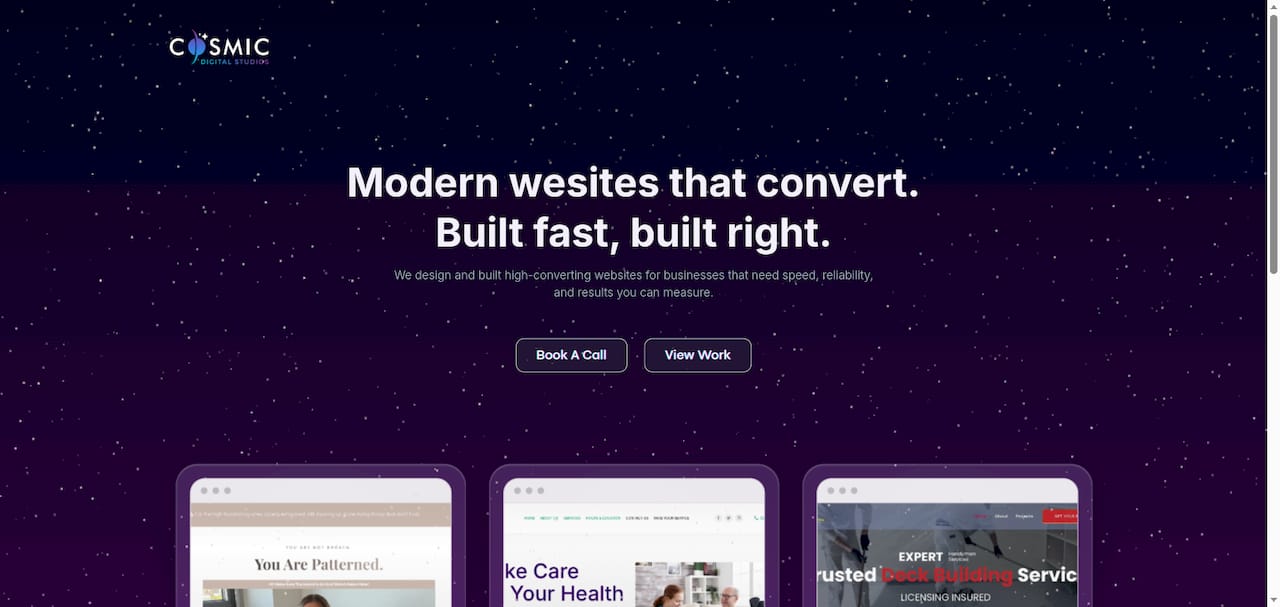
Whether you are starting fresh or need a website redesign that actually performs, we handle the build so you can focus on running your business. No guesswork. No checklist items falling through the cracks. Visit Cosmicdigitalstudios to see how we approach local service websites and what a conversion-focused build looks like in practice.
FAQ
What pages does a local service website need at launch?
At minimum, you need a Home, About, Services, and Contact page. These four pages cover the core customer journey from first impression to reaching out.
How long does it take a new site to rank locally?
Most new local sites begin appearing in search results within 4 to 12 weeks, assuming your Google Business Profile is verified, your site is indexed, and your NAP data is consistent across listings.
What is the most common technical mistake at launch?
Forgetting to unblock search engines in the robots.txt file is one of the most frequent and costly launch errors. Your staging site should be blocked, but your live site must be fully crawlable from day one.
Do I need a blog for local SEO?
Not immediately. Focus on getting your core pages right first. Once live, even one or two location-specific blog posts per month can meaningfully improve your local search visibility over time.
How much should a local service website cost to launch?
Most local service businesses can launch a professional website for under $3,000 by prioritizing core pages and deferring complex features like custom booking systems until the business justifies the investment.