
A multi-location service website is a single branded web presence that serves customers across two or more physical locations through dedicated, locally optimized pages. The best examples of multi-location service websites share three traits: unique location pages with distinct URLs, consistent brand identity, and local SEO signals that help each location rank in its own market. Brands like Two Men and a Truck and The UPS Store have proven this model at scale. Successful multi-site service websites combine technical structure with localized content to drive real engagement at the local level.
What features define successful multi-location service websites?
The strongest multi-location business examples share a clear set of design and functional features. These features determine whether a visitor finds the right location fast or leaves frustrated.
- Dedicated location pages with unique URLs. Each location gets its own page at a path like
/locations/chicagoor/dallas-plumbing. This structure gives search engines a clear signal for each market. - Interactive maps with filtering. Tools like Storepoint let visitors filter locations by service type, hours, or distance. This reduces friction and keeps visitors on the site longer.
- Consistent branding with local customization. The logo, color palette, and tone stay the same. The address, phone number, local team photos, and neighborhood references change per page.
- Mobile responsiveness and fast load times. Most local searches happen on mobile devices. A slow or broken mobile experience kills conversions before they start.
- Review widgets and local testimonials. Displaying Google reviews specific to each location builds trust with visitors in that market.
- Clear navigation for location discovery. A “Find a Location” link in the main navigation is standard on every strong multi-site service website.
Pro Tip: Create a location page template that locks brand elements but leaves content fields open for local customization. This cuts build time per location while keeping quality consistent.
1. Two Men and a Truck: centralized brand, local execution

Two Men and a Truck operates 400+ worldwide locations through a single centralized website with individual location pages. Each page carries local contact details, service areas, and customer reviews specific to that franchise. The result is a 96% customer referral rate, which reflects how well the local experience matches the brand promise. The site proves that a national brand can feel local without building hundreds of separate websites.
The key lesson here is structure. Two Men and a Truck does not rely on a generic contact page to handle all inquiries. Every location has its own conversion path, its own phone number, and its own local content. That specificity is what drives referrals.
2. Michelin: Google Business Profile integration that drove a 43% lift
Michelin’s multi-location digital strategy shows what happens when on-site pages and Google Business Profiles work together. After aligning business names to a “Brand – Location” format across all profiles, customer actions jumped 43% in a single month. That is not a gradual SEO gain. It is a direct result of fixing a naming inconsistency that was suppressing local visibility.
The Michelin case also confirms a broader rule: your location pages and your Google Business Profiles must tell the same story. When they conflict, search engines and customers both lose confidence in the listing.
3. The UPS Store: IT and lifecycle management at 5,500 locations
The UPS Store supports over 5,500 franchise locations through a single IT partner managing consistent deployment and lifecycle operations. This is not just a technology story. It is a model for how multi-location brands maintain quality across independently owned units. When every location runs the same systems, the website experience stays consistent for every customer.
“Multi-location networks more often fail due to poor local execution than brand problems. Centralized lifecycle management partners improve consistency and reporting across every location.”
The UPS Store example shows that the website is only one layer. The operational infrastructure behind it determines whether the site’s promises hold up in real life.
4. A 15-location brand: 720% growth in map impressions
A standardized local SEO program applied to a 15-location brand produced a 720% increase in map impressions and a 280% rise in direction requests within 12 months. The average Google rating for those locations climbed from 4.1 to 4.8 over the same period. These numbers show what happens when every location follows the same SEO playbook instead of managing its own presence independently.
The program covered Google Business Profile optimization, citation consistency, and review generation. None of those tactics are complicated. The gain came from applying them uniformly across all 15 locations at the same time.
5. Herbal Nails and Spa: rapid scale with top local rankings
Herbal Nails and Spa scaled to 14 or more locations while maintaining top local search rankings across each market. The brand achieved this by building location-specific landing pages that matched the search intent of customers in each city. Each page used local keywords, neighborhood references, and location-specific offers. This approach kept the brand competitive in local search without requiring a separate domain for each location.
The Herbal Nails and Spa model is particularly useful for service businesses in competitive local markets. Ranking in one city does not carry over to the next. Each location needs its own SEO foundation.
Best practices vs. common pitfalls for multi-location sites
The difference between a site that generates leads and one that gets ignored often comes down to a few specific decisions.
| Best Practice | Common Pitfall |
|---|---|
| Unique content on every location page | Copy-pasting the same text with only the city name changed |
| One Google Ads account with geographic targeting | Separate campaigns per location competing against each other |
| Centralized brand standards with local content fields | Letting each location manage its own page without oversight |
| Consistent NAP (name, address, phone) across all listings | Different phone numbers or address formats on different platforms |
| Regular review generation at each location | Ignoring reviews until a negative one appears |
Consolidating Google Ads campaigns under one Master Client Center with geographic targeting is the most overlooked fix in multi-location paid search. When each location runs its own campaign, they bid against each other for the same keywords. That drives up cost per click with no gain in total leads.
Pro Tip: Audit your Google Business Profiles before launching any new location pages. Mismatched business names between your site and your GBP listings will suppress local rankings regardless of how well the pages are built.
How to scale and manage multi-location websites with the right tools
Scaling a multi-location site past five or six locations requires more than a good CMS. You need systems that handle listing management, reputation monitoring, and performance tracking across every market.
- Listing management platforms keep your name, address, and phone number consistent across Google, Yelp, Apple Maps, and dozens of other directories. A single data error across listings can suppress local rankings.
- Unified dashboards let you track traffic, rankings, and conversion rates per location from one view. Without this, you are flying blind on which locations are underperforming.
- Review generation workflows automate the process of asking satisfied customers for reviews after each service. Local search scaling typically requires 60–90 days of consistent review activity before measurable lead growth appears.
- AI-driven brand systems require dual-layer visibility: per-location signals for local relevance and portfolio-level signals for brand authority. This matters most for brands managing acquisitions or rapid expansion.
Brands that dominate local search combine location-specific Google Business Profiles, citation management, review programs, and consistent brand messaging across every location. No single tactic does the job alone. The power comes from all of them working together.
The service area page structure you choose also affects how well each location page ranks. Pages built around specific service areas with unique content outperform generic city pages every time.
Key Takeaways
The most effective multi-location service websites combine dedicated local pages, consistent Google Business Profiles, and centralized management to drive measurable lead growth at every location.
| Point | Details |
|---|---|
| Dedicated location pages | Each location needs a unique URL, local content, and its own conversion path. |
| GBP and on-site alignment | Matching your site and Google Business Profile naming format can lift customer actions by 43% in one month. |
| Centralized paid search | One Google Ads account with geographic targeting prevents locations from competing against each other. |
| Consistent local SEO execution | Applying the same SEO program across all locations produced 720% more map impressions for one 15-location brand. |
| Operational infrastructure | Centralized IT and lifecycle management, as used by The UPS Store across 5,500 locations, keeps the experience consistent. |
What I have learned from studying these examples
The brands that get multi-location websites right are not necessarily the ones with the biggest budgets. They are the ones that treat each location as its own local business while keeping the brand architecture tight.
The mistake I see most often is treating the location page as a formality. Owners build one template, swap in the city name, and call it done. That approach produces pages that rank for nothing and convert no one. The Michelin case is instructive here. A simple naming fix across Google Business Profiles produced a 43% lift in customer actions in 30 days. The site itself did not change. The local signal did.
Paid search is where I see the most money wasted. Franchise and multi-location brands routinely run separate campaigns per location, then wonder why their cost per lead keeps climbing. The fix is straightforward: consolidate under one account, apply geographic targeting, and stop locations from bidding against each other. Most brands do not do this because no single person owns the problem.
The 60–90 day timeline for local SEO to produce measurable results is real. Business owners who expect immediate returns from a new location page will pull back too early. The brands that win are the ones that commit to the full program, including review generation, citation management, and content updates, for at least three months before evaluating results.
If you are building or rebuilding a multi-location site, start with the local service website checklist before touching design. Structure and SEO decisions made early are expensive to fix later.
— Max
How Cosmicdigitalstudios builds multi-location websites that rank and convert
Cosmicdigitalstudios builds custom websites for service businesses that need to perform across multiple locations. Every build includes location-specific landing pages, clean URL structures, and on-page SEO built in from the start, not added as an afterthought.
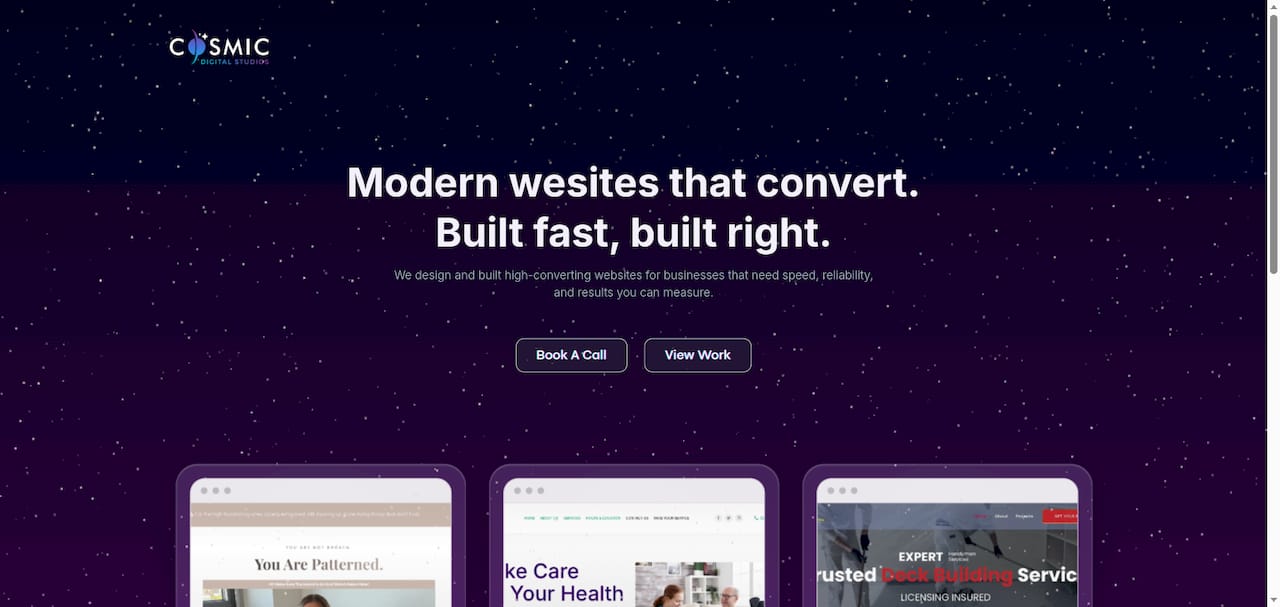
If you are ready to build a site that generates leads in every market you serve, Cosmicdigitalstudios designs and builds conversion-focused websites tailored to your locations and your goals. The work covers everything from page architecture to local content strategy. You get a site that looks professional, ranks locally, and turns visitors into booked calls. See how service pages drive rankings and what that means for your bottom line.
FAQ
What makes a multi-location service website effective?
An effective multi-location service website gives each location its own dedicated page with a unique URL, local content, and a clear conversion path. Consistent Google Business Profile alignment and centralized brand standards complete the foundation.
How long does local SEO take to show results for multiple locations?
Local search efforts typically require 60–90 days of consistent activity, including review generation and content updates, before measurable lead growth appears across locations.
How do I prevent my Google Ads from competing across locations?
Consolidate all location campaigns under one Master Client Center account and use geographic targeting to assign each budget to its own market. This eliminates internal bidding competition and lowers cost per lead.
Do I need a separate website for each location?
No. A single website with dedicated location pages and unique URLs is the standard structure used by brands like Two Men and a Truck across 400 or more locations. Separate domains create SEO fragmentation and management complexity.
What is the biggest mistake multi-location businesses make online?
The most common mistake is using duplicate location pages with only the city name changed. Search engines treat these as thin content, and they rarely rank. Each location page needs unique local content to compete in its own market.