
Your local service website is either working for you or costing you leads. There is no in-between. If you have been putting off a redesign because the process feels overwhelming, this local service website redesign checklist 2026 gives you everything you need to approach it with a clear plan. You will know what to audit, what to fix, and how to make decisions that actually move the needle on lead generation. No guesswork. No wasted budget. Just a structured path from your current site to one that earns its keep.
Table of Contents
- Key takeaways
- Your local service website redesign checklist 2026 starts here
- ## 1. Audit and map your existing pages
- 2. Reframe your site structure around user tasks
- 3. Build for mobile first, not mobile second
- 4. Write service pages that match local search intent
- 5. Add trust signals that are specific and credible
- 6. Plan your SEO migration before you touch a URL
- 7. Update all metadata and on-page SEO elements
- 8. Set up analytics and tracking before launch
- 9. Test on multiple devices and browsers before launch
- Comparing redesign approaches for local service sites
- Deciding when to act and what to do next
- What I have learned from watching local service site redesigns go sideways
- Ready to build a local service site that actually generates leads?
- FAQ
Key takeaways
| Point | Details |
|---|---|
| Audit before you build | Review your current site’s speed, SEO, and conversion paths before making any design decisions. |
| Mobile performance is non-negotiable | Most local searches happen on mobile, so your redesign must prioritize speed and usability on small screens. |
| SEO migration needs a plan | Changing URLs or platforms without a redirect strategy can erase rankings you’ve spent years building. |
| Match scope to your goals | A visual refresh and a full rebuild serve different business situations. Choose based on your actual needs. |
| Post-launch is not optional | Ongoing monitoring with analytics and heatmaps separates a one-time redesign from a long-term lead machine. |
Your local service website redesign checklist 2026 starts here
Before you redesign anything, you need to know where your current site stands. Most local service businesses skip this step, jump straight into picking colors and layouts, and end up with a prettier site that still does not convert.
Here are the five areas to evaluate before your redesign begins:
- Site speed. Longer than 3 seconds is a clear signal your site needs attention. Optimal 2026 performance means hitting Google Core Web Vitals targets: INP under 200ms and CLS below 0.1. Run your current site through Google PageSpeed Insights and record your scores.
- Mobile experience. Poor mobile UX leads directly to higher bounce rates and lost leads. Check every page on an actual phone, not just a browser simulator.
- SEO health. Pull a crawl report using a tool like Screaming Frog or Ahrefs. Identify your best-performing pages and flag any technical issues like broken links, duplicate title tags, or missing meta descriptions.
- Lead generation audit. How many of your current pages have a clear call to action? Where do visitors drop off? Tools like Google Analytics and Hotjar can show you exactly where leads are leaking.
- Competitor analysis. Look at two or three local competitors who rank ahead of you. Note what their site structure looks like, what trust signals they display, and how easy it is to contact them.
Pro Tip: Document your current Google rankings for your top service keywords before you touch a single page. This becomes your benchmark for measuring whether your redesign helped or hurt your SEO.
## 1. Audit and map your existing pages
Start by listing every page on your current site. Categorize each one as keep, update, or retire. Pages that rank, get traffic, or convert should be preserved and improved. Pages that are outdated, duplicate, or generate no traffic can be cut.
Pay close attention to your service pages. These are your highest-value pages for lead generation and local SEO. Any page you keep must carry over its URL structure or have a redirect in place.

2. Reframe your site structure around user tasks
Most local service websites are organized around what the business wants to say, not what the user needs to do. Visitors land on your site with a specific task: find pricing, check your service area, read reviews, or book a call. Your site structure should make each of those tasks take as few clicks as possible.
Map out a simple site architecture on paper before your designer builds anything. Think in terms of user goals, not company departments.
3. Build for mobile first, not mobile second
Local searches and conversions happen predominantly on mobile devices. This means your design decisions need to start at the smallest screen size and scale up, not the other way around. Buttons need to be large enough to tap. Forms should be short. Phone numbers should be click-to-call.
Test your new design on at least three different real devices before launch. Emulators miss real-world rendering issues.
4. Write service pages that match local search intent
Generic service pages do not rank or convert. Real geographic relevance and specific service intent are what make a page both visible in local search and persuasive to the people who land on it. That means mentioning your city and service area naturally in the copy, not stuffing keywords into every paragraph.
Each service page should answer three questions immediately: What do you do? Where do you do it? Why should someone choose you over the competition?
5. Add trust signals that are specific and credible
Generic testimonials like “Great service, 5 stars” do not move buyers. Specific proof points such as star-rated reviews with named customers, certifications displayed near your services, and before-and-after project photos improve local conversion rates meaningfully.
Every service page should have at least one form of social proof sitting close to your call to action. Do not make visitors go searching for reasons to trust you.
Pro Tip: If you have Google reviews, embed a live feed of them on your homepage and key service pages. Real reviews from real people outperform any testimonial you write yourself.
6. Plan your SEO migration before you touch a URL
This is the step that kills redesigns when skipped. Google recommends planned redirects any time URLs change during a site move. If you change your URL structure without setting up 301 redirects, you will lose your rankings, possibly permanently.
Build a redirect map before launch. Every old URL that is changing needs to point to its new equivalent. This is not optional if you care about organic traffic.
7. Update all metadata and on-page SEO elements
During your redesign, every page needs a unique title tag and meta description. Write them to match 2026 search behavior: specific, benefit-led, and under the character limits Google displays in results. Your H1 heading on each page should match the primary search term that page is targeting.
Do not copy-paste metadata from your old site. This is your opportunity to improve every page at once.
8. Set up analytics and tracking before launch
A surprising number of local service businesses launch a redesigned site with no tracking in place. Google Analytics 4, Google Search Console, and a goal-tracking setup should be configured and tested before your site goes live. You need to know from day one whether the new site is generating more leads than the old one.
Set up conversion events for form submissions and phone call clicks specifically. These are the metrics that tell the real story.
9. Test on multiple devices and browsers before launch
Before you hit publish, test every page on Chrome, Safari, Firefox, and at least two mobile devices. Check that forms submit correctly, that phone numbers are clickable, and that load times meet your Core Web Vitals targets. Check your mobile site speed one more time with PageSpeed Insights on the staging version.
A single broken form on launch day can cost you a week of leads while you diagnose the issue.
Comparing redesign approaches for local service sites
Not every situation calls for a full rebuild. Here is how the main approaches stack up:
| Approach | Best for | Cost range | Impact on leads |
|---|---|---|---|
| Visual refresh | Solid structure, outdated look | Low | Minimal without UX work |
| Conversion-focused UX redesign | Sites with traffic but low conversions | Mid | High if done correctly |
| Platform migration | Moving from outdated CMS to modern stack | Mid to high | Neutral until SEO stabilizes |
| Full strategic rebuild | Scaling businesses needing custom functionality | High | Highest long-term potential |
A redesign focused only on visuals without addressing UX and SEO rarely improves lead volume. The most effective redesigns combine messaging clarity, conversion optimization, and technical improvements together.
When comparing budgets, planning 10 to 20 percent contingency for scope changes is a consistent recommendation from experienced project managers. Costs scale significantly with complexity, so defining your goals before getting quotes saves both time and money.
Key factors to decide your approach:
- If your current site gets decent traffic but few calls or form fills, a conversion-focused UX redesign is your move.
- If your site is on an outdated platform that limits speed and flexibility, a platform migration paired with content improvements gives you the foundation to grow.
- If your business has changed significantly and your site no longer reflects what you do or who you serve, a full rebuild is the right call.
Deciding when to act and what to do next
Here is a simple framework. You likely need a content update if your pages are outdated but your structure and platform are working fine. You need a redesign if your bounce rate is high, your conversion rate is low, or your site looks significantly older than your competitors. You need a full rebuild if your platform cannot support the features, speed, or integrations your business requires.
Pro Tip: Do not redesign right before your busiest season. Plan your launch for a slower period so you have time to monitor and fix any issues without losing peak-season leads.
Signs that your site needs a full redesign now:
- Your homepage does not clearly state what you do and who you serve in the first few seconds.
- You cannot make basic content changes without a developer.
- Your site takes more than three seconds to load on mobile.
- You have not updated your service pages in over a year.
After launch, use heatmaps, analytics, and user feedback to keep improving. A redesign is not a one-time event. It is the start of an ongoing process of measurement and refinement that compound over time.
What I have learned from watching local service site redesigns go sideways
I have reviewed a lot of local service websites over the years, and the pattern I see most often is this: a business spends real money on a redesign, the new site looks great in the browser, and then three months later the phone is still not ringing any more than before.
The design was fine. The problem was that no one asked the hard questions before the build started. What do visitors actually need to do on this site? What objections do they have before booking? Why would someone choose this business over the one two miles away?
Good design does not fix unclear messaging. A fast site does not fix a weak offer. The businesses that see real lead growth from their redesigns are the ones that treat the website as a sales tool, not a brochure. They map out the customer decision-making process, write copy that speaks directly to real concerns, and build their conversion paths around how people actually behave on mobile screens.
The other thing I have learned: most local service sites are undermeasured. If you cannot tell me your current conversion rate, your top traffic-driving pages, or where visitors exit most often, you are making redesign decisions blind. Fix that before you spend a dollar on anything new.
— Max
Ready to build a local service site that actually generates leads?
If you have worked through this checklist and realized your current site needs more than a quick fix, Cosmicdigitalstudios builds custom websites and conversion-focused funnels designed specifically to generate booked calls and leads for local service businesses.
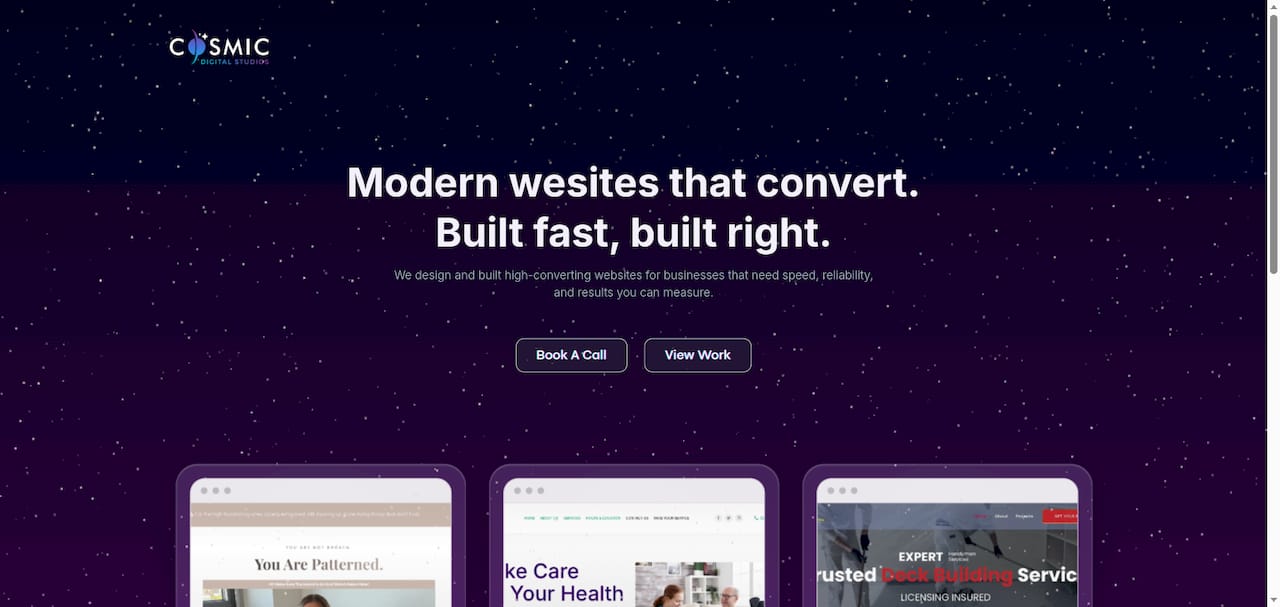
Every project starts with a clear strategy: understanding your services, your local market, and the specific conversion paths your customers need to take. From there, the team at Cosmicdigitalstudios handles design, development, SEO migration, and analytics setup so your launch is clean and your results are trackable from day one.
Whether you need a full website redesign or want to understand what pages your site is missing, Cosmicdigitalstudios has the tools and experience to get you there. You can also explore essential pages for local service sites to see what a high-converting local service site actually needs before you start planning.
FAQ
What is the first step in a local service website redesign?
Start with an audit of your current site covering speed, SEO health, mobile experience, and conversion performance. This gives you a baseline to measure improvements against after launch.
How do I avoid losing Google rankings during a redesign?
Map every URL that is changing to its new destination and set up 301 redirects before launch. Google recommends planned redirects whenever URLs change during a site migration.
How long does a local service website redesign take?
Most redesigns for local service businesses take four to twelve weeks depending on the scope, the number of pages, and how quickly content decisions are made.
Do I need a full rebuild or just a refresh?
A visual refresh works if your site structure and platform are solid but the design looks dated. A full rebuild is the right call when your platform limits speed, your messaging no longer reflects your business, or your conversion rate has never been strong.
What should I track after launching a redesigned site?
Track form submissions, phone call clicks, bounce rate, and your Google Search Console performance weekly for the first 90 days. Use heatmaps to see how visitors interact with your key pages and refine your calls to action based on what the data shows.