
A lead generation website is defined as a purpose-built site designed to convert visitors into contactable prospects by driving one of four core actions: form fills, call bookings, trial sign-ups, or asset downloads. Unlike a standard business website, every page on a lead generation site serves a conversion goal. Platforms like ActiveCampaign and Leadpages have built entire product ecosystems around this model because the demand for structured, conversion-focused web design keeps growing. If your website gets traffic but produces no inquiries, you likely have a brochure site, not a lead generation machine.
What is a lead generation website and how does it work?
A lead generation website, also called a conversion-focused site in professional marketing circles, is structured to guide visitors toward a specific action at every stage of their visit. The homepage, blog posts, service pages, and dedicated landing pages all function as conversion points aligned with visitor intent. Traffic arrives from search engines, paid ads, or social media, and the site architecture funnels each visitor toward a form, a booking link, or a download.

This differs from a traditional informational website, which prioritizes content delivery over lead capture. A brochure site tells visitors who you are. A lead generation site asks them to take a step. That distinction drives every design and content decision, from the placement of a call-to-action button to the number of fields in a contact form.
The most effective lead generation sites treat every page as a conversion opportunity. A blog post ends with a content upgrade offer. A service page includes a booking widget. The homepage leads with a single, clear headline and one primary CTA. Nothing is left to chance.
How does a lead generation site differ from a landing page or brochure site?
These three formats serve different purposes, and confusing them costs you conversions. The table below breaks down the key differences.
| Feature | Brochure site | Lead generation site | Landing page |
|---|---|---|---|
| Primary goal | Inform visitors | Capture leads across multiple pages | Convert one specific offer |
| Navigation | Full menu | Full menu with conversion CTAs | None or minimal |
| Number of offers | Many | Multiple, segmented by intent | One |
| CRM integration | Rarely | Standard | Often |
| Traffic source | Organic, direct | Ads, SEO, social, email | Paid ads, email campaigns |
A landing page focuses on one audience, one offer, and one CTA with navigation removed to reduce friction. It is a single conversion engine, not a full site. A lead generation website integrates multiple landing pages, blog content, and service pages into one connected system. You can think of landing pages as individual rooms inside the larger building of a lead generation site.
Campaigns that send paid traffic to a generic homepage lose leads at a high rate. A focused landing page with messaging matched to the ad that drove the click consistently outperforms a homepage in conversion rate. Understanding the landing page vs. website difference is one of the fastest ways to improve your results without changing your ad spend.
Pro Tip: If you run paid ads, never send traffic to your homepage. Build a dedicated landing page for each campaign with messaging that mirrors the ad copy exactly.
What are the essential components of a successful lead generation website?
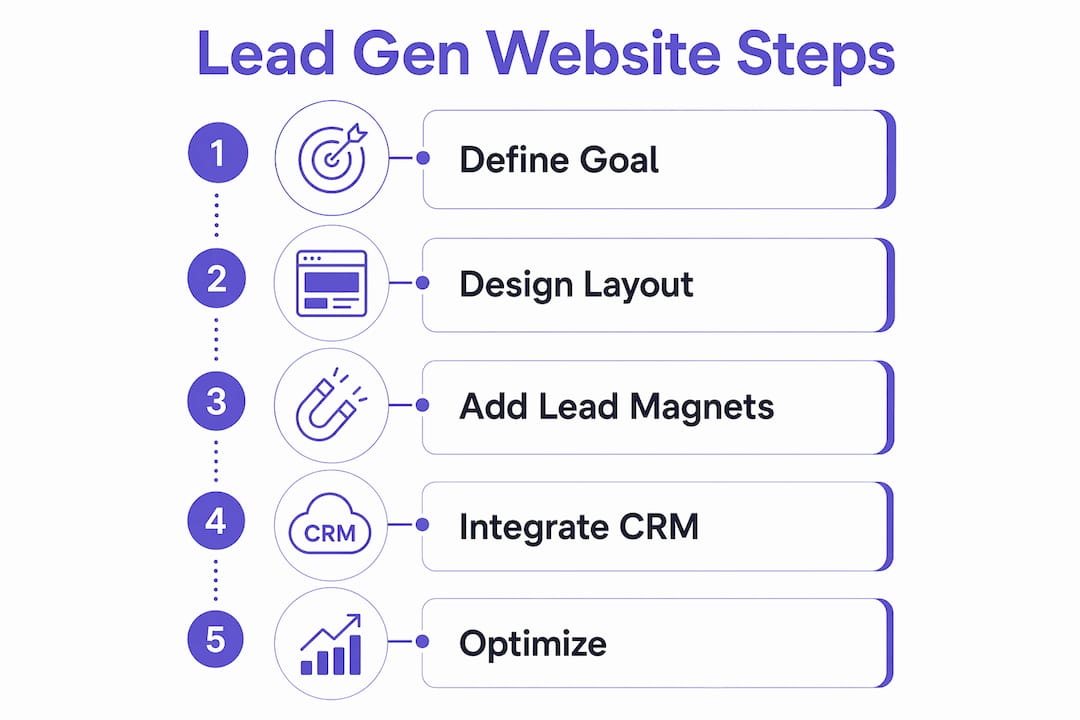
A high-performing lead generation site is built from five connected layers. Each layer depends on the one before it. Missing any one of them creates a gap where leads fall out.
- Lead magnets. A lead magnet is a free resource or offer that gives visitors a reason to share their contact information. Common formats include PDF guides, free audits, webinar registrations, and trial access. The magnet must solve a specific problem for a specific audience.
- Capture surfaces. These are the places where visitors actually submit their information. Landing pages, exit-intent popups, embedded forms in blog posts, and sticky header bars all serve as capture surfaces. The best sites use multiple capture surfaces so visitors encounter an offer regardless of where they enter the site.
- Lead qualification. Not every lead is worth the same follow-up effort. Lead scoring in 2026 includes fit, intent, and engagement metrics to prioritize leads effectively. Fit measures whether the lead matches your ideal customer profile. Intent measures how close they are to buying. Engagement measures how they interact with your content.
- Automated nurturing. Once a lead is captured, an automated email sequence keeps them engaged until they are ready to buy. This is where CRM platforms like ActiveCampaign and Salesforce become critical. A connected lead generation funnel links magnets, capture surfaces, qualification systems, and nurturing sequences into one continuous flow.
- Performance measurement. Every element of the site should be tracked. Conversion rates, traffic sources, form completion rates, and lead quality scores all tell you where the funnel is working and where it is leaking.
Pro Tip: Set up your CRM integration before you launch any lead capture form. Leads captured without a connected CRM are leads you will manually chase later, and most of them will go cold.
A practical example of this system in action: a marketing agency publishes a blog post on ad strategy, offers a free audit at the end of the post, captures the visitor’s email and company name, scores the lead based on company size, and triggers a three-email nurture sequence before a sales rep reaches out. That is a complete lead generation funnel built into a single content piece.
How to optimize your lead generation website for maximum conversions
Optimization is not a one-time project. It is a continuous process of testing, measuring, and adjusting. These are the four areas that produce the most consistent results.
-
Build single-focus landing pages for every offer. Each landing page should target one audience segment with one message and one CTA. Mixing multiple offers on a single page dilutes attention and reduces conversions. Tools like Leadpages make it straightforward to build and test multiple page variants without developer support.
-
Remove navigation from landing pages. Every link on a landing page is an exit ramp. Removing the navigation menu keeps visitors focused on the one action you want them to take. This single change consistently lifts conversion rates on paid traffic campaigns.
-
Improve form design and placement. Shorter forms convert at higher rates. Ask only for the information you need to qualify the lead and start a conversation. Place your primary form above the fold so visitors see it without scrolling. Add a secondary form at the bottom of the page for visitors who read all the way through.
-
Use lead enrichment tools for smarter follow-up. Lead enrichment tools append job role, industry, and company size to a lead record immediately upon capture. This allows your automated follow-up to reference relevant details rather than sending a generic response. The result is a higher reply rate and faster qualification.
-
Feed your landing pages from multiple traffic channels. Focusing on 2–3 integrated channels outperforms spreading effort across every platform at once. A typical high-performing setup combines SEO-driven blog content, Google Ads for immediate traffic, and LinkedIn or Meta retargeting to re-engage visitors who did not convert on the first visit.
Website speed also directly affects conversion rates. A slow-loading landing page loses visitors before they ever see your offer. Every second of load time matters, especially on mobile.
What metrics and tools should you track to improve performance over time?
Measurement is what separates a lead generation site from a guess. Key metrics in 2026 include conversion rates, lead quality scores, bounce rates, and performance broken down by traffic source. Each metric tells a different part of the story.
| Metric | What it tells you |
|---|---|
| Conversion rate | Percentage of visitors who complete a lead capture action |
| Lead quality score | How well a lead matches your ideal customer profile |
| Bounce rate | Percentage of visitors who leave without taking any action |
| Traffic source performance | Which channels deliver the highest-quality leads |
| Cost per lead | How much you spend to acquire each contactable prospect |
CRM platforms like Salesforce and ActiveCampaign track the full lead lifecycle from first form fill to closed deal. Automated nurturing combined with lead scoring enables sales teams to prioritize high-value prospects and improves overall growth efficiency. Without this data, you are making design and budget decisions based on assumptions.
A/B testing is the most direct way to improve conversion rates over time. Test one variable at a time: headline copy, CTA button color, form length, or hero image. Run each test long enough to reach statistical significance before drawing conclusions.
Pro Tip: Track lead quality, not just lead volume. A landing page that generates 50 qualified leads beats one that generates 200 unqualified contacts every time. Connect your CRM data to your ad platform to measure actual revenue per traffic source.
Key Takeaways
A lead generation website converts visitors into qualified prospects by combining targeted landing pages, lead magnets, CRM automation, and continuous performance measurement into one connected system.
| Point | Details |
|---|---|
| Definition is specific | A lead gen site drives form fills, bookings, trials, or downloads. It is not a brochure. |
| Landing pages are components | Single-focus landing pages live inside a lead generation site and handle specific offers. |
| Five layers drive results | Magnets, capture surfaces, qualification, nurturing, and measurement must all connect. |
| Enrichment improves follow-up | Appending job role and company data at capture makes automated outreach more relevant. |
| Measure quality, not just volume | Track lead scores, traffic source performance, and CRM outcomes, not just raw form fills. |
Why most lead generation sites fail before they even launch
Most businesses build a website and then try to bolt lead generation onto it afterward. That approach produces duct-taped funnels: a contact form here, a popup there, no CRM connection, and no follow-up sequence. The leads that do come in go cold because no one follows up fast enough.
The fix is treating lead generation as a connected system from the start, not a collection of isolated tactics. Concentrating efforts on a few deeply integrated channels consistently outperforms spreading thin across every platform. I have seen businesses with modest traffic generate more revenue than competitors with ten times the visitors, simply because their funnel was connected and their follow-up was automatic.
The other mistake I see constantly is ignoring the gap between inbound and outbound timelines. Inbound content takes months to build momentum. Outbound prospecting produces results in weeks. A well-structured lead generation strategy runs both in parallel, using inbound to build authority and outbound to fill the pipeline while the content compounds. Treating them as competing approaches is a false choice.
Invest in dedicated landing pages connected to nurturing workflows before you spend another dollar on ads. The page your ad sends traffic to matters more than the ad itself.
— Max
How Cosmicdigitalstudios builds websites that generate real leads
If your current site gets visitors but not inquiries, the architecture is the problem, not the traffic.
Cosmicdigitalstudios builds custom lead generation websites designed from the ground up to capture and convert. Every build includes conversion-focused landing pages, clear CTAs, fast load times, and messaging structured to guide visitors toward booking a call or submitting a form. Whether you need a full website redesign or a new funnel built around a specific offer, the work is tailored to your business goals. Clean design, direct messaging, and real conversion results.
FAQ
What is a lead generation website in simple terms?
A lead generation website is a site built to collect contact information from visitors through forms, booking links, or downloads. Every page is designed to move visitors toward one of those actions.
What is a landing page and how does it fit into lead generation?
A landing page is a single-page conversion tool focused on one offer with no navigation distractions. It functions as a key component inside a broader lead generation website, handling traffic from specific ads or campaigns.
How do you generate leads from a website?
You generate leads by combining a clear offer, a focused landing page, a short form, and an automated follow-up sequence connected to a CRM. Traffic from SEO, ads, or social media feeds the system.
What are the best lead generation websites built around?
The best lead generation sites combine lead magnets, multiple capture surfaces, lead scoring, CRM integration, and continuous A/B testing. Platforms like ActiveCampaign and Salesforce are commonly used to manage the nurturing and qualification layers.
How many landing pages does a lead generation site need?
A lead generation site needs at least one dedicated landing page per offer or traffic source. High-performing sites often run five or more landing pages simultaneously, each targeting a different audience segment or campaign.