
A service guarantee page is a dedicated section of your website that formally commits your business to specific service quality standards and spells out exactly what customers receive if those standards are not met. Think of it as a public promise with teeth. Unlike a vague “we care about quality” statement buried in your About page, a true guarantee page names the commitment, defines the remedy, and makes the whole thing easy to claim. Research shows that well-designed guarantee pages can reduce consumer risk perceptions dramatically, which directly removes one of the biggest barriers between a visitor and a conversion.
What is a service guarantee page, and what does it include?
A service guarantee page is a formal, standalone commitment that covers three core elements: the promise, the standard, and the remedy. The promise tells customers what you will deliver. The standard defines how success is measured. The remedy explains what happens when you fall short.
Most effective guarantee pages include the following components:
- The specific commitment. State exactly what you are promising. “We will respond to all support requests within 4 business hours” is a guarantee. “We value your time” is not.
- Performance standards. Define measurable outcomes such as response times, completion deadlines, or satisfaction thresholds. Service guarantees differ from warranties by focusing on operational performance metrics rather than product defects.
- Clear remedies. Name the exact compensation: a full refund, a service credit, a free repeat of the work. Vague language like “we will make it right” does not build confidence.
- Invocation instructions. Tell customers exactly how to claim the guarantee. One email address, one phone number, one simple form.
- Scope and conditions. Explain what the guarantee covers and what it does not. Keep this short. Clear, simple language free of legalese increases perceived trustworthiness.
The industry recognizes two broad categories: unconditional guarantees and conditional guarantees. An unconditional guarantee covers all aspects of service with no exceptions and is the simplest for customers to understand. A conditional guarantee applies to specific situations or service tiers. Both can work, but unconditional guarantees tend to generate stronger trust signals because customers do not need to read fine print to know they are protected.
Pro Tip: Write your guarantee page at an 8th-grade reading level. If a first-time customer cannot understand your promise in 30 seconds, rewrite it.

Why does a service guarantee page benefit your business?
A guarantee page does more than reassure customers. It creates a financial accountability structure inside your business that forces operational improvement.
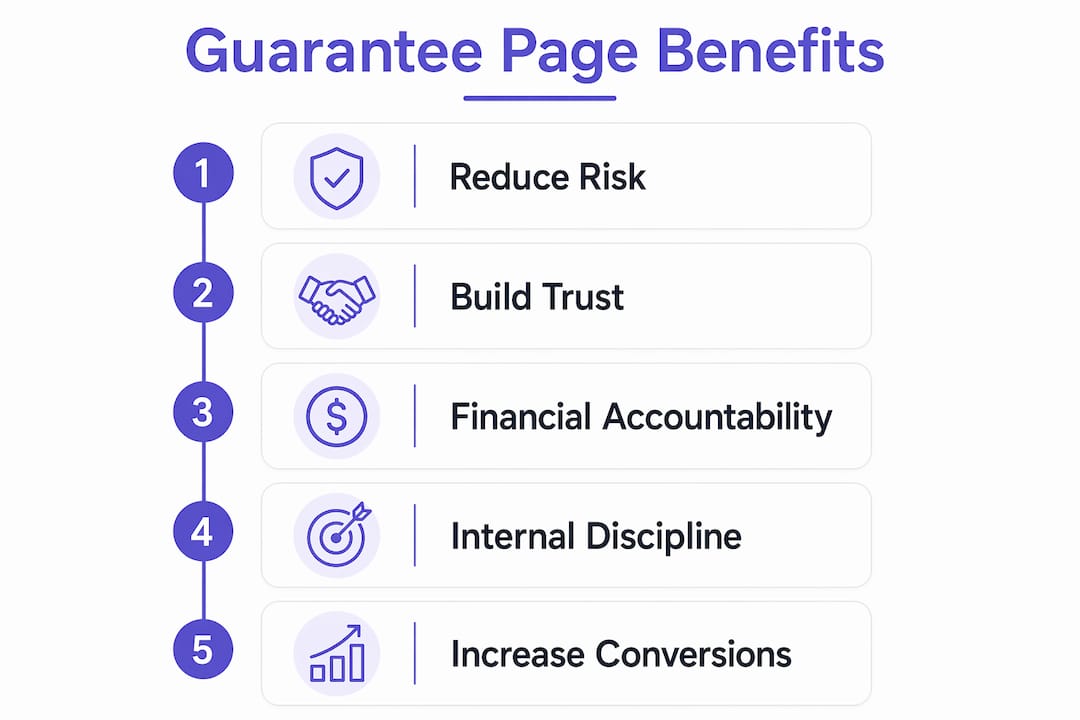
Service guarantees assign a tangible financial cost to every service failure. When a missed deadline or a poor outcome triggers a refund, management cannot ignore the root cause. That financial pressure motivates teams to fix recurring problems rather than absorb complaints quietly. The guarantee becomes an internal quality control mechanism, not just a marketing badge.
The customer-facing benefits are equally concrete:
- Lower purchase hesitation. Customers who see a clear guarantee feel less risk in saying yes. This is especially powerful for first-time buyers who have no prior experience with your business.
- Competitive differentiation. Most service businesses do not publish a formal guarantee. Displaying one prominently sets you apart in competitive markets where buyers are comparing multiple providers.
- Structured customer feedback. Guarantees encourage and reward customer complaints, giving you systematic data on where your service actually breaks down. That feedback is more reliable than surveys because it is tied to real dissatisfaction.
- Higher conversion rates. A guarantee page works as a trust signal at the decision stage of the buying process, where visitors are closest to taking action.
“Companies are forced to compensate customers when service quality fails, which drives internal improvements.” — University of St. Thomas research on service quality
The internal discipline effect is the most underestimated benefit. Businesses that treat their guarantee page as a living operational commitment, rather than a static marketing page, consistently uncover root causes of recurring service issues they had previously overlooked.
How do you design an effective service guarantee page?
Effective guarantee pages follow six principles identified across service quality research. Apply all six, and your page builds trust. Skip one, and the whole promise loses credibility.
-
Make it unconditional. The strongest guarantees carry no exceptions. Every condition you add is a reason for a customer to doubt you. If you cannot offer a fully unconditional guarantee, keep conditions to an absolute minimum and state them plainly.
-
Use clear, simple language. Excessive small print harms trust and reduces the perceived value of the guarantee. Write one or two sentences that state the promise, then one sentence that states the remedy.
-
Make it relevant. Your guarantee must address what customers actually care about, not what is easiest for you to promise. A cleaning company’s customers care about thoroughness and reliability. A web design agency’s customers care about results and timelines. Match the guarantee to the real concern.
-
Make it credible. Only promise what you can consistently deliver. An over-the-top guarantee that you cannot honor destroys trust faster than having no guarantee at all. Align your commitment with your actual operational capabilities.
-
Make it easy to invoke. Any complexity in claiming a guarantee erodes customer confidence immediately. No approval chains, no lengthy forms, no waiting periods. A customer should be able to trigger the remedy with a single message.
-
Market it prominently. Guarantees that are prominently marketed accelerate customer trust and business growth. Place your guarantee in your site navigation, on your pricing page, and near every call-to-action button. Visibility is what converts the promise into a sales tool.
Pro Tip: Test your invocation process yourself before publishing. If claiming your guarantee takes more than two steps, simplify it. Customers who hit friction will not complain. They will leave.
Avoid the common mistake of hiding your guarantee in a footer link or burying it inside your terms of service. A guarantee page that customers cannot find delivers zero marketing value. Treat it as a core website page, not an afterthought.
Service guarantee examples and how to put them into practice
Four guarantee types cover most service business scenarios. Choosing the right one depends on your service model and what your customers value most.
| Guarantee type | What it covers | Example remedy |
|---|---|---|
| Single-attribute | One specific performance metric | Refund if response time exceeds 4 hours |
| Multi-attribute | Several defined service standards | Credit if any of three listed standards are missed |
| Full satisfaction | All aspects of the service, no exceptions | Full refund, no questions asked |
| Combined | Mix of specific metrics and full satisfaction | Partial credit for metric failures, full refund for total dissatisfaction |
Full satisfaction guarantees cover all aspects with no exceptions and are the simplest for customers to understand. They are also the most powerful trust signal because they remove every possible objection. The trade-off is that they require strong operational confidence.
When building your guarantee page, avoid these common pitfalls:
- Vague language. “We guarantee your satisfaction” without defining what satisfaction means or how to claim it is not a guarantee. It is a slogan.
- Hidden conditions. Conditions buried in footnotes or linked documents destroy credibility. If a condition exists, state it on the guarantee page itself.
- Misaligned promises. Guaranteeing same-day delivery when your operations cannot support it creates claims you cannot honor. Start with a guarantee you can fulfill 95% of the time, then raise the bar as your operations improve.
- No clear next step. Every guarantee page needs a direct path to invocation. Link to a contact form, list a phone number, or include a one-click email button.
A well-structured guarantee page also supports your service pages for SEO, because it adds unique, trust-relevant content that search engines and visitors both reward.
Key Takeaways
A service guarantee page is the single most direct way to reduce purchase hesitation and create internal accountability for service quality at the same time.
| Point | Details |
|---|---|
| Define the promise clearly | Name the specific commitment, standard, and remedy on one page with no legalese. |
| Make invocation effortless | Customers must be able to claim the guarantee in one or two steps, or the trust benefit disappears. |
| Use it as an internal tool | Guarantees assign financial costs to failures, forcing teams to fix root causes rather than ignore them. |
| Match the guarantee to customer priorities | Promises must address what customers actually value, not what is easiest for you to offer. |
| Market it prominently | Place the guarantee near every call-to-action and in your main navigation to maximize its conversion impact. |
The internal power of guarantees most businesses ignore
Most business owners treat a guarantee page as a marketing checkbox. They write a vague promise, tuck it into a footer, and move on. That approach captures none of the real value.
What I have seen consistently is that the businesses getting the most from their guarantee pages are the ones using them as operational scorecards. When a guarantee triggers a refund, that is not just a cost. It is a signal. It tells you exactly where your service broke down, which customer segment was affected, and how often the failure is happening. That data is worth more than any customer survey you could run.
The other thing most businesses underestimate is how much the invocation process matters. A guarantee that requires a customer to fill out a three-page form, wait for manager approval, and follow up twice is not a guarantee. It is a deterrent. I have seen businesses with genuinely strong service commitments lose customer trust entirely because claiming the guarantee was harder than just walking away.
My recommendation for small business owners and marketers: start with a single-attribute guarantee tied to your most important service metric. Make it unconditional, make it easy to claim, and put it somewhere visible. Then track every claim for 90 days. You will learn more about your operational gaps in those 90 days than you would from a year of internal reviews.
— Max
How Cosmicdigitalstudios builds guarantee pages that convert
A guarantee page only works if it is designed to be seen, read, and trusted. Cosmicdigitalstudios builds custom websites that integrate trust-building pages like service guarantees directly into the conversion flow, not as afterthoughts buried in footers.
Every site Cosmicdigitalstudios delivers is built around clear messaging, strong trust signals, and a logical path from visitor to booked client. If your current website does not have a guarantee page, or if the one you have is not doing any conversion work, that is a fixable problem. Visit Cosmicdigitalstudios to see how a professionally designed guarantee page fits into a website that actually generates leads.
FAQ
What is the difference between a service guarantee and a warranty?
A warranty covers product defects, while a service guarantee promises specific operational outcomes such as response times or completion deadlines. Service guarantees focus on performance metrics that differentiate service firms in competitive markets.
What should a guarantee page include?
A guarantee page must include a specific commitment, a measurable performance standard, a named remedy, and a simple invocation process. Clear language free of legal jargon is non-negotiable.
How does a service guarantee page increase conversions?
A guarantee page reduces the perceived risk of buying by giving customers a clear safety net. Visitors who see a credible, easy-to-claim guarantee are more likely to take action because the downside of a bad experience is removed.
Should a guarantee be unconditional?
Unconditional guarantees are the most powerful because they remove every customer objection. If your operations cannot support a fully unconditional promise, keep conditions minimal and state them plainly on the guarantee page itself.
How do I make my guarantee easy to claim?
Limit the claim process to one or two steps: a single email, a phone number, or a one-click form. Any complexity in claiming erodes the trust your guarantee was designed to build.