
Above-the-fold content is defined as the portion of a webpage visible immediately when a visitor lands, before any scrolling occurs. For local business sites, this zone is the single most important real estate on the page. It shapes first impressions, drives conversion decisions, and directly affects whether a visitor stays or leaves. Understanding what is above fold on a local site means understanding the industry term “above the fold,” borrowed from print newspapers, where the top half of a folded paper carried the most critical headlines. In web design, the fold line is not fixed. It shifts based on screen size, device, and browser, making intentional local site design more critical than ever.
What elements should appear above the fold on a local site?
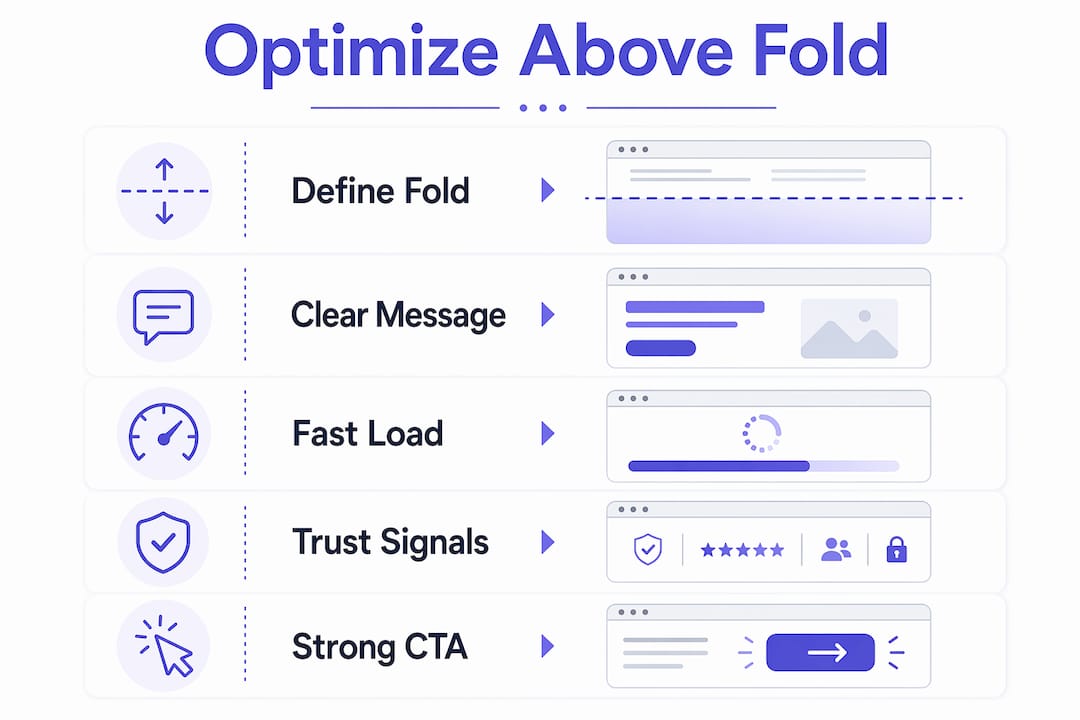
The above-the-fold area of a local business website must answer one question immediately: “Am I in the right place?” Every element in that zone should serve that answer. Core components include a clear value proposition, a supporting subheadline, a primary call-to-action, and a hero visual that confirms local relevance.
Value proposition and subheadline
Your value proposition is the headline. It tells visitors exactly what you do and who you serve. A plumber in Austin should not have a headline that reads “Quality Service You Can Trust.” It should read “Licensed Plumbing Repairs in Austin, TX — Same-Day Service.” The subheadline adds one layer of context, such as the number of years in business or a specific service guarantee. Together, they give the visitor a reason to stay within three seconds.
Primary call-to-action
The primary CTA belongs above the fold, not buried below three paragraphs of copy. For local service businesses, the most effective CTAs are direct: “Call Now,” “Get a Free Quote,” or “Book an Appointment.” One CTA is enough. Two competing buttons split attention and reduce clicks on both.
Hero visual and trust signals
The hero image or video should confirm location and business type at a glance. A photo of your actual team, your storefront, or a completed local job outperforms any generic stock image. Trust signals, such as Google review ratings, local awards, or license badges, belong in this zone too. Location-specific messaging, including your city name, address, and phone number, increases local relevancy and helps visitors confirm they found the right business.

Pro Tip: Limit your above-the-fold area to five or fewer distinct visual focal points. More than five elements reduce clarity and measurably drop engagement metrics.
How to optimize above-the-fold technical performance for local sites
Design alone does not determine whether your above-the-fold content works. Technical performance is inseparable from design. A beautiful hero section that takes four seconds to load loses visitors before they ever see it.
Google’s Core Web Vitals set the standard here. Two metrics matter most for the fold area:
-
Largest Contentful Paint (LCP): This measures how long it takes for the largest visible element, usually your hero image or headline, to render. The target is under 2.5 seconds. An LCP above 4 seconds signals a poor experience and hurts local SEO rankings.
-
Cumulative Layout Shift (CLS): This measures how much the page layout jumps around as it loads. A CLS score below 0.1 is the target. Layout shifts above the fold are especially damaging because they cause visitors to misclick or lose their place before they even read your headline.
-
Optimize images: Compress hero images using modern formats like WebP. A 2MB hero image is one of the most common causes of slow LCP scores on local business sites.
-
Inline critical CSS: Load only the styles needed to render the above-the-fold content first. Push non-critical styles to load after. This technique alone can reduce perceived load time significantly.
-
Minimize render-blocking resources: JavaScript files that load before the page renders delay everything. Defer non-essential scripts so the fold area appears fast.
-
Design mobile-first: The fold line sits roughly between 600px and 900px depending on device and screen resolution. Viewport height varies across devices, so your most critical content must be visible across that entire range, not just on a desktop monitor.
Fast-loading local websites consistently produce better organic rankings and stronger user retention in local markets. Speed is not a bonus feature. It is a baseline requirement.
Pro Tip: Use heatmap tools like Hotjar and Google Analytics scroll reports to identify exactly where visitors stop engaging. Behavioral analytics reveal whether your CTA is being seen and clicked or ignored entirely.
How does above-the-fold content influence user behavior and local engagement?
User behavior around the fold has changed significantly. Above-the-fold content used to capture about 80% of user attention in 2010. By 2025, that figure had dropped to roughly 40% as instinctive scrolling became the norm. That shift does not make the fold irrelevant. It changes what the fold must accomplish.
The goal is no longer just to capture attention. The goal is to give visitors a compelling enough reason to keep scrolling. Think of the above-the-fold zone as a hook, not a complete story. Here is what that means in practice for local sites:
-
Clarity over completeness. Your above-the-fold content does not need to explain everything. It needs to confirm relevance and create curiosity. A local HVAC company does not need to list every service above the fold. It needs to say “Fast AC Repair in Phoenix” and show a clear CTA.
-
Scroll cues work. A subtle downward arrow, a partially visible section, or a short animated element signals to visitors that more content exists below. Modern above-the-fold design must actively encourage scrolling rather than assuming visitors will do it automatically.
-
Bounce rate is your feedback loop. A high bounce rate on a local landing page almost always points to a mismatch between what the visitor expected and what they saw above the fold. Check your bounce rate by traffic source. Visitors from local Google searches have specific intent. Your fold content must match it precisely.
-
CTA placement affects click rate. A CTA button placed above the fold consistently outperforms one placed only in the footer or mid-page. For local service businesses, where the conversion goal is a phone call or form submission, this placement difference is measurable in booked jobs.
You can review the local service website checklist to confirm your fold content aligns with each stage of the visitor’s decision process.
Common mistakes to avoid in above-the-fold design for local businesses
Most local business websites fail at the fold for predictable reasons. Knowing these mistakes lets you avoid them before they cost you leads.
-
Too many focal points. When everything competes for attention, nothing wins. A fold area with a slider, a pop-up, a video, a headline, and three CTAs creates visual noise. Visitors freeze, then leave.
-
Ignoring mobile viewport differences. A design that looks perfect on a 1440px desktop monitor may push your CTA completely below the fold on a 375px mobile screen. Test your fold content on actual mobile devices, not just browser emulators. The fold range of 600px–900px means your critical content must sit well within that window.
-
Slow loading or layout shifts. If your hero image loads late and pushes your headline down, visitors experience a jarring layout shift. That single technical failure can undo an otherwise strong design.
-
Generic or irrelevant imagery. Stock photos of smiling strangers in hard hats do not build trust for a local contractor. Real photos of your team, your work, and your location convert better every time.
-
Weak or missing CTAs. A local business site without a clear CTA above the fold is leaving conversions on the table. Visitors should never have to hunt for how to contact you. Common contractor website design mistakes almost always include a buried or absent CTA.
Key Takeaways
Above-the-fold content on a local site is the most conversion-critical zone on the page, requiring clear messaging, fast load times, and a single focused CTA to retain visitors and drive action.
| Point | Details |
|---|---|
| Define your fold zone | The fold line falls between 600px and 900px; design critical content to be visible across that full range. |
| Lead with local relevance | Include your city, service type, and CTA above the fold to match local search intent immediately. |
| Hit Core Web Vitals targets | Target LCP under 2.5 seconds and CLS below 0.1 to protect both user experience and local SEO rankings. |
| Limit visual focal points | Keep above-the-fold elements to five or fewer to maintain clarity and protect conversion rates. |
| Use analytics to improve | Heatmaps and bounce rate data reveal whether your fold content is engaging visitors or losing them. |
Above-the-fold content in 2026: what I’ve learned from local site builds
The debate about whether the fold still matters misses the real question. The fold has always mattered. What changed is why it matters.
When I work on local business sites, the fold is where I spend the most time. Not because visitors stop there, but because it sets the tone for everything below. A weak headline above the fold does not just lose the visitor at the top. It poisons the credibility of everything they might scroll to see. Visitors make a judgment call in under three seconds, and that judgment is almost entirely based on what they see first.
What I have found is that local sites fail at the fold for one of two reasons. Either the design is too cluttered, trying to say everything at once, or it is too vague, using generic language that could apply to any business in any city. Neither builds trust. Both kill conversions.
The technical side is equally underestimated. I have seen beautifully designed fold sections that load in 5 seconds on mobile. The design team was proud of the visuals. The business owner was losing half their mobile visitors before the page finished rendering. Speed is not a developer concern. It is a revenue concern.
The shift in scrolling behavior is real, but it does not mean the fold is less important. It means the fold now has to work harder. Your above-the-fold content needs to hook the visitor and signal that something worth scrolling for exists below. That is a higher bar than it used to be, and most local business sites are not clearing it.
— Max
How Cosmicdigitalstudios builds above-the-fold content that converts
If your local site is losing visitors before they scroll, the fold is almost certainly the problem.
Cosmicdigitalstudios builds fast, conversion-focused websites for local businesses that need to turn visitors into booked calls and leads. Every build starts with the fold: clear local messaging, a single strong CTA, and a technical foundation that hits Core Web Vitals targets. The result is a site that loads fast, ranks well in local search, and gives visitors an immediate reason to stay. If you want to see what a properly built local site looks like, explore what a redesign involves and how it applies to your business.
FAQ
What is above the fold in web design?
Above the fold refers to the portion of a webpage visible without scrolling. The term comes from print newspapers, where the most important content appeared on the top half of a folded front page.
What is the fold line for local sites?
The fold line is not a fixed pixel value. It falls roughly between 600px and 900px depending on the visitor’s device and screen resolution, which is why mobile-first design is required for local sites.
Why does above-the-fold content matter for local SEO?
Above-the-fold content affects both user engagement and Core Web Vitals scores, which Google uses as ranking signals. A fast-loading, locally relevant fold section improves both rankings and conversion rates.
How many elements should appear above the fold?
Limit above-the-fold content to five or fewer distinct visual focal points. More than five elements reduce clarity and lower engagement metrics on local business sites.
What is the best CTA to place above the fold for a local business?
Direct, action-specific CTAs perform best. Options like “Call Now,” “Get a Free Quote,” or “Book an Appointment” match the high-intent behavior of local search visitors and drive more conversions than generic buttons.