For most professional coaches, the right choice is a conversion-first lead-generation website with integrated booking. It does one job well: turn visitors into booked discovery calls. Before you brief a designer or request a proposal, here are the four site types worth knowing:
- Lead-generation / discovery-call site — the default for coaches selling high-ticket 1:1 or group programs
- Program / productized coaching site — built around a specific offer with a buy-now or apply-now flow
- Membership / client portal site — for coaches with recurring revenue and a gated content library
- Content-first authority site — for coaches building organic traffic and positioning before monetizing
The recommended next step: brief a specialist studio. Cosmicdigitalstudios builds custom coaching websites and conversion funnels designed specifically to book calls and close clients.
Table of Contents
- What are the main types of coaching websites?
- What are the six core pages every coaching site needs?
- Website vs. platform: how do you connect the two?
- How do you choose the right site type and brief a designer?
- What messaging actually books calls on a coaching website?
- Ready-to-use templates: headlines, CTAs, and wireframes by site type
- Key Takeaways
- What most coaches get wrong about their website
- Cosmicdigitalstudios builds coaching websites that actually book calls
- Further reading and references
What are the main types of coaching websites?
The main types of coaching websites align to typical coaching business models, each with a unique set of CTAs, revenue strategies, and required pages. The six core types are: Lead-generation/discovery-call sites, program/productized coaching sites, membership/client portal sites, platform-integrated delivery sites, content-first authority sites, and event/course sales sites. Each type is optimized for a distinct visitor journey and booking or purchase flow. Every type leverages a tailored CTA and ensures essential pages are included to fulfill that model’s specific conversion goals.

Pro Tip: Template builders are fast for early-stage offer validation. Once you’re generating consistent revenue and want SEO control or custom integrations, a studio-built site pays for itself quickly.
What are the six core pages every coaching site needs?
A coaching website that converts functions as a client acquisition system, and each page has exactly one job.
-
Home. Qualify the visitor in under five seconds. Lead with a clear outcome statement, one line of social proof, and a single primary CTA (book a call or apply). No competing links above the fold.
-
About. Build trust and connection. Share your story and credentials, but frame everything around the client’s outcome. Include a photo, one strong testimonial, and a CTA to your services page.
-
Services / Programs. Convert interest into intent. Describe the offer clearly: who it’s for, what they get, what changes. One CTA per offer. Application forms work better than generic contact forms for high-ticket programs.
-
Booking / Contact. Remove friction from the final step. Embed a scheduling tool directly on the page. Confirm what happens after they book. A thank-you page with next steps reduces no-shows.
-
Blog / Resources. Build authority and organic traffic. Even a small library of targeted posts signals expertise to both visitors and search engines. Link internally to your services page from every post.
-
Privacy / Legal or Thank-You. Required for compliance and post-conversion sequencing. Use the thank-you page to introduce the next step in your onboarding flow.
A practical six-page blueprint assigns one conversion job to each page so nothing overlaps and nothing is missed.
Website vs. platform: how do you connect the two?
Your website is your public marketing asset. Your coaching platform is your operational back-end. They serve different purposes, and integrating them removes the friction that kills conversions between “interested visitor” and “paying client.”
| Layer | Function | Common tools (U.S. market) |
|---|---|---|
| Website / CMS | Public marketing, SEO, lead capture | WordPress, Webflow, Squarespace |
| Booking | Scheduling discovery calls and sessions | Calendly, Acuity Scheduling |
| Payment | Collecting deposits and program fees | Stripe, PayPal |
| CRM / Email | Lead nurturing and onboarding sequences | ActiveCampaign, ConvertKit |
| Client portal | Session notes, resources, accountability | Coaching platforms with native portals |
Pro Tip: Map the full client journey before you build: ad or search result → hero CTA → booking page → confirmation email → first session. Every gap in that sequence is a drop-off point. Fix the gaps in the design brief, not after launch.
How do you choose the right site type and brief a designer?
Start with these five criteria before you write a single brief:
- Client value per sale. High-ticket offers ($3,000+) justify a custom-built site with a full funnel. Lower-priced offers can start with a template.
- Volume vs. selectivity. High-volume programs need e-commerce and automation. Selective 1:1 coaching needs an application flow.
- SEO ambitions. Serious organic growth requires WordPress or a self-hosted CMS with strong SEO controls. Template builders are fine for paid traffic.
- Integration needs. If you need booking, payment, CRM, and a client portal connected, plan for a custom build.
- Timeline and budget. A template launch takes 1–2 weeks and costs $500–$2,000. A custom site with funnels and integrations typically runs $3,000–$10,000+ and takes 4–8 weeks.
When you brief a studio, ask these questions:
- What deliverables are included, and what is out of scope?
- Who owns the domain, hosting, and code after launch?
- How are booking and payment integrations handled?
- What analytics and tracking are set up at launch?
- What does post-launch support cover, and for how long?
Red flags to watch for: no mention of analytics or conversion tracking, a vague “great design” pitch with no funnel strategy, and proposals that skip integration details entirely. If a studio can’t explain how a visitor becomes a booked client, that’s a problem. See the full list of common coaching website failures before you sign anything.
What messaging actually books calls on a coaching website?
The most effective coaching pages lead with problem-agitation-transformation copy, not credentials. Top-performing sites use “from X to Y” value props and specific outcome statements in the hero. Credentials belong below the fold.
Headline templates by site type:
- Lead-gen: “Stop [pain point]. Book a free call and get a clear plan to [specific outcome].”
- Program: “In [timeframe], go from [current state] to [desired result] — without [common objection].”
- Membership: “Get [specific resource or support] every month, on demand.”
- Authority / content: “The [niche] coach helping [audience] achieve [outcome] — free resources inside.”
Hero wireframe checklist (above the fold):
- Value prop headline (outcome-focused, 8–12 words)
- One-line supporting statement (who it’s for)
- Social proof signal (number of clients, a short quote, a credential badge)
- Single primary CTA button (“Book a Free Call,” “Apply Now”)
A single primary CTA per page consistently outperforms pages with multiple competing links. For tracking, set up GA4 goal events on every CTA click and form submission from day one. Add a heatmap tool to identify where visitors drop off, and run an A/B test on your hero headline within the first 30 days of launch. For deeper guidance on conversion copywriting, the principles apply directly to coaching hero sections.
Ready-to-use templates: headlines, CTAs, and wireframes by site type
These are brief-ready. Drop them directly into a design brief or a landing page draft.
Lead-generation site
- Headline: “I help [audience] achieve [outcome] in [timeframe] — book a free strategy call.”
- CTA: “Book My Free Call” (above the fold and repeated after testimonials)
- Hero elements: headshot, 2–3 client results, booking embed
Program / productized site
- Headline: “The [program name]: [specific transformation] for [audience] in [timeframe].”
- CTA: “Apply for the Program” or “Join the Next Cohort”
- Hero elements: program outcome, cohort dates, short video or testimonial block
Membership site
- Headline: “Everything you need to [goal] — in one place, every month.”
- CTA: “Start Your Membership” or “Join the Community”
- Hero elements: content library preview, member count, monthly price
Authority / content site
- Headline: “[Niche] insights for [audience] who want [outcome].”
- CTA: “Get the Free Guide” or “Subscribe”
- Hero elements: featured post, opt-in offer, brief bio with credibility line
For real-world examples of these patterns in action, the high-converting coach website examples on the Cosmicdigitalstudios site show how each type performs with actual design and copy.
Key Takeaways
The single most important decision for your coaching website is matching the site type to your revenue model before you brief a designer.
| Point | Details |
|---|---|
| Match site type to revenue model | Lead-gen sites suit high-ticket 1:1 offers; program sites suit defined group offers with a fixed CTA. |
| Six core pages cover every job | Home, About, Services/Programs, Booking/Contact, Blog/Resources, and Privacy/Legal or Thank-You each have one conversion role in a well-structured client acquisition system. |
| Integrate website and platform | Connect booking, payment, CRM, and email automation before launch to eliminate drop-off gaps. |
| One CTA per page wins | Single primary CTAs consistently outperform pages with competing links or multiple offers. |
| Cosmicdigitalstudios builds the full stack | Custom sites, landing pages, funnels, and integrations built for coaches who want booked calls, not just a pretty page. |
What most coaches get wrong about their website
The conventional wisdom says “just get something live.” That advice costs coaches real money. A site that looks professional but has no clear CTA, no booking integration, and no tracking isn’t a marketing asset. It’s a digital business card nobody reads.
What actually works is treating the website as the first step in a client acquisition sequence, not a destination. The hero section either qualifies a visitor or loses them. Most coaches bury their offer below a long bio and a stock photo. The coaches whose sites consistently book calls lead with the client’s problem and the specific outcome they deliver, then make it trivially easy to take the next step.
Design choices also signal price. Visual patterns like dark palettes and premium typography tell a visitor what to expect before they read a word. A $10,000 coaching program presented on a $29 template sends a conflicting message. The design has to match the price point.
The other underestimated factor: the gap between the website and the platform. Coaches often build a great front-end and then send visitors to a clunky booking page on a different domain with different branding. That gap kills trust at the exact moment a visitor is ready to act. Closing it is a design decision, not a technical afterthought.
Cosmicdigitalstudios builds coaching websites that actually book calls
Most coaching websites look fine and convert poorly. The gap is almost always messaging, CTA placement, or a broken handoff between the site and the booking flow. Cosmicdigitalstudios fixes all three in a single project.
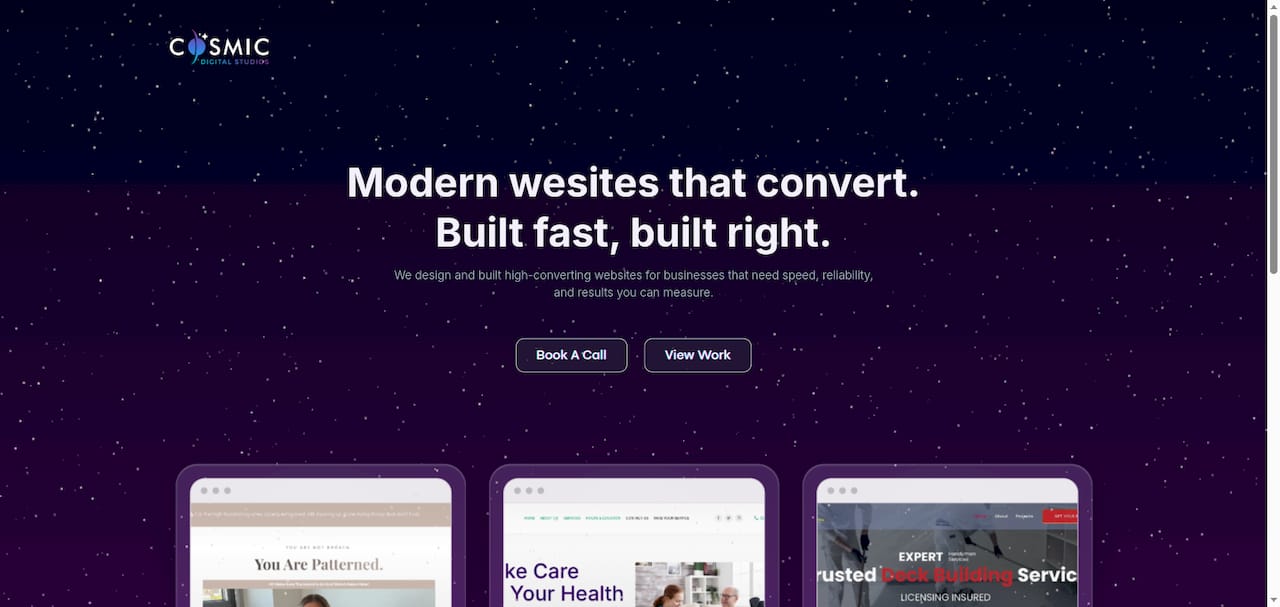
Every build includes a custom-designed site or landing page, a conversion-optimized hero, booking and payment integration, GA4 tracking setup, and a post-launch A/B testing plan. For coaches who need a full funnel, the studio adds email automation, lead capture sequences, and advertising campaign setup. The result is a site that moves visitors from first impression to booked call without manual follow-up.
Ready to build a site that works? Get your coaching website built by a studio that specializes in exactly this, or visit Cosmicdigitalstudios to start a project conversation today.
Further reading and references
- Build a coaching website that converts: step-by-step guide — Cosmicdigitalstudios’s full implementation guide covering every build phase from strategy to launch.
- High-converting coach websites: 8 real examples — Visual case examples showing how different site types perform with real design and copy.
- What is a lead generation website? A 2026 guide — Explains lead-gen architecture and the KPIs to set before you build.
- How to build a coaching website that converts — Practical breakdown of the six-page client acquisition system with CTA guidance.
- 72 best coaching websites — A large examples gallery showing headline patterns, hero treatments, and UX decisions across coaching niches.
- DIY SEO for business owners — A practical SEO roadmap for coaches who plan to build organic traffic alongside their website launch.
Recommended
- High-Converting Coach Websites: 8 Real Examples – cosmicdigitalstudios.com
- Why Your Coaching Website Fails to Book Clients – cosmicdigitalstudios.com
- Benefits of Professional Web Design Coaches for Growth – cosmicdigitalstudios.com
- Build a coaching website that converts: step-by-step guide – cosmicdigitalstudios.com