The best all-in-one platforms for coaches right now are Simply.Coach, CoachAccountable, Paperbell, Upcoach, and Satori — and if you’re a solo coach just getting started, Simply.Coach is the one to trial first.
TL;DR shortlist:
- Simply.Coach — Best overall for solo and small-team coaches who want a full lifecycle platform with AI session notes
- CoachAccountable — Best for deep accountability tracking and progress reporting
- Paperbell — Best for coaches who want a clean client purchase experience with minimal setup
- Upcoach — Best for group programs, cohort coaching, and community-driven delivery
- Satori — Best for operations-focused coaches who need ICF coaching log exports
- TrueCoach — Best for fitness and personal training coaches
- CoachVantage — Best for solo coaches who want a lightweight, affordable operations hub
- Kajabi — Best for coaches who sell courses and digital products alongside 1:1 work
- Bonsai — Best for coaches who need freelancer-grade contracts, invoicing, and proposals
- Delenta — Best for coaches who want a marketplace presence plus delivery tools
- Coaching.com — Best for enterprise and organizational coaching programs
- CoachHub — Best for enterprise L&D buyers deploying coaching at scale
- LifeCoachHub — Best for new coaches who need a free starting point with marketplace visibility
- Quenza — Best for coaches who build structured, activity-based client pathways
Who should trial Simply.Coach first: Solo coaches and small practices that want scheduling, contracts, invoicing, goal tracking, and AI-assisted session notes in one place without paying enterprise prices. The Starter plan has a low entry price, which makes it the lowest-risk entry point on this list.
Table of Contents
- How the top all-in-one coaching platforms compare at a glance
- Detailed reviews of the best all-in-one coaching platforms
- How to choose the right coaching management system for your business
- How we evaluated these platforms
- Which platform fits your coaching business model?
- Key Takeaways
- Why your coaching platform and your website need to work together
- Your coaching platform works harder with a purpose-built landing page
- Sources and references
How the top all-in-one coaching platforms compare at a glance
The table below covers the dimensions that actually affect your choice: pricing, free trial availability, core features, group coaching support, key integrations, AI features, setup time, scalability, and ICF credentialing support.
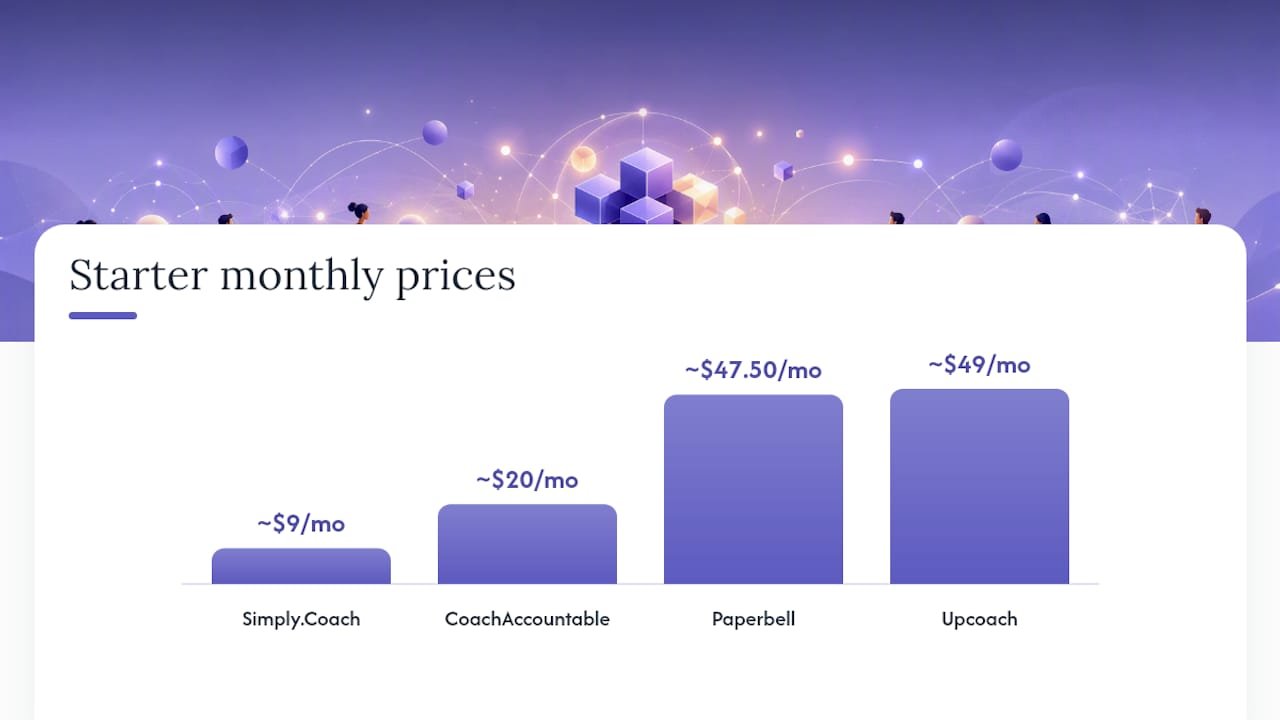
| Platform | Best For | Starter Price | Free Trial | Core Features | Group Coaching | Key Integrations | AI Features | Setup Time | Scalability | ICF Support |
|---|---|---|---|---|---|---|---|---|---|---|
| Simply.Coach | Solo/small team, full lifecycle | ~$9/mo | Yes (14-day) | Scheduling, notes, goals, contracts, invoicing, client portal | Yes | Zoom, Google/Outlook Calendar, Stripe, Zapier | AI session notes | 3–5 hrs | Up to team plans | Partial |
| CoachAccountable | Accountability & progress tracking | ~$20/mo | 30-day free trial | Progress tracking, worksheets, journaling, scheduling, invoicing | Yes (cohorts) | Zoom, Google Calendar, Stripe, Zapier | Limited | 4–6 hrs | Unlimited clients | Partial |
| Paperbell | Clean client purchase flow | ~$47.50/mo | 1 free client | Scheduling, contracts, payments, client portal, packages | Limited | Zoom, Google Calendar, Stripe | None | Under 1 hr | Unlimited clients | No |
| Upcoach | Group programs & community | ~$49/mo | 14-day free trial | Program builder, habit trackers, forum, client portal, scheduling | Strong | Zoom, Google Calendar, Stripe, Zapier | Limited | 3–5 hrs | Team/Business+ | No |
| Satori | ICF logs & operations | Not publicly listed | Yes | Scheduling, invoicing, onboarding, coaching logs | Limited | Zoom, Google Calendar, Stripe | None | 2–4 hrs | Up to 150 clients (Leader plan) | Yes (ICF log export) |
| TrueCoach | Fitness & personal training | ~$19/mo | 14-day free trial | Program builder, messaging, progress photos, nutrition tracking | Limited | MyFitnessPal, Zoom, Stripe | Limited | 1–2 hrs | Scales by client count | No |
| CoachVantage | Lightweight solo operations | ~$26/mo | 14-day free trial | Scheduling, contracts, invoicing, session notes, client portal | Limited | Zoom, Google Calendar, Stripe, Zapier | None | 1–2 hrs | Solo-focused | No |
| Kajabi | Courses + coaching combo | ~$69/mo | 14-day free trial | Course builder, landing pages, email marketing, community, payments | Yes (communities) | Zoom, Stripe, Zapier | Limited | 5–8 hrs | High (enterprise-ready) | No |
| Bonsai | Contracts, invoicing & proposals | ~$21/mo | 7-day free trial | Contracts, proposals, invoicing, time tracking, client portal | No | Zapier, Stripe, PayPal | None | 1–2 hrs | Freelancer-focused | No |
| Delenta | Marketplace + delivery | Not publicly listed | Yes | Marketplace listing, scheduling, invoicing, client portal | Yes | Zoom, Stripe, Zapier | None | 2–4 hrs | Small-to-mid teams | No |
| Coaching.com | Enterprise org programs | Custom pricing | Demo only | Program management, reporting, multi-coach admin, analytics | Yes | Zoom, enterprise SSO, Zapier | Yes | 8+ hrs | Enterprise | Yes |
| CoachHub | Enterprise L&D at scale | Custom pricing | Demo only | AI coach matching (AIMY™), analytics, enterprise reporting | Yes | Enterprise SSO, Zoom | Yes (AIMY™) | 8+ hrs | Enterprise | Yes |
| LifeCoachHub | New coaches, marketplace entry | Free (1 client) | Free tier | Marketplace listing, scheduling, basic client tools | Limited | Limited | None | Under 1 hr | No | |
| Quenza | Structured activity pathways | ~$25/mo | 1-month trial ($1) | Activity builder, pathway tools, client portal, forms | Yes | Zapier, limited native | None | 3–5 hrs | Solo-to-small team | No |
Pricing reflects publicly available 2026 starter-plan rates. Enterprise plans are custom-quoted. Always verify current pricing directly with each vendor before purchasing.
Detailed reviews of the best all-in-one coaching platforms
The coaching software market in 2026 is defined by a clear split: platforms that specialize in one lane (client purchase flow, accountability, or full lifecycle operations) versus those that try to cover everything. Knowing which lane a platform occupies saves you from paying for features you’ll never use or, worse, discovering a critical gap after you’ve onboarded 30 clients.
1. Simply.Coach
Simply.Coach is the closest thing to a true full-lifecycle platform at an accessible price point. It covers scheduling, session notes, goal tracking, contracts, invoicing, intake forms, and client portals in a single interface. The standout feature in 2026 is AI-assisted session notes, which automatically summarize sessions and flag action items, saving coaches meaningful prep time between calls.
Pricing runs at entry-level, mid-tier, and top-tier plans priced affordably as of early 2026. Setup typically requires a few hours to configure workflows and client portals properly.
Pros: Full lifecycle coverage, genuine AI features, affordable entry price, Zoom and calendar integrations, clean client portal.
Cons: ICF credentialing support is partial, and the mobile app is functional but not as polished as the desktop experience.
Best for: Solo coaches and small practices who want one platform to handle everything from intake to invoicing.
2. CoachAccountable
CoachAccountable has been the go-to for coaches who take progress tracking seriously, and a 2026 UI refresh made the interface noticeably more modern without sacrificing its depth. The platform’s accountability tools, including worksheets, journaling prompts, metric tracking, and automated check-ins, are more developed than anything else on this list.
Starter plans begin at a low monthly cost, and the free trial period is one of the most generous on the market. Group coaching is supported through cohort management, and Zapier integration opens up a wide automation surface.
Pros: Unmatched accountability and progress-tracking depth, 30-day trial, strong customer service reputation, cohort support.
Cons: The interface, even after the refresh, has a learning curve. Not the right fit if your priority is a slick client purchase experience.
Best for: Coaches whose value proposition centers on measurable client progress and sponsor reporting.
3. Paperbell
Paperbell is built around one idea: making it dead simple for a client to find a package, pay, sign a contract, and book a session in a single flow. That focus shows. Setup takes under an hour, and the client-facing experience is cleaner than most platforms that cost twice as much.
The trade-off is depth. Group coaching support is limited, there are no AI features, and the program-building tools are minimal. Pricing starts at a mid-range monthly cost billed annually, with the time saved on client onboarding often justifying the expense.
Pros: Fastest setup on the list, polished purchase flow, unlimited clients, Stripe and Zoom integrations.
Cons: Weak group coaching tools, no ICF log export, limited reporting.
Best for: Solo coaches who sell packages and want clients to self-serve from discovery to booking without friction.
4. Upcoach
Upcoach is purpose-built for coaches who run group programs, cohorts, or community-driven experiences. The program builder, habit trackers, and built-in forum set it apart from platforms that treat group coaching as an afterthought. Clients get a structured portal where they can track habits, complete modules, and engage with peers, all without leaving the platform.
Pricing starts at an entry-level monthly cost for Starter, with higher tiers priced accordingly, and Business+ available at custom pricing. Stripe integration handles payments natively.
Pros: Best-in-class program builder, habit tracking, community forum, strong group coaching UX.
Cons: Less suited to 1:1 coaching operations, no ICF log export, AI features are limited.
Best for: Coaches running structured group programs, online courses with live coaching, or cohort-based experiences.
5. Satori
Satori is an operations engine. It handles onboarding, scheduling, invoicing, and coaching logs with precision, and it’s one of the few platforms that includes a proper ICF coaching log export, which matters if you’re working toward ACC, PCC, or MCC credentials. Client limits are capped by plan: Essentials handles up to 10 clients, Pro up to 50, and Leader up to 150.
Those caps are the main thing to plan around. If you’re scaling past 150 active clients, Satori will require a migration. For solo and boutique practices within those limits, it’s a tight, well-designed system.
Pros: ICF log export, clean onboarding flows, solid invoicing, good scheduling tools.
Cons: Hard client caps per plan, no marketplace, limited AI features, setup requires 2–4 hours.
Best for: Credentialing-focused coaches and boutique practices that need clean operations and ICF hour tracking.
6. TrueCoach
TrueCoach is the clear winner for personal trainers and fitness coaches. The program builder is designed for workout delivery, and the native MyFitnessPal integration connects nutrition tracking directly to client progress. Progress photos, messaging, and video demonstrations are all built in.
One important 2026 update: TrueCoach introduced a platform payment fee that affects coaches processing high payment volumes. If you’re running a high-ticket fitness program with frequent billing cycles, run the math on total cost before committing.
Pros: Fitness-specific program builder, MyFitnessPal integration, progress photo tracking, clean mobile experience.
Cons: Not suited to non-fitness coaching, new payment fee impacts high-volume processors, limited group coaching.
Best for: Personal trainers and fitness coaches who need a polished delivery platform with nutrition and workout tracking.
7. CoachVantage
CoachVantage sits in the lightweight operations lane. It covers the core needs of a solo coach: scheduling, contracts, session notes, invoicing, and a client portal, without the complexity of a full enterprise system. Pricing starts around $26/month with a 14-day trial.
The platform won’t win on depth, but it’s reliable and fast to set up (typically 1–2 hours). Zoom, Google Calendar, Stripe, and Zapier integrations cover the standard workflow. Group coaching support is limited, and there are no AI features, but for a solo coach who wants clean operations without a steep learning curve, it delivers.
Pros: Fast setup, clean UI, affordable, covers core solo-coach operations.
Cons: Limited group coaching, no AI, not built to scale beyond a solo practice.
Best for: Solo coaches who want a no-fuss operations hub without paying for features they don’t need.
8. Kajabi
Kajabi is not a coaching-first platform, but it’s the strongest option for coaches who blend 1:1 work with digital products, courses, and community memberships. The course builder, email marketing, landing pages, and community tools are all production-grade. Pricing starts around $69/month.
Setup takes 5–8 hours to configure properly, and the learning curve is real. But if your business model includes selling courses or memberships alongside coaching packages, Kajabi eliminates the need for separate tools like Teachable or Mailchimp.
Pros: Best course builder on this list, email marketing included, community features, high scalability.
Cons: Expensive for pure coaching use, no ICF support, setup time is significant.
Best for: Coaches who sell courses, memberships, or digital products alongside their coaching services.
9. Bonsai
Bonsai is a freelancer-grade business management tool that coaches use for its contract, proposal, and invoicing capabilities. It’s not a coaching-specific platform, but it handles the business side of a solo practice cleanly. Stripe and PayPal integrations are solid, and the contract templates are legally reviewed.
Pricing starts around $21/month with a 7-day trial. There’s no program builder, no client accountability tools, and no group coaching support. Think of Bonsai as the back-office layer for coaches who handle delivery elsewhere.
Pros: Strong contracts and proposals, PayPal support (rare on this list), clean invoicing, time tracking.
Cons: No coaching-specific delivery features, no group tools, no ICF support.
Best for: Coaches who already have a delivery system and need a clean, professional business operations layer.
10. Delenta
Delenta combines a marketplace listing with delivery tools, which means coaches get both inbound lead exposure and a platform to run sessions, invoicing, and client portals. That dual-purpose design is useful for coaches who are still building their client base and can’t afford separate tools for discovery and delivery.
Pricing is not publicly listed; you’ll need to contact the vendor for current rates. Zoom, Stripe, and Zapier integrations are available. Group coaching is supported at a basic level.
Pros: Marketplace + operations in one product, group coaching support, Zoom and Stripe integrations.
Cons: Pricing not transparent, less feature depth than dedicated platforms, smaller marketplace than LifeCoachHub.
Best for: Coaches who want marketplace visibility and delivery tools without stitching two separate products together.
11. Coaching.com
Coaching.com is built for organizational and enterprise coaching programs, not solo practitioners. It handles multi-coach administration, program management, detailed analytics, and reporting for HR and L&D buyers. ICF credentialing support is included.
Pricing is custom-quoted, and onboarding takes 8 or more hours. If you’re a solo coach, this is not your platform. If you’re an L&D director deploying coaching across a company, it’s one of the most capable options available.
Pros: Enterprise program management, multi-coach admin, strong analytics, ICF support.
Cons: Not suited to solo coaches, custom pricing only, significant setup investment.
Best for: Enterprise buyers and organizational coaching program managers.
12. CoachHub
CoachHub leads the enterprise coaching space with AIMY™, its AI-powered coach matching and analytics system. The platform connects employees with certified coaches from a large global network and gives L&D teams detailed engagement and outcome analytics. It’s sophisticated technology, but it’s targeted squarely at enterprise L&D, not independent coaches.
Custom pricing, demo-only access, and an 8+ hour setup commitment confirm that CoachHub is an enterprise procurement decision, not a solo-coach subscription.
Pros: AIMY™ AI matching, massive certified coach network, enterprise-grade analytics.
Cons: Not accessible to solo coaches, custom pricing, no self-serve trial.
Best for: Enterprise L&D teams deploying coaching programs at scale across large organizations.
13. LifeCoachHub
LifeCoachHub is the entry point for coaches who need both a marketplace presence and basic delivery tools without paying anything upfront. The free tier supports one client, which is genuinely useful for a coach testing the platform before committing. The marketplace gives new coaches inbound visibility they’d otherwise have to build from scratch.
As your practice grows, the free tier’s limits become real constraints. But as a zero-cost starting point with marketplace exposure, it’s hard to beat for coaches in their first year.
Pros: Free tier available, marketplace visibility, low barrier to entry.
Cons: Limited features on free tier, smaller marketplace than Delenta, not built for scaling.
Best for: New coaches who need marketplace exposure and a free starting point before investing in a paid platform.
14. Quenza
Quenza is built for coaches who design structured, activity-based client pathways. The activity builder lets you create custom exercises, reflection prompts, psychometric tools, and automated sequences that clients complete between sessions. It’s closer to a digital therapeutics tool than a traditional coaching platform, which makes it uniquely powerful for coaches with a structured, evidence-based methodology.
Pricing starts around $25/month, and the first month is available for $1 as a trial. Setup takes 3–5 hours to build meaningful pathways.
Pros: Best activity and pathway builder on this list, strong for structured methodologies, affordable.
Cons: Limited native integrations, no marketplace, not suited to unstructured coaching styles.
Best for: Coaches who use structured frameworks, CBT-adjacent methods, or evidence-based activity sequences with clients.
How to choose the right coaching management system for your business
The right platform depends on three things: your coaching model, your current client volume, and where your biggest operational friction is right now.
Decision criteria to prioritize
- Group vs. 1:1 delivery — Platforms like Upcoach are built for cohorts and programs. Platforms like Paperbell are built for 1:1 packages. Using the wrong one for your model creates friction at every step.
- Payment flow and fees — Check whether the platform charges a transaction fee on top of Stripe or PayPal fees. TrueCoach’s 2026 platform payment fee is a recent example of a cost that changes the value math at scale.
- LMS and course hosting needs — If you sell courses or digital products, Kajabi is the only platform on this list with production-grade course hosting built in.
Questions to ask during a free trial
- Can I export all client data (notes, goals, session logs) if I switch platforms?
- Does the scheduling tool handle time zones automatically for international clients?
- What happens to client access if I downgrade or cancel my plan?
- Can clients pay via PayPal, or is Stripe the only option?
- How does the platform handle group session scheduling and cohort communication?
- Is there a transaction fee on payments processed through the platform?
Pricing ranges by practice size
| Practice Size | Expected Monthly Cost | Recommended Tier |
|---|---|---|
| Solo (1–10 clients) | $9–$47/mo | Simply.Coach Starter, Paperbell, CoachVantage |
| Growing (10–50 clients) | $29–$119/mo | Simply.Coach Professional, CoachAccountable, Upcoach Pro |
| Established (50–150 clients) | $49–$200+/mo | Satori Leader, Upcoach Business+, Kajabi |
| Enterprise / Org programs | Custom | Coaching.com, CoachHub |
How we evaluated these platforms
This review covers 14 platforms across the coaching software market. The evaluation draws on published vendor documentation, third-party review sources, and hands-on assessment of publicly available trials and demos. Pricing reflects the most current publicly listed rates as of 2026; always verify directly with vendors before purchasing, as rates change.
Data sources
Primary sources include 2026 coaching platform reviews, platform-specific deep dives, and buyer-facing roundups. Pricing data was cross-referenced across multiple sources. Where pricing was not publicly listed, it is noted as such.
Conflict of interest disclosure: Cosmicdigitalstudios builds websites and funnels for coaches but does not resell, white-label, or receive referral fees from any platform reviewed here. Platform recommendations are based on fit, not commercial relationships.
Last checked: Pricing, AI features, and payment fee structures were last verified in 2026. The TrueCoach payment fee and Simply.Coach AI features reflect 2026 updates specifically.
Which platform fits your coaching business model?
Coaching platforms pick lanes, and matching the platform to your business model is the single most important decision you’ll make. The wrong fit doesn’t just waste money; it creates friction that slows client delivery and makes your practice look less professional than it is.
Coach-type mapping
| Coach Profile | Primary Platform | Secondary / Complement |
|---|---|---|
| Solo 1:1 coach, just starting | Simply.Coach or LifeCoachHub | Bonsai (for contracts) |
| Solo 1:1 coach, established | Paperbell or CoachVantage | Custom landing page (see below) |
| Group program / cohort coach | Upcoach | Kajabi (if selling courses too) |
| Fitness / personal trainer | TrueCoach | Bonsai (for contracts) |
| Credentialing-focused coach | Satori | CoachAccountable (for accountability depth) |
| Marketplace-dependent coach | Delenta or LifeCoachHub | Custom website for owned traffic |
| Enterprise / org L&D buyer | Coaching.com or CoachHub | N/A (enterprise procurement) |
| Structured methodology coach | Quenza | Simply.Coach (for scheduling/invoicing) |
Combination recommendations
Some coaches need two tools: one for operations and one for marketing or discovery. A platform like Satori handles delivery cleanly but won’t generate leads. Pairing it with a lead generation website gives you owned traffic that doesn’t depend on a marketplace algorithm.
Similarly, Upcoach is excellent for program delivery but its built-in site builder won’t convert cold traffic the way a purpose-built landing page will. Coaches running paid ads or SEO campaigns need a separate, conversion-optimized page to capture and qualify leads before they hit the platform.
Pro Tip: Don’t use your platform’s built-in site builder as your primary marketing page. Platform site builders are designed for client portals, not lead conversion. A dedicated coaching landing page built for conversion will consistently outperform a platform-generated page for cold traffic.
Scaling considerations
Most solo-coach platforms cap clients or charge per-client fees. Satori’s hard cap at 150 clients (Leader plan) is the most explicit example, but CoachVantage and Paperbell also have pricing structures that increase with volume. Plan your platform choice against your 12-month client target, not just your current roster.
For coaches moving from solo to team, look for platforms that support multiple coach seats without requiring an enterprise contract. Simply.Coach and Upcoach both offer team plans at mid-tier pricing. CoachAccountable scales to unlimited clients, which removes one migration trigger as you grow.
Effective business coaching strategies consistently show that operational clarity, not just client acquisition, drives sustainable growth. Choosing a platform that grows with you avoids the costly disruption of migrating clients mid-program.
Key Takeaways
The strongest all-in-one coaching platforms in 2026 match your business model first: Simply.Coach for full lifecycle solo work, Upcoach for group programs, Satori for ICF credentialing, TrueCoach for fitness, and CoachHub or Coaching.com for enterprise L&D.
| Point | Details |
|---|---|
| Match platform to model | Solo, group, fitness, and enterprise coaches need different platforms; the wrong fit creates friction at every step. |
| ICF credentialing needs a specific tool | Only Satori and enterprise platforms (Coaching.com, CoachHub) offer reliable ICF coaching log exports. |
| Watch for hidden payment fees | TrueCoach’s 2026 platform payment fee is a live example; always calculate total cost including transaction fees before committing. |
| Platform site builders won’t convert cold traffic | A dedicated conversion-optimized landing page consistently outperforms platform-generated pages for lead capture and paid ads. |
| Cosmicdigitalstudios builds the conversion layer | For coaches pairing a platform with a custom landing page, Cosmicdigitalstudios designs and builds conversion-first coaching pages that connect directly to your chosen platform’s booking and payment flow. |
Why your coaching platform and your website need to work together
Most coaches pick a platform and assume it handles everything. It handles delivery. It does not handle discovery.
The platforms on this list are built to manage clients you already have. They are not built to convert strangers into booked calls. That’s a different job, and it requires a different tool.
Platform site builders are designed for client portals and package pages, not for converting cold traffic from Google, Instagram, or paid ads. The page structure, the copy hierarchy, the trust signals, the call-to-action placement — none of that is optimized for a visitor who doesn’t know you yet. A coaching website that converts is built around the visitor’s decision journey, not the platform’s feature set.
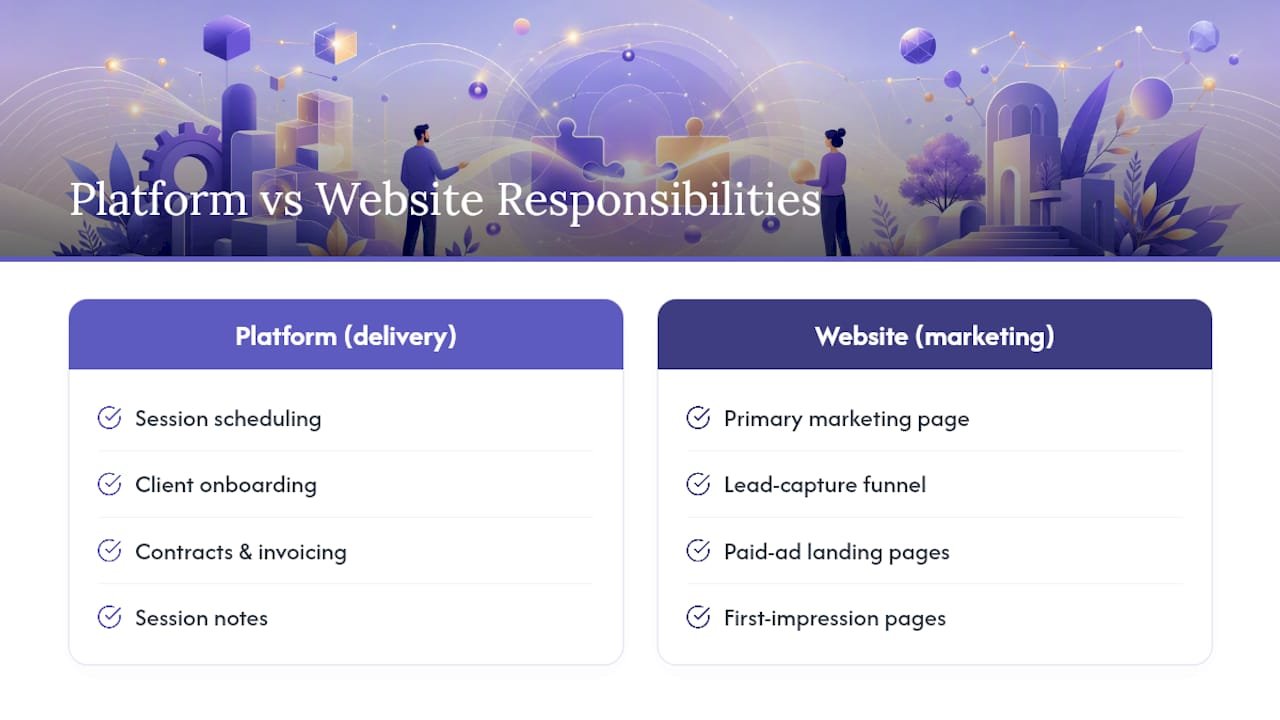
What to keep in-platform: session scheduling, client onboarding, contracts, invoicing, session notes, goal tracking, and program delivery. What to outsource to a web studio: your primary marketing page, your lead capture funnel, your paid ad landing pages, and any page where a cold prospect makes their first impression of your business.
The coaches who grow fastest are the ones who stop asking their delivery platform to do marketing work it was never designed for.
Your coaching platform works harder with a purpose-built landing page
You’ve picked your platform. Now the real question is: how are new clients finding you and deciding to book?
Cosmicdigitalstudios builds high-converting coaching landing pages that connect directly to your chosen platform’s scheduling and payment flow. Every page is custom-built around your offer, your audience, and the specific action you want visitors to take, whether that’s booking a discovery call, joining a waitlist, or purchasing a package.
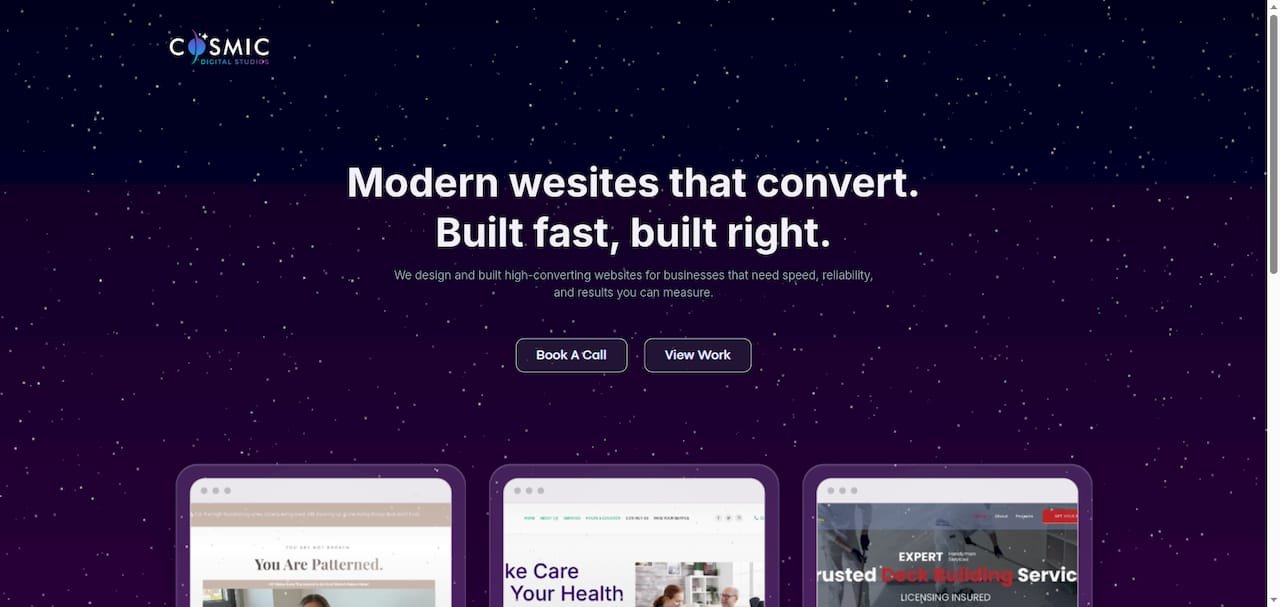
The difference between a platform-generated page and a custom-built one shows up in your booking rate. Platform pages are functional. Custom pages are built to convert. Cosmicdigitalstudios handles the design, the messaging, the booking integration, and the payment connection, so your platform does what it’s good at and your website does what it’s good at.
If you’re ready to stop relying on a platform page to do your marketing, get a custom coaching landing page built that actually books clients.
Sources and references
The following sources were consulted in building this comparison. Pricing and features were last verified in 2026. Verify all details directly with vendors before purchasing, as rates and features change.
- The Best Coaching Software Platform Review for 2026
- Simply.Coach Review 2026: A Genuine Coaching Platform
- Upcoach Review: Best Coaching Software? 100% Honest Review 2026
- Satori Review (2026): I’ve Used It For Coaching (It Has Limitations)
- TrueCoach Review (2026) – MakerStack
- The 5 Best Online Coaching Platforms of 2026 (Ranked …
Disclosure: Cosmicdigitalstudios does not receive referral fees or affiliate commissions from any platform listed in this article. Platforms were selected based on SERP consensus and coaching-market relevance. No direct competitors of Cosmicdigitalstudios are featured as primary recommendations in this review.
Recommended
- Types of Coaching Websites for Coaches & Consultants – cosmicdigitalstudios.com
- High-Converting Coach Websites: 8 Real Examples – cosmicdigitalstudios.com
- Best Website Platforms for Contractors in 2026 – cosmicdigitalstudios.com
- Drive Traffic to Your Coaching Website: 2026 Guide – cosmicdigitalstudios.com