
An online directory listing is a public business profile containing your name, address, phone number, website, hours, and reviews that customers and search engines use to find and verify you. Claim your Google Business Profile today, check that your name and address match exactly across every platform, and upload at least one photo. Those three steps alone will move the needle faster than almost anything else you can do this week.
Two facts worth knowing before you go further:
- Businesses with numerous accurate directory citations rank 53% higher in local searches, and full NAP consistency can drive a 156% average increase in Google Maps visibility within 90 days.
- A new domain linked from a quality directory can get indexed by Google in 1–3 days instead of the typical 2–4 weeks.
Three things to do today:
- Go to Google Business Profile and claim or verify your listing.
- Search your business name on Google, Yelp, and Bing. Compare the name, address, and phone number on each. Fix any mismatch.
- Add at least one exterior or storefront photo to your Google Business Profile.
Table of Contents
- What an online directory listing actually contains
- How directories collect and share your business data
- What types of directories should you prioritize?
- What your business actually gains from directory listings
- How to claim, verify, and optimize your listings step by step
- Why NAP consistency matters and how to audit your listings
- How to manage listings at scale without losing your mind
- How directories make money and what that means for your strategy
- Your 30/60/90-day audit and action plan
- Key Takeaways
- Why listings alone won’t close the deal
- Your listings are driving traffic. Is your website ready to convert it?
- Useful sources
What an online directory listing actually contains
A directory listing is a structured data record, not a webpage you design. Each platform stores specific fields, and the completeness of those fields determines how often you show up and how much trust customers place in you.
Core fields every listing should have:
- Name: Exact legal or DBA name, no keyword stuffing (e.g., “Joe’s Plumbing” not “Joe’s Plumbing Best Plumber Chicago”)
- Address: Full street address including suite number, formatted consistently
- Phone: Local number, not a tracking number that changes
- Website: The specific landing page most relevant to that listing
- Hours: Including holiday hours and special closures
- Categories: Primary category first, then secondary categories that match real services
- Attributes: Wheelchair accessible, women-owned, outdoor seating, accepts credit cards, etc.
- Photos: Exterior, interior, team, products, or completed work
- Reviews: Customer ratings and written feedback
Statistic callout: Citation quality and consistency is an important and controllable factor influencing local search rankings for small businesses. Citation signals account for roughly 11% influence on local ranking factors.
The difference between a directory listing and your website is simple: your website is where you control the full story. A directory listing is where a third-party platform surfaces your core facts to people who haven’t found you yet. Google Business Profile sits in between. It functions as both a directory listing and a search result, which is why it carries more weight than any other single platform.
Common places listings live: Google Maps, Apple Maps, Yelp, Bing Places, YellowPages, TripAdvisor, Foursquare, the Better Business Bureau, local chamber of commerce sites, and vertical directories specific to your industry.
**
How directories collect and share your business data
Directories don’t wait for you to submit. Most large platforms pull business data from four main routes simultaneously, which is why listings for your business may already exist before you’ve done anything.
The four data routes:
- Self-submission and claiming: You create or claim the listing and control the data directly. This is the most accurate route and the one you should prioritize.
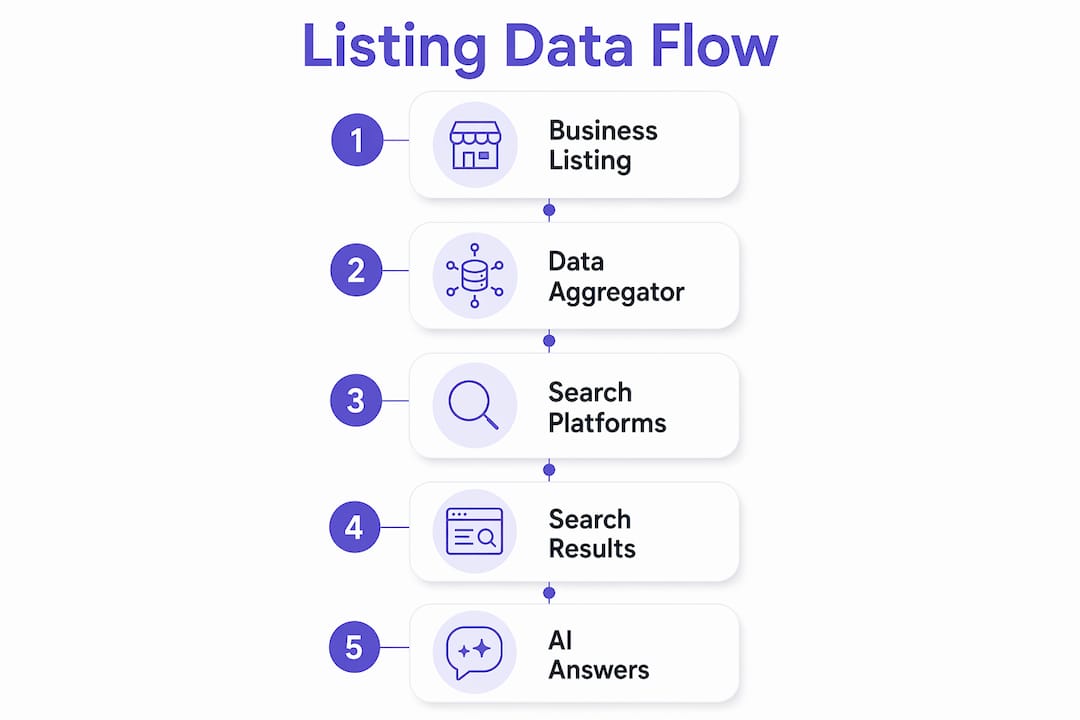
- Data aggregators: Companies like Neustar Localeze compile business records from public sources and license them to hundreds of downstream directories and map platforms. An error at the aggregator level can spread to dozens of sites automatically.
- Licensed bulk feeds: Large platforms purchase datasets from aggregators or government sources and ingest them in bulk. Coverage is wide but accuracy depends on the source.
- User and contributor edits: Platforms like Google Maps allow users to suggest edits. These can correct errors, but they can also introduce new ones if you’re not monitoring.
Once a listing exists, search engines crawl it. Google cross-references your Google Business Profile data against citations found across directories to decide whether your business information is trustworthy. When independent sources agree, confidence in your listing rises and so does your visibility. When they conflict, Google flags the inconsistency as a trust problem.
Pro Tip: Set your Google Business Profile as the authoritative source for all other listings. Whatever name, address, and phone number appear there should be copied exactly, character for character, to every other platform. Even “St.” versus “Street” creates a citation conflict.

Directory submissions can accelerate indexation for new domains from weeks to days because Googlebot follows links from crawled directories to your site. For a brand-new website, this is one of the fastest ways to get on Google’s radar. Directories also feed AI answer engines and voice assistants, which increasingly pull structured data from consistent citation sources to compose answers rather than just return links.
[Diagram: Business listing → data aggregator → Google/Apple/Bing → search results and AI answers]
What types of directories should you prioritize?
Not all directories carry the same weight. The type of directory determines who finds you, how they find you, and what they do next.
Map and search platforms
These are non-negotiable for any U.S. business. Google Business Profile is the single most important listing you will ever claim. It directly controls your appearance in Google Maps and the local pack (the three-business block that appears above organic results for location-based searches). Apple Business Register feeds Apple Maps, which is the default map on every iPhone. Bing Places for Business feeds Microsoft’s search results and Cortana.

If a customer searches “plumber near me” on any device, these platforms are where the answer comes from.
National general directories
YellowPages remains a meaningful citation source. The BBB (Better Business Bureau) carries strong trust signals and high domain authority, making a listing there valuable even if direct traffic is modest. These platforms are less about discovery and more about verification.
Vertical and niche directories
These drive the highest-intent traffic because visitors already know what they need. Examples:
- Healthcare: Healthgrades, Zocdoc, WebMD
- Legal: Avvo, FindLaw, Justia
- Home trades: Houzz, Angi, HomeAdvisor
- Restaurants: TripAdvisor, OpenTable, Yelp
- Professional services: LinkedIn Company Page, Clutch
A restaurant owner gets more value from a verified TripAdvisor listing than from a generic national directory. A contractor gets more qualified leads from Angi than from most other sources. Match the directory to the customer’s search behavior.
Local and regional directories
Chamber of commerce listings and city business guides often carry strong local authority backlinks. High-authority local directories like the BBB, YellowPages, and local chamber sites deliver the best return for businesses competing in a specific geographic market.
Data aggregators
You won’t list directly on aggregators like Neustar Localeze in most cases, but errors in their databases spread everywhere. Monitoring and correcting aggregator data is part of a complete listing strategy.
What your business actually gains from directory listings
The benefits of directory listings fall into four categories: discovery, local SEO authority, trust, and conversions. Each one compounds the others.
Discovery is the obvious one. Customers searching for your category in your city will find you on Google Maps, Yelp, or a vertical directory before they ever see your website. Multiple listings across platforms give you multiple chances to appear for the same search query, since different platforms rank for different query variations and serve different demographics.
Local SEO authority is where the math gets interesting. Consistent NAP data across authoritative directories correlates with a 53% higher ranking in local searches. Each accurate listing acts as a vote of confidence that tells search engines your business is real, established, and located where you claim. The more authoritative the directory, the stronger the signal.
Statistic callout: Full NAP consistency across directories can produce a 156% average increase in Google Maps visibility within 90 days.
Trust comes from third-party validation. A customer who finds you on Google, then sees you on Yelp with 47 reviews and a claimed listing on the BBB, is far more likely to call than one who finds only your website. Online reviews strongly influence purchase decisions, and directory listings are the primary channel for collecting them at scale.
Conversions happen faster with directory traffic than with most other channels. Directory visitors are further down the purchase funnel and more likely to call, click, or request directions immediately. They’re in solution-finding mode, not browsing mode.
For new domains, the SEO benefit is especially fast. Quality directory submissions can move a new site into measurable authority ranges within 60 days, which helps attract organic link outreach. Knowing why local businesses need websites alongside their listings is what turns that traffic into revenue.
Pro Tip: The fastest measurable return from directory listings is referral clicks and phone calls, often within the first week of claiming and completing a Google Business Profile. Track these in your GBP dashboard under “Calls” and “Website clicks” before you measure anything else.
How to claim, verify, and optimize your listings step by step
Work through this list in order. The platforms at the top deliver the most traffic and the strongest SEO signals.
-
Google Business Profile — Go to business.google.com. Search for your business. If a listing exists, click “Claim this business.” If not, create one. Verification is usually by postcard (arrives in 5–14 days), phone call, or video verification. Complete every field: primary category, secondary categories, hours, website, phone, description (750 characters, lead with your main service and city), and at least 10 photos. Respond to every review within 48 hours.
-
Apple Business Register — Go to register.apple.com. Create an Apple ID if needed, then claim or create your listing. Verification requires a phone call to your business number. Apple Maps is the default on all iPhones, so this listing reaches a large audience that never opens Google.
-
Bing Places for Business — Go to bingplaces.com. You can import your Google Business Profile data directly, which saves significant time. Verification is by phone or postcard. Bing serves Microsoft Edge users, Cortana, and a meaningful share of desktop searches.
-
Facebook Business Page — Create or claim your page at facebook.com/pages/create. Complete the “About” section with your full NAP, hours, and website. Facebook listings appear in Facebook search and feed into some third-party aggregators.
-
Yelp — Go to biz.yelp.com. Claim your listing and complete every field. Yelp ranks prominently in Google results for service-category searches and drives substantial direct traffic. Add photos, respond to reviews, and do not solicit reviews in ways that violate Yelp’s policies.
-
YellowPages — Claim at yellowpages.com. This is a foundational citation source with high domain authority. The direct traffic may be modest, but the citation value is real.
-
TripAdvisor — Required for restaurants, hotels, and tourism businesses. Go to tripadvisor.com/owners. Claim your listing and add full details, photos, and menu or service information.
-
Foursquare — Claim at business.foursquare.com. Foursquare functions primarily as a data aggregator that feeds location data to dozens of apps and platforms. A clean Foursquare listing improves data accuracy across the broader ecosystem.
-
BBB — Accreditation is paid, but a free basic listing at bbb.org is available and carries strong trust signals. Complete the profile fully.
-
Vertical directories — After the above, add the two or three vertical directories most relevant to your industry. Prioritize platforms where your customers actually search.
Optimization fields that make the biggest difference:
- Business name: match your signage exactly, no added keywords
- Address: include suite numbers; use “Suite 100” not “#100”
- Phone: local number, not an 800 number
- Website: link to the most relevant landing page, not just the homepage
- Description template: “[Business name] is a [category] serving [city/region] since [year]. We specialize in [top 2–3 services]. Call us at [phone] or visit [website] to [action].”
- Photos: exterior (for wayfinding), interior, team headshots, and product or work samples
Pro Tip: Claim Google Business Profile, Bing Places, and Apple Business Register in the same week. While waiting for postcard verification on one, complete the others. You can run all three verification processes in parallel and have all three live within 14 days.
Why NAP consistency matters and how to audit your listings
NAP stands for Name, Address, Phone. These three fields are the foundation of your citation profile. Search engines cross-reference them across hundreds of sources to decide whether your business information is trustworthy. When they don’t match, the algorithm treats the inconsistency as a red flag.
The harm is concrete. “123 Main Street” on Google and “123 Main St.” on Yelp looks minor to a human. To a search algorithm, it’s a discrepancy that reduces confidence in both listings. Multiply that across 20 directories and your local ranking takes a measurable hit.
Audit checklist — check these fields across every major directory:
- Business name (exact spelling, no added keywords, no abbreviations)
- Street address (full street name, suite/unit number, city, state, ZIP)
- Phone number (same format: (555) 123-4567 or 555-123-4567, pick one and stick to it)
- Website URL (same URL, no trailing slashes or www variations unless consistent)
- Business hours (including holiday hours)
- Primary category (should match Google Business Profile)
- Business description (consistent core facts, even if wording varies)
Remediation steps, in priority order:
- Fix Google Business Profile first. It’s the authoritative source.
- Fix Apple Maps and Bing Places next.
- Correct Yelp, YellowPages, and BBB.
- Address vertical directories and smaller platforms last.
For review management, the ethical approach is simple: ask every satisfied customer to leave a review on Google. You can do this in person, by text, or by email. Ethical review generation means asking genuinely, not offering incentives or filtering who you ask. Respond to every review, positive or negative, within 48 hours. A thoughtful response to a negative review often does more for conversion than five positive ones.
Pro Tip: Search Google for your business name plus your city. Look at the “People also search for” and “Related searches” panels. Any listing that appears with wrong information is one you need to claim. Also run a search for your phone number in quotes — this surfaces auto-generated listings on platforms you didn’t know existed.
How to manage listings at scale without losing your mind
One location with ten listings is manageable manually. Three locations with 30 listings each is a different problem. Here’s how to think about the right approach for your situation.
Three management approaches:
- Manual internal process: You or a team member claims and updates each listing individually. Works well for one location with infrequent changes. Time cost is high; error rate rises with volume.
- Directory management tools: Platforms that offer bulk editing, API sync to major directories, review monitoring, and analytics dashboards. Look for tools that cover Google, Apple, Bing, Yelp, and the major aggregators from a single interface. Cost shapes vary: entry-level tools for single locations typically run less than enterprise platforms built for multi-location chains.
- Agency or outsourced services: An agency handles claiming, optimization, and ongoing monitoring. Best for businesses with multiple locations, frequent menu or hours changes, or no internal bandwidth. Multi-location service websites that convert well require consistent listing data feeding into location-specific landing pages.
Capabilities to look for in a management tool:
- Bulk NAP editing across all connected directories
- API sync so updates push automatically to major platforms
- Review monitoring and response workflow
- Citation consistency scoring
- Analytics showing referral traffic and call volume by directory
Decision criteria:
- 1 location, stable info: Manual process is fine. Set a quarterly calendar reminder to audit.
- 1–3 locations, frequent changes: A mid-tier management tool pays for itself in time saved.
- 4+ locations: Outsource or invest in an enterprise tool with API sync.
Focusing on 30–50 high-quality directories produces the best balance of effort and measurable ranking gains. Beyond that threshold, the marginal SEO value of each additional submission drops significantly. Prioritize authoritative platforms and local sources before expanding to smaller directories. Poor-quality or spammy submissions from mass auto-submission services can dilute citation consistency and offer no SEO benefit.
How directories make money and what that means for your strategy
Free listings exist because directories need businesses to attract searchers. The revenue comes from the business side, not the searcher. Understanding the model helps you decide when a paid upgrade is worth it.
Common directory revenue models:
- Promoted or featured listings: Your listing appears above organic results for relevant searches. Useful when you’re in a competitive category and the directory drives real traffic.
- Display advertising: Banner or sidebar ads shown to searchers. Less relevant to your listing strategy.
- Pay-per-lead or lead generation: You pay for each inquiry the directory sends you. Common on Angi, Thumbtack, and similar platforms. Cost per lead varies widely by category.
- Subscription tiers: A monthly fee unlocks enhanced profiles, more photos, competitor ad blocking, or analytics. Yelp’s enhanced profile is one example.
- Data licensing: Directories sell aggregated business data to other platforms. This is how aggregators like Neustar Localeze generate revenue.
Free vs. paid tiers: For most small businesses, a fully optimized free listing outperforms a neglected paid one. The SEO citation value comes from the listing existing and being accurate, not from paying for a featured placement. Paid features make sense when the directory drives measurable direct traffic and your average customer value justifies the cost per lead.
Pro Tip: Before paying for a featured listing or lead-gen subscription on any directory, check whether that platform actually ranks in Google for your category and city. Search “[your service] [your city]” and see if the directory appears on page one. If it doesn’t, the traffic won’t be there regardless of your placement.
Your 30/60/90-day audit and action plan
This plan gives you concrete tasks for each window and the KPIs to measure whether they’re working.
Days 1–30: Claim and verify
- Claim and verify Google Business Profile (priority one, day one).
- Complete every field on GBP: categories, hours, description, photos, website.
- Claim Apple Business Register and Bing Places; run verifications in parallel.
- Claim Facebook Business Page and Yelp.
- Audit NAP across all five platforms. Fix any mismatch before moving on.
- Set up Google Business Profile notifications for new reviews.
- Respond to any existing reviews.
Days 8–30: Clean up and expand
- Claim YellowPages, BBB, TripAdvisor (if applicable), and Foursquare.
- Run a full NAP audit across all claimed listings using a spreadsheet.
- Identify and claim any auto-generated listings surfaced by a Google search of your business name.
- Add photos to every platform that accepts them.
- Identify the two or three vertical directories most relevant to your industry and claim them.
Days 31–90: Expand to 30–50 quality directories
- Submit to local chamber of commerce and city business guides.
- Add industry-specific vertical directories.
- Consider a local SEO tool to monitor citation consistency and review volume.
- Begin a systematic review request process: ask every customer after a completed job.
- Review GBP analytics weekly: impressions, clicks, calls, direction requests.
KPI table
| KPI | How to measure | Target for a small business |
|---|---|---|
| Verified listings | Count of claimed and verified profiles | 8–10 major platforms by day 30 |
| Citation consistency score | Directory management tool or manual audit | 90%+ NAP match across all listings |
| Referral traffic from directories | Google Analytics > Acquisition > Referral | Upward trend month over month |
| Google Maps impressions | GBP dashboard > Performance | Growing week over week |
| Review count and rating | GBP and Yelp dashboards | New reviews every month; positive average |
Key Takeaways
Consistent, accurate directory listings across 30–50 authoritative platforms are the single most controllable lever a small business has for local search visibility and qualified lead generation.
| Point | Details |
|---|---|
| Claim GBP first | Google Business Profile is the highest-impact listing; claim and complete it on day one. |
| NAP consistency drives rankings | Businesses with 40+ accurate directory citations rank 53% higher in local searches; fix mismatches before expanding. |
| 30–50 quality listings is the target | Marginal SEO value drops sharply after 50 directories; prioritize authoritative and local sources. |
| Reviews compound trust and ranking | Respond to every review within 48 hours; review velocity and diversity both influence local ranking. |
| Cosmicdigitalstudios converts the traffic | Once listings drive visitors to your site, a conversion-focused website and funnel turns those clicks into booked calls. |
Why listings alone won’t close the deal
Here’s the part most directory guides skip: a perfect listing profile gets you found. It does not get you hired.
The businesses I see struggle most with directory listings aren’t the ones who haven’t claimed their profiles. They’re the ones who have 50 accurate listings, a 4.8-star rating, and a website that loads in six seconds on mobile and has no clear call to action above the fold. The directory did its job. The website didn’t.
Directory visitors are high-intent. They’ve already decided they need what you sell. When they click through to your site, they’re not browsing. They’re evaluating. If your homepage doesn’t immediately confirm you serve their area, show social proof, and give them a frictionless way to contact you, they leave. That’s not a listing problem. That’s a conversion problem.
The other thing worth saying plainly: the shift toward AI-driven answers makes citation consistency more important, not less. An AI answer engine composing a response to “best HVAC company in Austin” checks whether independent sources agree on your name, address, and phone number before surfacing you. Inconsistent data gets filtered out. This is the same logic that’s driven NAP consistency for years, but the stakes are higher now because the answer engine doesn’t show ten results. It shows one or two.
My honest recommendation: treat your directory listings and your website as one system. The listing gets the click. The website closes the deal. Optimize both, in that order.
Your listings are driving traffic. Is your website ready to convert it?
Getting your directory listings right is the first half of the equation. The second half is what happens when someone clicks through to your site. If your website is slow, unclear, or missing a strong call to action, you’re paying for visibility that doesn’t convert.
Cosmicdigitalstudios builds custom websites and conversion-focused funnels specifically designed to turn directory-driven traffic into booked calls and signed clients. Whether you need a local landing page that matches your listing data, a multi-location site with location-specific pages, or a complete funnel from click to confirmation, every build is tailored to your business goals. No generic templates, no duct-taped solutions.
If your listings are live and your traffic is growing, the next step is making sure your site can close. See how we turn visitors into clients or visit Cosmicdigitalstudios to get started.
Useful sources
These are the primary sources used throughout this article. Each one is worth bookmarking if you want to go deeper on a specific topic.
- Backlynk: Directory Submission Benefits — The source for the 53% ranking lift and 156% Maps visibility figures cited in this article. Covers citation impact data and the case for quality over quantity.
- TurnkeyDirectories: Business Directory Complete Guide — Explains how directories work as platforms, including data aggregation and the risks of low-quality submissions.
- TurnkeyDirectories: Directory Submission Strategy — The source for the 30–50 quality submissions threshold and diminishing returns analysis.
- Destinali: Benefits of Directory Listing — Covers review influence on purchase decisions and the role of directories in AI-driven search surfaces.
- Destinali: Local Rank Practitioner Perspective — Explains how independent directories now function primarily as verification sources for major map platforms rather than direct discovery destinations.
- SalesHive: Directory User Intent — Practitioner data on why directory visitors convert at higher rates than general search traffic.
- BBB.org — The Better Business Bureau’s own platform for claiming a free business listing and understanding accreditation options.
- Epicware: How to Get More Google Reviews — Practical, ethical tactics for review generation and solicitation without violating platform policies.
Re-check your top five listings every quarter. Business hours, phone numbers, and addresses change. A listing that was accurate six months ago may be wrong today, and a wrong listing costs you customers you never knew you lost.