
Most local business owners underestimate exactly how much money they leave on the table without a website. Social media pages feel like enough, and a Google Business Profile seems to cover the basics. But the data tells a different story. Understanding why local businesses need websites comes down to one clear reality: reviews generate interest, and your website is where that interest either converts into a customer or disappears. This article breaks down the real reasons a dedicated website matters more now than ever before.
Table of Contents
- Key Takeaways
- Why local businesses need websites in 2026
- SEO and local search visibility
- How your website builds trust
- Common misconceptions about websites
- Practical steps to get the most from your site
- My take on what most local owners get wrong
- Build a website that actually converts
- FAQ
Key Takeaways
| Point | Details |
|---|---|
| Reviews drive website visits | 54% of consumers visit a website after reading positive reviews, making your site the final conversion step. |
| Google Business Profile is not enough | Social profiles and business listings lack the SEO control and owned content that a website provides. |
| Mobile speed decides fast | Local searchers make decisions within 24 hours, so slow or outdated sites cost you real bookings. |
| Websites build credibility | Accurate, current information on a well-designed site signals professionalism and earns customer trust. |
| Ongoing updates protect your ranking | Treating your site as a living marketing asset keeps you visible and competitive in local search. |
Why local businesses need websites in 2026
The link between online reviews and your website traffic is not theoretical. It is measurable and direct. 54% of consumers visit a business’s website after reading positive reviews, and 85% are more likely to use that business as a result. That means your reviews are doing real marketing work. But where do they send people? Straight to your website.
If you have no website, or a neglected one, you are burning the trust that your reviews worked hard to earn.
“Websites and reviews form a funnel: after trusting reviews, customers use websites to confirm info and take action.” — BrightLocal 2026 Local Consumer Review Survey
The timeline matters too. 88% of local consumers who search on mobile visit or call a business within 24 hours. These are not people leisurely browsing. They are ready to act. They want to confirm your hours, check your services, and find a phone number or booking form. If your site fails them at that moment, they move to a competitor who has one.
Think about what a potential customer experiences. They find your business through a Google search, read a few five-star reviews, and feel good about reaching out. Then they click through to verify your address or see if you offer the specific service they need. A missing website, a page that hasn’t loaded correctly since 2021, or a phone number that was changed two years ago — any of these ends the relationship before it starts.
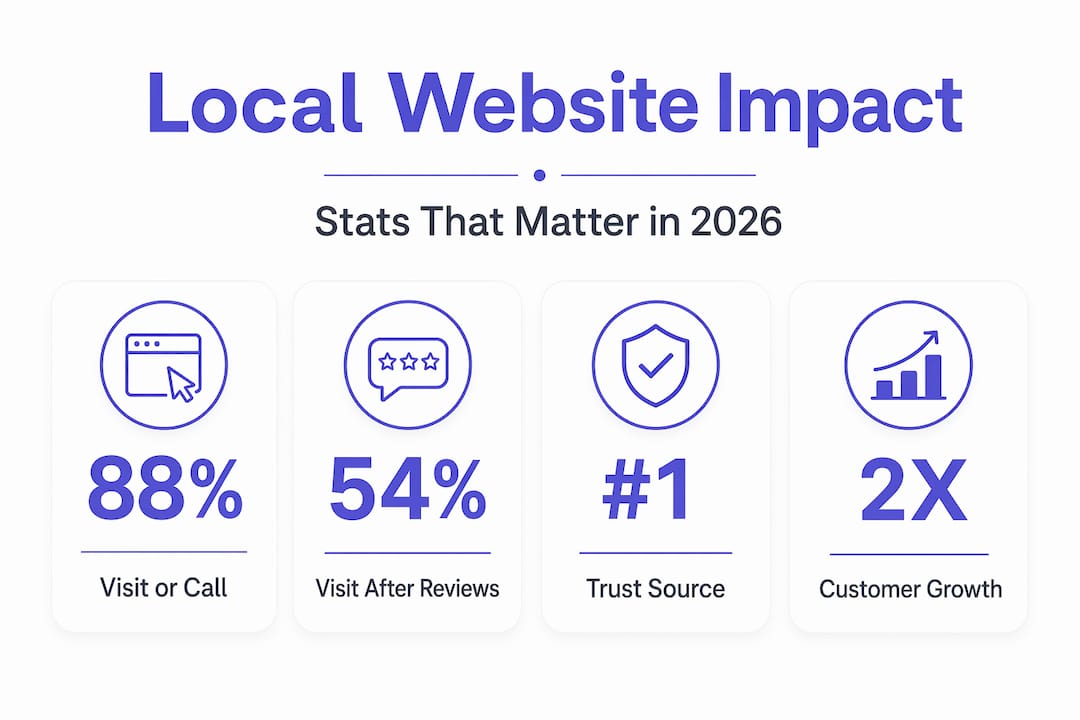
Your website is not just a digital business card. It is the place where review-driven trust becomes an actual booking or inquiry.
SEO and local search visibility
Google Business Profile is a starting point. It is not a complete strategy. A dedicated website gives you a platform that Google Business Profile simply cannot replace, especially as search continues to evolve.
Google’s 2026 Search Central guidance makes clear that unique, valuable, and localized content remains foundational for visibility — including in AI-powered search features. That content lives on your website, not your social media feed. Google needs something to crawl, index, and rank. A profile page gives Google very little to work with.
Here is what a website lets you do that no profile or social page can:
- Optimize for local keywords specific to your city, neighborhood, or service area
- Create dedicated service pages that match exactly what your customers are searching for
- Publish location-specific content that builds topical authority over time
- Meet Google’s technical requirements for search eligibility, including site structure, page speed, and crawlability
- Control your narrative with content that you own, not content that a platform can limit or remove
Google Search Essentials requirements cover technical access, spam policies, and content quality standards. Your website must meet all of them to even be eligible for search results. A social profile does not.
Pro Tip: Pair your website with a local SEO strategy that targets [city plus service] keywords on individual pages. A plumber in Austin should have a page specifically for “Austin plumber” rather than relying on one generic homepage to rank for everything. Check out these local SEO strategies to see how this works in practice.
How your website builds trust
Customers expect to find accurate, complete information fast. When they land on your site and find outdated hours, a disconnected phone number, or a service list that no longer reflects what you offer, the damage to your credibility is immediate.

Research from AZ Big Media confirms that slow or confusing websites cause instant credibility loss. Consumers expect transparency and quick access to the basics. The experience your site delivers directly shapes how trustworthy your business appears.
Here is what a credible local business website gets right:
- Mobile optimization: Most local searches happen on phones. A site that breaks on mobile loses that visitor immediately. This mobile speed guide explains exactly how load time affects your results.
- Fast loading: A page that takes more than three seconds to load causes most users to bounce before they even see your content.
- Consistent information: Your name, address, and phone number should match exactly across your website, Google Business Profile, and any directory listings.
- Clear calls to action: Visitors should know within seconds what you want them to do — call, book, request a quote, or get directions.
- Up-to-date service details: If you stopped offering a service or added a new one, your website needs to reflect that.
Pro Tip: Check your site on a real mobile device right now. If you have to pinch to zoom, wait more than three seconds for it to load, or struggle to find a phone number, so do your customers.
The essential pages every local service site needs include a homepage, a services page, an about page, a contact page, and at minimum one local landing page. Missing any of these creates gaps that erode trust before the customer ever reaches out.
Common misconceptions about websites
There are a few beliefs that keep local business owners from investing in a proper website. Each one costs them.
“My Google Business Profile is enough.” Your Google Business Profile controls what people see before they click. Your website controls what they experience after. According to BrightLocal’s 2026 data, a business without a website loses the majority of post-review traffic because there is nowhere credible to send it.
“I have social media, so I’m covered.” Social platforms limit your reach, can change their algorithms overnight, and give you no real SEO benefit. You do not own that audience. You rent access to it.
“My website is done. I built it three years ago.” Businesses that treat websites as one-time assets consistently lose trust due to outdated information. A page announcing “2022 Holiday Hours” or a blog with a last-published date from years ago signals neglect.
Here is a direct comparison of what each digital presence offers:
| Feature | Google Business Profile | Social Media Page | Owned Website |
|---|---|---|---|
| Local SEO benefit | Moderate | Minimal | High |
| Content ownership | No | No | Yes |
| Conversion-focused design | No | Limited | Yes |
| Algorithmic risk | High | Very high | Low |
| Customizable for your brand | No | Limited | Full |
| Ability to rank for keywords | No | No | Yes |
The pattern is clear. A website redesign checklist is worth reviewing annually to make sure your site stays current and competitive.
Practical steps to get the most from your site
Knowing that a website matters is one thing. Making it work is another. These are the steps that produce real results for local businesses.
-
Build the core pages first. Every local service business needs a homepage, a services page, an about page, and a contact page at minimum. Each page should speak directly to local customers and use location-specific language.
-
Keep your business information current. Review your site every time your hours, services, or contact details change. Outdated information is one of the top reasons businesses lose customers who found them online.
-
Prioritize mobile performance. Mobile-first is not optional. More than half of local searches happen on mobile, and slow load times drive people away fast.
-
Add a clear call to action on every page. Do not make visitors hunt for how to contact you. Put a phone number, booking link, or contact form where people will actually see it.
-
Publish localized content regularly. Even one new blog post or updated service page per month adds fresh content for Google to index and gives customers a reason to return.
-
Audit your local SEO signals. Check that your name, address, and phone number are consistent everywhere online. Use an SEO checklist designed for small businesses to cover your bases.
-
Use your website launch or redesign as a marketing moment. A new or updated site is something worth promoting across your existing channels.
Pro Tip: Use your website launch checklist before going live to catch technical issues, missing pages, and conversion gaps before they cost you leads.
My take on what most local owners get wrong
I’ve watched local businesses with genuinely great reviews and real community trust lose customers week after week because their websites let them down at the final moment. The customer was sold. The reviews convinced them. The website sent them away.
What I’ve found again and again is that owners underestimate the cumulative effect of website neglect. It doesn’t feel urgent because the damage is invisible. A customer visits your site, finds something confusing or outdated, and quietly goes elsewhere. You never know it happened.
The businesses that grow consistently treat their websites as living assets, not finished products. They update service pages when their offerings change. They add content that reflects what their customers are actually asking. They check their mobile experience on a real phone.
My advice is simple: schedule a 30-minute website review every quarter. Look at it the way a new customer would. If something seems off to you, it definitely seems off to them.
The competitive advantage in most local markets is not complicated. It is a fast, accurate, well-organized website that meets customers where their trust already is.
— Max
Build a website that actually converts
Reading about the importance of local business websites is step one. Fixing yours is step two. At Cosmicdigitalstudios, we build custom websites specifically for local service businesses — fast, mobile-ready, and designed to turn visitors into booked calls and inquiries. Every page is structured to communicate clearly and guide customers toward action.
Whether you need a new site from scratch, a redesign that fixes what is not working, or a complete local SEO setup, the team at Cosmicdigitalstudios handles the technical and strategic sides so you can focus on running your business. Visit Cosmicdigitalstudios to see how we approach conversion-focused design for local businesses. You can also explore how we think about building sites that convert to get a sense of the process before reaching out.
FAQ
Why do local businesses need websites if they have Google?
A Google Business Profile shows customers basic info, but 54% of consumers visit a website after reading reviews. Without one, you lose most of the traffic that reviews generate.
Can social media replace a website for a local business?
No. Social platforms offer no real SEO benefit, you don’t own your audience, and algorithm changes can cut your visibility overnight. A website gives you control that social media cannot.
How often should a local business update its website?
Review your business information whenever anything changes, and publish new content at least once a month. Businesses that treat websites as static consistently lose trust from outdated information.
Does a website help with local SEO?
Yes, significantly. A website lets you optimize for local keywords, create location-specific service pages, and meet Google’s technical requirements for search eligibility — none of which a Google Business Profile can do on its own.
What pages does a local business website need?
At minimum: a homepage, a services page, an about page, and a contact page. Review the essential pages guide to make sure each page is built to convert.