
Three plug-and-play upsell funnels will increase average client lifetime value for consultants when framed around client outcomes: the low-ticket tripwire audit, the packaged retainer upgrade, and the value-add subscription. Each one targets a different stage in the client relationship and a different buyer readiness level.
Here is what each delivers at a glance:
- Low-ticket tripwire audit (a low-cost front-end offer): converts cold or warm traffic into pre-qualified buyers before you pitch high-ticket services. Expect a moderate take rate on the initial offer when the page and copy are dialed in.
- Packaged retainer upgrade (a mid-to-high ticket monthly offering): turns a completed project into a recurring engagement by anchoring the next scope to results already delivered. Conversion depends heavily on timing and proposal framing.
- Value-add subscription (a moderate monthly fee): a monthly advisory or health-check retainer upsold after a fixed project closes. Predictable revenue, low delivery overhead.
TL;DR: Test the tripwire first if you need qualified leads fast. Move to the retainer upgrade once a project delivers its first measurable result. Layer in the subscription offer at the 30-day post-delivery mark to lock in recurring revenue.
Table of Contents
- Why do upsell funnels matter more than new-client acquisition?
- Where do upsells fit in a consulting funnel?
- Five upsell funnel examples you can copy and implement
- Which tools do you need to run a consulting upsell funnel?
- What mistakes do consultants make with upsell funnels?
- How do you measure whether your upsell funnel is working?
- What are the legal and ethical rules for upselling consulting services?
- What does a full upsell workflow look like, step by step?
- Key Takeaways
- Why the “logical next step” framing changes everything
- Cosmicdigitalstudios builds upsell funnels that convert for consultants
- Useful sources and further reading
Why do upsell funnels matter more than new-client acquisition?
Upselling is the practice of encouraging an existing client to choose a higher-value version of your service or add a complementary offer. In consulting, that means moving a client from a one-time audit to a retainer, from a retainer to an expanded scope, or from a project to a productized subscription.
The economics are straightforward. Acquiring a new client costs time, ad spend, and sales cycles. Expanding an existing relationship costs almost none of that. Service businesses that build intentional upsell sequences report that upsells can represent a significant share of total revenue, often at higher margins than new-client work because the trust and onboarding cost are already absorbed.
Where upsells pay off most:
- After a project delivers a clear, measurable win
- During a client’s annual or quarterly budget planning window
- When a client asks “what’s next?” before you’ve prepared an answer
- At the end of a retainer term, when renewal is already on the table
Where upsells backfire:
- Pitched before the first deliverable is complete
- Framed around your service features rather than the client’s next goal
- Presented without a clear outcome promise or scope boundary
- Offered to clients who haven’t yet seen ROI from the current engagement
Client lifetime value (LTV) is the number that changes most when you add a structured upsell path. A consultant who closes a $5,000 project and never follows up leaves substantial additional revenue on the table. One well-timed retainer upgrade or subscription offer can double or triple client lifetime value without adding a single new client to your pipeline.
Where do upsells fit in a consulting funnel?
A consulting funnel moves through five stages. Each one creates a natural trigger point for an upsell offer.
| Funnel Stage | What Happens | Upsell Trigger |
|---|---|---|
| Lead | Prospect discovers you via content, referral, or ad | Tripwire audit offer on landing page |
| Consult | Discovery call or proposal stage | Tiered proposal with expansion option baked in |
| Engage | Contract signed, project begins | Order bump: add-on hours or onboarding sprint |
| Deliver | Work is completed, results are visible | Retainer upgrade or subscription offer |
| Expand | Ongoing relationship, new goals emerge | Multi-department or new-scope upsell |
Aligning your upsell offer to the client’s fiscal calendar dramatically increases acceptance. A retainer proposal sent in October, when Q4 budgets are being finalized, lands differently than the same proposal sent in February with no budget context.
High-conversion trigger points to watch for:
- Completion of an audit or diagnostic (the client now knows what’s broken)
- First ROI signal from your work (proof of concept moment)
- End-of-retainer review meeting (natural renewal conversation)
- Client mentions a new initiative or pain point during a check-in
- C-suite approval of a new budget cycle
Timing rules: For post-purchase upsells, the strongest window is 24–72 hours after a deliverable is received, while the value is fresh. For retainer upgrades, wait until at least one measurable result is documented. Never pitch an expansion during a delivery problem.
Five upsell funnel examples you can copy and implement
These are practical funnel templates built around real consulting price points. Each one includes the offer structure, a short copy snippet, and a timing checklist.
1. Low-ticket tripwire audit
The offer: A focused, deliverable-based audit at a low price point. The purchase qualifies the buyer as someone willing to pay for your thinking, which makes the follow-up pitch for a full engagement far easier.
Funnel flow: Landing page → checkout (Stripe) → order bump (add a 30-minute debrief call for $97) → thank-you page with a soft pitch for your core service → 3-email post-purchase sequence.
Sample subject lines for the post-purchase sequence:
- Email 1 (Day 1): “Your audit is ready — here’s what I found”
- Email 2 (Day 3): “The one fix that moves the needle fastest”
- Email 3 (Day 6): “Want help implementing this together?”
Upsell copy snippet: “Your audit flagged three gaps that are costing you clients right now. I can fix all three in a 90-day engagement. Here’s what that looks like.”
Timing checklist: Send Email 3 no earlier than Day 5. Book the call within 7 days of purchase. Present the full-service proposal on the call, not via email.
Pro Tip: Treat the tripwire as a qualifying mechanism, not a profit center. The booked call is the objective, not the small front-end fee.
2. Packaged retainer upgrade
The offer: A tiered proposal that presents your core project alongside a retainer option, anchored by the results you’ve already delivered or promised.
Discovery questions that surface expansion needs:
- “What happens after this project is done — who owns the ongoing work?”
- “Is there a second phase you’ve been putting off?”
- “What would need to be true six months from now for this engagement to be a success?”
Pricing frame: Present three tiers. Tier 1 is the project-only scope. Tier 2 adds a 3-month retainer at a notable discount versus buying separately. Tier 3 is a 6-month retainer with a priority response SLA. Most clients choose Tier 2, which is the intended anchor.
Sample proposal language: “Based on what we’ve built together, the fastest path to [client goal] is a 90-day advisory retainer. Here’s what’s included and what it costs compared to restarting from scratch.”

Timing checklist: Introduce the retainer option at the 60–70% completion mark of the current project, not at the final delivery meeting.
3. Subscription value-add
The offer: A monthly advisory or “health-check” subscription, priced within an accessible monthly range depending on your niche and access level. Upsold after a fixed project closes.
Funnel flow: Project closes → thank-you/offboarding email → subscription offer page → Stripe recurring billing → monthly check-in calendar slot via Calendly.

Sample copy: “The project is done, but the work doesn’t stop. For $X/month, I’ll review your [metrics/campaigns/operations] every 30 days and flag anything that needs attention before it becomes a problem.”
Timing checklist: Send the subscription offer 3–5 days after final delivery. Keep the scope narrow and the price easy to approve without a committee.
4. Workshop-to-retainer path
The offer: A paid half-day or full-day workshop at an affordable price range that solves a specific, scoped problem. The workshop itself is the qualifying filter. Attendees who engage deeply are your retainer prospects.
Application-filter language: “This workshop is limited to teams actively working on [specific problem]. To confirm fit, tell me where you’re stuck right now.” This pre-qualifies attendees and gives you discovery data before the room fills.
Post-workshop upsell: Present a scoped retainer proposal within 48 hours of the workshop, while the problem is still top of mind.
Pro Tip: Build the retainer scope directly from the workshop’s action items. Clients who see their own notes reflected in your proposal close at a much higher rate.
5. Add-on productized services
The offer: Bundled add-ons with fixed prices and defined scopes. Examples: a monthly performance dashboard ($300/month), an implementation hours bundle (10 hours at a fixed rate), or a quarterly strategy review ($750/quarter).
Pricing guidance by band:
- Low price band: maintenance plans, monthly reporting, async Q&A access
- Mid price band: implementation sprints, quarterly reviews, team training sessions
- High price band: multi-department rollouts, fractional advisory, annual strategy days
These work best when presented as a menu during the proposal stage, not as an afterthought. Baking expansion paths into your initial proposals anchors clients to larger solutions from day one and reduces friction when you bring them up later.
Which tools do you need to run a consulting upsell funnel?
You don’t need a complex stack. A lean setup handles 90% of consulting upsell flows.
Core stack:
- Landing page: A custom-built, conversion-focused page (or a ClickFunnels build for a faster start)
- Checkout: Stripe for one-time and recurring payments, with webhook triggers to fire post-purchase automations
- Scheduling: Calendly to embed a booking link directly in thank-you pages and post-purchase emails
- Forms and qualification: Typeform for discovery intake, application filters, and post-project surveys
- CRM and email automation: Tag buyers in your CRM the moment Stripe fires a payment event, then trigger the upsell sequence automatically
- Analytics: Track three events at minimum: offer shown, offer accepted, calendar booked
Where ClickFunnels and Heyflow fit: ClickFunnels works well for consultants who want a pre-built funnel environment with order bumps and one-click upsells wired in. Heyflow is a strong choice when your upsell entry point is a multi-step form or quiz, particularly for diagnostic-style tripwires. For consultants who want a fully custom page that matches their brand and converts at a higher rate, a custom-built landing page outperforms template builders on trust signals.
Implementation checklist:
- Connect Stripe to your CRM via webhook
- Tag every buyer with “upsell-eligible” on purchase
- Start the upsell email sequence automatically (Day 1 trigger)
- Embed a Calendly link in Email 3 of the sequence
- Track calendar bookings as a conversion event in your analytics
| Tool | Role in funnel | Best for |
|---|---|---|
| ClickFunnels | Full funnel builder with order bumps | Consultants wanting an all-in-one setup |
| Heyflow | Interactive form-based funnels | Diagnostic tripwires and qualification flows |
| Calendly | Scheduling and booking | Post-purchase call booking |
| Stripe | Payments and recurring billing | All checkout and subscription flows |
| Typeform | Discovery intake and application filters | Workshop sign-ups and pre-qualification |
For sales teams managing qualification and follow-up, TrailerCast’s SDR enablement tools can help structure discovery conversations and track follow-up sequences.
What mistakes do consultants make with upsell funnels?
Most upsell failures come down to four recurring errors.
Top mistakes:
- Upselling too soon: Pitching an expansion before the client has seen results destroys trust. The first ROI signal is your green light.
- Feature-focused framing: “This package includes 10 hours of consulting” is not an upsell. “This retainer gets you to [specific outcome] in 90 days” is.
- Complicated checkout flows: Every extra click between “yes” and payment costs you conversions. One page, one offer, one button.
- No qualification filter: Chasing every client for an upsell wastes time. Use Typeform intake questions or a low-cost diagnostic to identify decision-ready buyers before you invest in a pitch.
Best practices:
- Frame every upsell as the logical next step from work already done, not a separate pitch
- Use tiered proposals from the start so the upsell option is already on the table at signing
- Build a simple one-click upsell into your thank-you page for low-ticket offers
- Set a 30-day post-delivery reminder in your CRM to trigger the subscription offer
Red flags that tell you to stop and iterate:
- Upsell email open rates below 20%
- Fewer than 5% of buyers click the upsell offer page
- Clients respond to upsell emails with confusion about what’s included
Pro Tip: If your upsell isn’t converting, the problem is almost always the framing, not the price. Rewrite the offer around a specific client outcome before you touch the price point.
How do you measure whether your upsell funnel is working?
Track these five KPIs from day one.
- Upsell conversion rate: percentage of eligible clients who accept the upsell offer
- Average contract value (ACV) uplift: difference in total revenue per client before and after the upsell sequence
- Revenue per client: total revenue divided by active clients, tracked monthly
- Acquisition cost payback period: how many months of upsell revenue it takes to recover your original client acquisition cost
- Retention delta: whether clients who accept an upsell stay longer than those who don’t
Real funnel case studies show that moving from a manual, application-style follow-up to an automated evergreen upsell sequence improves both conversion velocity and revenue predictability.
Sample benchmark table (populate with your own client data):
| Funnel Type | Target Upsell Conversion Rate | ACV Uplift Goal | Retention Impact |
|---|---|---|---|
| Tripwire audit to core service | — | 3–5x front-end price | High (qualified buyers) |
| Retainer upgrade from project | 20% | 2–4x project value | Very high |
| Subscription value-add | 10% | Adds recurring MRR | High |
| Workshop to retainer | — | Significant scope expansion | Very high |
Post-purchase sequences that extend the funnel into client lifetime value are the single highest-leverage move for service businesses that depend on recurring revenue.
What are the legal and ethical rules for upselling consulting services?
Upselling in consulting is legal and standard practice. The ethical line is clear: the upsell must genuinely serve the client’s goals, not just your revenue targets.
A few practical rules to stay on the right side of both:
- Disclose scope clearly. Every upsell offer should include a written scope summary. Vague promises create disputes.
- Don’t manufacture urgency. Fake deadlines and artificial scarcity damage long-term client relationships. If there’s a real reason to act now (budget cycle, project momentum), say so plainly.
- Respect “no.” A client who declines an upsell should receive the same quality of service on their current engagement. Upsell pressure that affects delivery quality is a reputation risk.
- Contractual clarity: If the upsell changes the scope of an existing contract, document it with a written amendment or a new statement of work. Verbal agreements on scope expansions create liability.
- FTC guidelines on endorsements and advertising apply if you use client results in your upsell marketing. State results accurately and avoid implying typical outcomes that aren’t representative.
This is general information, not legal advice. Confirm current requirements with a qualified attorney for your specific situation.
What does a full upsell workflow look like, step by step?
Here is a complete 14-day upsell sequence for a consultant running the tripwire-to-retainer path.
Day 0: Client purchases the tripwire audit at a modest price point via Stripe. Stripe webhook fires, tags the buyer in your CRM, and triggers the email sequence.
Day 1: Deliver the audit. Email subject: “Your audit is ready.” Body: 3–5 specific findings, one quick win they can act on today, and a soft mention of your core service.
Day 3: Follow-up email. Subject: “The one fix that moves the needle fastest.” Focus on the highest-priority finding. End with: “If you want help implementing this, reply and I’ll send you details.”
Day 6: Upsell email. Subject: “Here’s what working together looks like.” Present the core service offer with a clear outcome promise, a price, and a Calendly link to book a 20-minute call.
Day 8: If no call booked, send a one-line nudge: “Still open to a quick call this week if the timing works.”
Day 14: Final follow-up. Subject: “Closing the loop.” Offer a lighter-touch option (the subscription or a single implementation session) for clients who aren’t ready for the full engagement.
Tracking checkpoints: Monitor open rates at Day 1 and Day 6. If Day 6 open rate drops below 20%, test a new subject line before changing the offer. If click rate on the Calendly link is below 3%, rewrite the outcome promise in the upsell email.
Key Takeaways
The most effective consulting upsell funnel starts with a low-ticket tripwire to qualify buyers, then moves to a retainer upgrade or subscription offer timed to the client’s first measurable result.
| Point | Details |
|---|---|
| Start with the tripwire | A low-cost audit qualifies buyers and opens the door to high-ticket pitches. |
| Time retainer upgrades carefully | Pitch the upgrade at 60–70% project completion, not at final delivery. |
| Align offers to budget cycles | Upsell proposals sent during client planning windows convert at higher rates. |
| Track five core KPIs | Measure upsell conversion rate, ACV uplift, revenue per client, payback period, and retention delta. |
| Cosmicdigitalstudios builds the funnel | Cosmicdigitalstudios designs custom landing pages, checkout flows, and upsell sequences for consultants ready to implement. |
Why the “logical next step” framing changes everything
Most consultants I’ve seen struggle with upsells aren’t failing because their offer is wrong. They’re failing because they’re treating the upsell as a separate sales event instead of the natural continuation of work already in progress.
The consultants who convert upsells consistently do one thing differently: they plant the seed in the initial proposal. They use tiered options, discovery questions that surface future needs, and outcome-focused language that makes the expansion feel inevitable rather than opportunistic. By the time the upsell email lands, the client has already been thinking about it.
The other thing worth saying plainly: the tools matter less than the framing. ClickFunnels, Heyflow, Typeform, Calendly, Stripe — these are all solid choices, and the funnel stage mapping matters more than which platform you pick. A well-framed offer on a plain landing page will outperform a beautifully designed page with a weak outcome promise every time.
The consultants who win with upsells treat every client engagement as the beginning of a longer relationship, not a transaction to close and move on from. That mindset shift is what the funnel structure is designed to support.
Cosmicdigitalstudios builds upsell funnels that convert for consultants
You now have the templates, the timing, and the tools. The gap between knowing the framework and having a live, converting funnel is the build itself. That’s where Cosmicdigitalstudios comes in.
Cosmicdigitalstudios designs and builds custom landing pages, checkout flows, and upsell sequences specifically for consultants. Every build is conversion-focused from the first pixel: clean design, clear messaging, and a page structure that guides clients toward the next step without friction. Whether you need a tripwire audit page, a tiered proposal landing page, or a full post-purchase email sequence wired to Stripe, the team builds it to your brand and your offer.
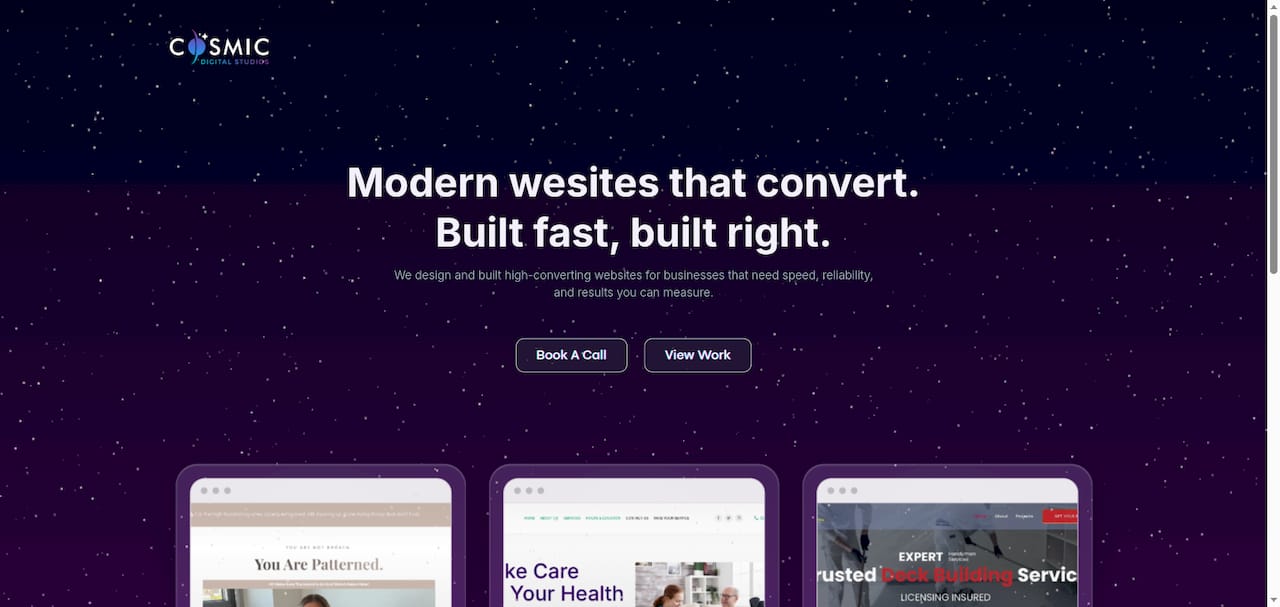
No generic templates. No duct-taped integrations. A complete, tested funnel built around your consulting offer and your clients. See what Cosmicdigitalstudios builds and book a discovery call to get your first upsell funnel live in two weeks.
Useful sources and further reading
Implementation:
- 6 Upselling Tips for Consultants to Generate More Revenue — MBO Partners
- How to price consulting services on your website — Cosmicdigitalstudios
Templates and examples:
- Turn website visitors into clients in 2026 — Cosmicdigitalstudios
Benchmarks and research:
- What Is Upselling? A Complete Guide + Examples — Salesforce
- 7 Types of Consulting Sales Funnel — Salesmate