
A website redesign is necessary when your local business site no longer represents your brand, converts visitors, or meets the technical standards search engines and users expect in 2026. Knowing exactly when to redesign a local business site separates businesses that grow their online presence from those that quietly lose ground to competitors. Redesign frequency averages two to five years, with faster-moving industries refreshing every two to three years. Google’s Core Web Vitals now serve as the measurable technical benchmark for whether your site deserves its current rankings. AI-driven local search has added a new layer of urgency, making a local business website overhaul more than a cosmetic decision.
What are the key signs your local business website needs a redesign?
The clearest indicator for a local business site update is a gap between what your site does and what your business needs it to do. That gap shows up in several concrete ways.
- Design looks dated or inconsistent. If your site was built before 2021 and hasn’t been touched since, it likely reflects design conventions that users now associate with low-quality businesses. Outdated design directly erodes user trust, which translates to higher bounce rates and fewer inquiries.
- Mobile experience is broken or clunky. More than half of local search traffic comes from mobile devices. A site that isn’t fully responsive, or that requires pinching and zooming, loses those visitors immediately.
- Core Web Vitals are failing. Google measures LCP (Largest Contentful Paint), INP (Interaction to Next Paint), and CLS (Cumulative Layout Shift) as real-user performance signals. Failing these thresholds is a direct ranking factor.
- Search rankings and organic traffic have dropped. A steady decline in Google Search Console impressions or clicks, without an obvious content reason, often points to a technical or structural problem that a patch won’t fix.
- Conversions and leads have declined. If your site gets traffic but visitors don’t call, book, or fill out a form, the site’s messaging, layout, or speed is failing them.
- Your business has changed but the site hasn’t. New services, new locations, online booking, or eCommerce capabilities require structural changes that surface-level updates can’t accommodate.
- Stakeholders can’t manage their own data. Stakeholder dissatisfaction with data control and lead tracking is a reliable signal that the site’s back end is no longer fit for purpose.
Pro Tip: Run a quick audit in Google Search Console before deciding on a full redesign. If your Core Web Vitals report shows red across LCP, INP, and CLS, you have a technical case for redesign, not just a visual one.
Any two or three of these signs appearing together make the case for a full redesign rather than incremental fixes. One sign alone might warrant a targeted update. The combination signals a structural problem.

How do Core Web Vitals influence the timing for a redesign?
Core Web Vitals are Google’s standardized performance metrics, and they set the technical floor for whether your site is competitive in 2026. Google evaluates LCP ≤ 2.5s, INP ≤ 200ms, and CLS ≤ 0.1 as passing thresholds, measured at the 75th percentile of real-user data. Missing these thresholds means a meaningful share of your actual visitors are experiencing a slow, unstable site.
LCP is the hardest metric to fix and the most impactful on perceived speed. It measures how long the largest visible element takes to load, typically a hero image or headline block. Poor Core Web Vitals correlate directly with lost conversions. Vodafone Italy improved LCP by three seconds and recorded an 8% increase in sales and 15% more leads. That is the business case for treating performance as a redesign trigger, not an afterthought.
When you’re deciding whether to patch your existing site or commit to a full redesign, follow this diagnostic sequence:
- Measure with field data first. Google Search Console’s Core Web Vitals report shows real-user experience data. PageSpeed Insights combined with field data gives you both lab diagnostics and actual user performance. Use both together.
- Check TTFB (Time to First Byte). Server response time is the root cause of many LCP failures. If TTFB is above 800ms, no amount of front-end tweaking will fix your LCP score.
- Prioritize fixes in order: TTFB, then LCP, then INP, then CLS. Optimizing in this sequence avoids wasted effort and targets the largest gains first.
- Use real user monitoring (RUM). RUM provides immediate field data feedback during optimization, which matters because Chrome UX Report (CrUX) data updates slowly and can mask whether your fixes are actually working.
- Decide: patch or redesign. If your Core Web Vitals failures trace back to a bloated theme, a page builder generating excessive JavaScript, or a hosting environment you can’t upgrade, a redesign is the more cost-effective path.
Pro Tip: Most competitors neglect Core Web Vitals optimization, which means a local business that passes all three thresholds gains a measurable SEO tiebreaker in competitive niches where content quality is comparable.
What are the SEO risks when redesigning a local business website?
A redesign that ignores SEO migration planning can erase years of ranking authority in days. Improper redirects and URL mapping cause traffic loss that can take months to recover from. This is the most common and most preventable mistake in a local business website overhaul.
The table below compares the two approaches most local businesses take when handling SEO during a redesign.
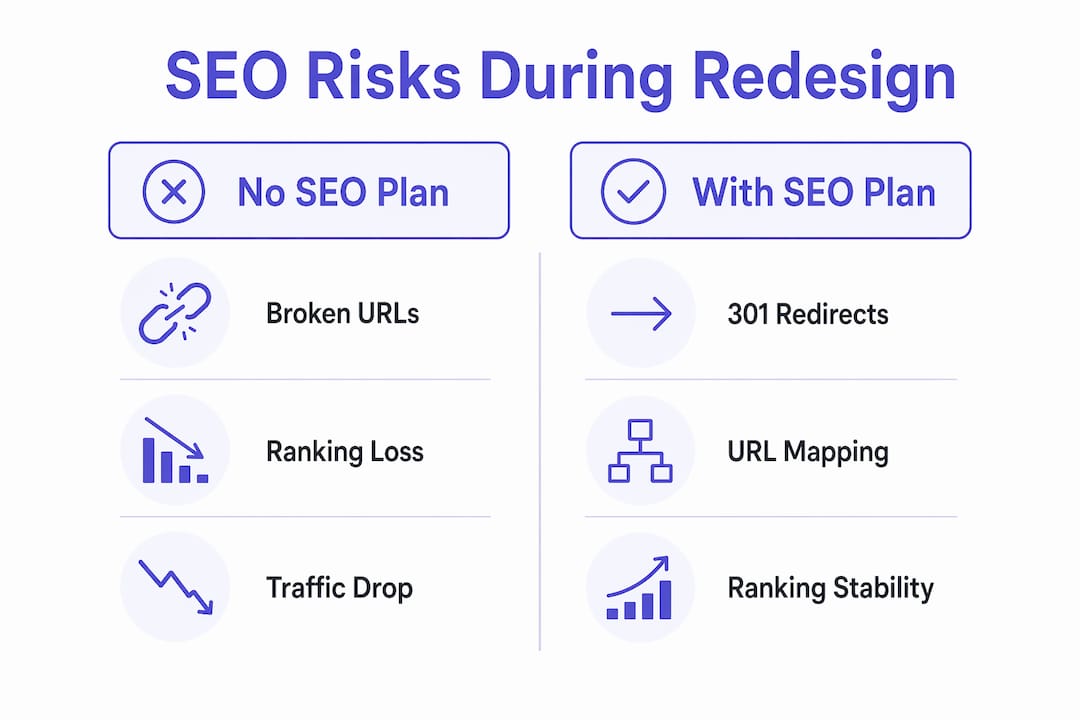
| Approach | What it involves | Risk level |
|---|---|---|
| No SEO migration plan | New URLs launched without redirects; internal links broken; content restructured without intent mapping | High: significant traffic and ranking loss likely |
| Full SEO migration plan | 1:1 URL mapping, 301 redirects, preserved internal linking, content intent maintained | Low: rankings typically recover within 4 to 8 weeks |
Disrupting crawlability or intent mapping can quietly reduce your discoverability even when the new design looks dramatically better. Google doesn’t reward visual improvement. It rewards structural continuity combined with performance gains.
The practical steps that protect your SEO during a redesign are straightforward. Crawl your existing site with a tool like Screaming Frog before you touch anything. Document every URL that has backlinks or organic traffic. Map each one to its equivalent on the new site. Set up 301 permanent redirects for every changed URL. After launch, monitor Google Search Console daily for crawl errors and ranking shifts for at least 30 days.
Local business listings add another layer of complexity. Your Google Business Profile, Yelp listing, and any directory citations that link to specific pages on your site need to be updated if those URLs change. Missing this step means broken links from your most trusted local citations. Review the redesign checklist for local businesses to make sure your migration covers every SEO touchpoint before you go live.
How does AI-driven local search affect your redesign decision?
AI-driven search has changed what a local business website needs to do in 2026. Google’s AI-first updates expand agentic booking and calling for local services, meaning users can now book appointments, request quotes, or call directly from AI-generated search results without visiting your site at all. If your site isn’t structured to support these flows, you’re invisible in a growing share of local search interactions.
A redesign that accounts for AI-driven search should include:
- Structured data markup. Schema for LocalBusiness, Service, FAQPage, and Review tells AI systems exactly what your business does, where it operates, and what customers say about it.
- Direct booking integration. A site that connects to Google’s booking ecosystem via a supported scheduling tool surfaces in AI-assisted booking flows. A static contact form does not.
- Clear, crawlable content. AI agents and voice search queries favor pages with direct answers to specific questions. Structured data helps your site surface in AI-driven journeys, but only if the underlying content is organized and specific.
- Fast load times on mobile. AI Overviews pull from pages that load quickly and reliably. A slow site is less likely to be cited as a source.
- Consistent NAP data. Name, address, and phone number must match exactly across your site, your Google Business Profile, and every directory listing.
Understanding how AI-driven search reshapes visibility is now a prerequisite for any redesign brief. A simple restyling project that doesn’t address structured data, booking integration, or page speed is not a redesign. It’s a paint job.
Key takeaways
A local business site needs a redesign when it fails Core Web Vitals thresholds, loses organic rankings, no longer supports business goals, or lacks the structured data required for AI-driven local search visibility.
| Point | Details |
|---|---|
| Redesign frequency | Most local business sites need a full overhaul every two to five years, with smaller updates in between. |
| Core Web Vitals as a trigger | Failing LCP, INP, or CLS thresholds is a measurable, objective reason to redesign rather than patch. |
| SEO migration is non-negotiable | Every URL change requires a 1:1 301 redirect; skipping this step causes ranking loss that takes months to recover. |
| AI search readiness | Structured data, booking integration, and fast mobile load times are now redesign requirements, not optional extras. |
| Signs to act now | Declining traffic, low conversions, broken mobile experience, and stakeholder frustration together signal a structural problem. |
The mistake I see local businesses make most often
Most local business owners I work with come to a redesign conversation after something breaks. Rankings drop, a competitor launches a better site, or a customer mentions the site looks old. By that point, the cost of inaction is already visible in the data.
The smarter move is to treat your Core Web Vitals report as a quarterly check-in, not a crisis alert. Fixing a slow LCP before it tanks your rankings costs a fraction of what a full emergency redesign costs six months later. I’ve seen businesses spend three times more on a rushed redesign than they would have on a planned one, simply because they didn’t monitor performance signals early enough.
The other mistake is treating redesign as a visual project. A new color scheme and updated photos don’t move rankings. What moves rankings is faster load times, cleaner information architecture, and content that matches what people are actually searching for. If your redesign brief doesn’t include a Core Web Vitals target, an SEO migration plan, and a structured data audit, it’s incomplete.
My honest advice: start with a full site performance audit before committing to a redesign scope. You may find that 60% of your problems are fixable without a full overhaul. Or you may confirm that the site’s foundation is too compromised to patch. Either way, you make a better decision with data than without it.
— Max
Ready to build a site that actually performs?
If your local business site is losing traffic, failing Core Web Vitals, or simply not converting visitors into customers, Cosmicdigitalstudios builds fast, modern, conversion-focused websites designed specifically for local businesses. Every project includes SEO migration planning, Core Web Vitals compliance, and structured data setup so your site is ready for both Google’s current algorithm and its AI-driven search features.
Cosmicdigitalstudios has helped local businesses replace outdated sites with high-converting local websites that rank, load fast, and turn visitors into booked calls. If you’re ready to stop patching and start performing, the next step is a conversation.
FAQ
How often should a local business redesign its website?
Most local businesses redesign every two to five years, with faster-moving industries refreshing closer to the two-year mark. Smaller iterative updates, such as content refreshes and performance fixes, should happen continuously between full redesigns.
What is the biggest SEO risk during a website redesign?
The biggest risk is changing URLs without setting up proper 301 redirects. Improper URL mapping causes direct traffic loss that can take months to recover, especially for established local business sites with existing backlinks and ranking history.
What Core Web Vitals scores indicate a redesign is needed?
A site failing Google’s thresholds of LCP ≤ 2.5s, INP ≤ 200ms, or CLS ≤ 0.1 at the 75th percentile of real users has a performance problem that often requires structural changes. If those failures trace back to a bloated theme or outdated platform, a redesign is more effective than patching.
Does AI search change what a local business website needs?
Yes. Google’s AI-first local search updates now support agentic booking and calling directly from search results. A local business site without structured data markup and booking integration is less likely to appear in these AI-driven interactions, regardless of how well it ranks in traditional results.
Can I refresh my site instead of doing a full redesign?
A refresh works when the site’s structure, platform, and performance are sound and only the visual design or content is outdated. If Core Web Vitals are failing, the information architecture is broken, or the platform can’t support new features like online booking, a full redesign delivers better long-term results than a surface-level refresh.