
Many businesses treat landing pages and websites as the same thing. They are not. Understanding the landing page vs website difference is one of the highest-leverage decisions you can make for your marketing. Get it wrong, and you end up sending paid ad traffic to a homepage that confuses visitors, or building a full website when a focused campaign page would convert far better. This article breaks down both tools clearly so you know exactly what each one does, when to use it, and how to get the most from each.
Table of Contents
- Key takeaways
- The landing page vs website difference, defined
- Key structural and functional differences
- When to use each one
- Design and optimization best practices
- My take on where businesses actually go wrong
- Build pages that actually convert with Cosmicdigitalstudios
- FAQ
Key takeaways
| Point | Details |
|---|---|
| Different tools, different jobs | Landing pages drive a single conversion; websites serve multiple audiences and goals. |
| Navigation kills conversions | Removing navigation from a landing page reduces distraction and keeps visitors focused on one action. |
| Paid ads need landing pages | Sending paid traffic to your homepage is a costly mistake that drains ad budget without results. |
| Websites build long-term authority | Websites grow organic traffic through SEO, content depth, and credibility over time. |
| Use both together | Landing pages and websites are complementary. The strongest strategies deploy both with intention. |
The landing page vs website difference, defined
Before comparing the two, you need a working definition of each. The industry term for what most people call a “landing page” is a dedicated campaign page, though “landing page” is the universally recognized term in digital marketing.
A landing page is a standalone page built around a single conversion goal. One offer. One call to action. One decision for the visitor to make. There is no navigation menu pulling visitors elsewhere. No blog links. No about page. Just a focused message designed to move one specific person toward one specific action, whether that is booking a call, downloading a resource, or signing up for a service.
A website is a multi-page digital platform that hosts your full brand presence. Think of it as your business headquarters online. It has multiple sections, multiple goals, and serves multiple types of visitors. Your homepage, service pages, blog, contact page, and about page all live here. Websites are multi-page hubs delivered through HTML, CSS, and JavaScript, enabling rich navigation and exploration.

There is also a common point of confusion worth clearing up: your homepage is not a landing page. A homepage provides navigation and caters to many different visitor types. A landing page is built for one audience segment and one conversion action, with no navigation at all.
Here is a quick breakdown of the core landing page definition versus website structure:
- Landing page: One page, one offer, one CTA, no navigation, campaign-specific traffic
- Website: Multiple pages, multiple CTAs, full navigation, organic and referral traffic, ongoing presence
- Homepage: Part of your website, acts as the front door, not optimized for a single conversion
- Purpose of landing pages: Drive a specific, measurable action tied to a marketing campaign
Key structural and functional differences
Now that the definitions are clear, here is how these two tools actually differ in practice.
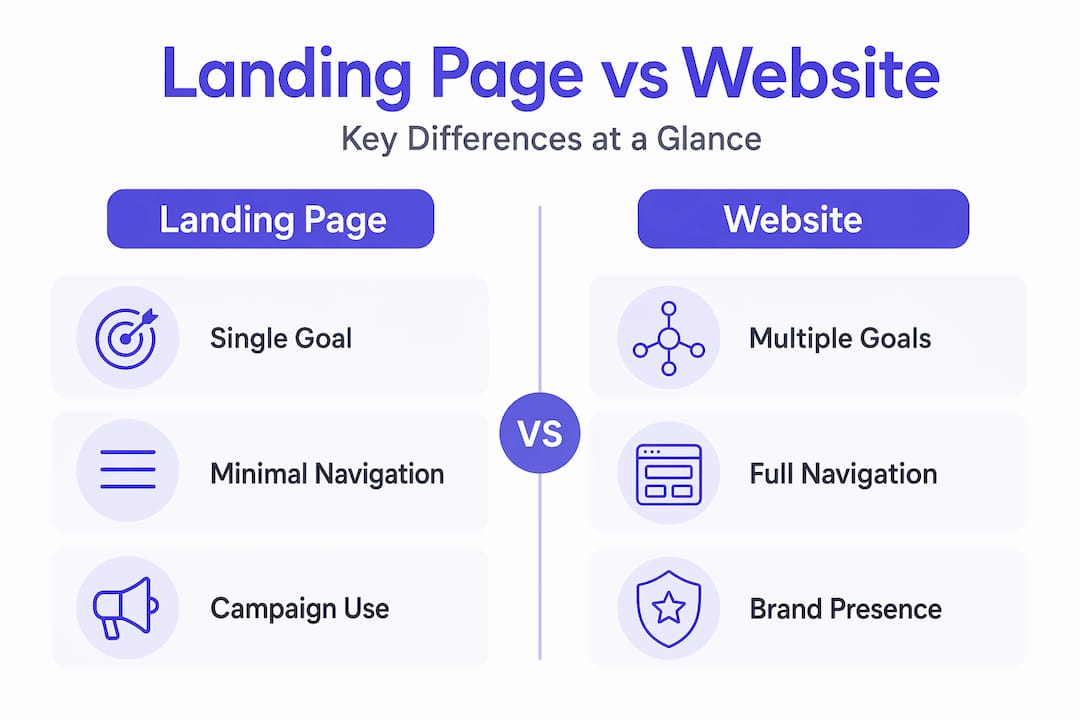
| Feature | Landing page | Website |
|---|---|---|
| Navigation | None or minimal | Full menu with multiple links |
| CTAs | Single, repeated | Multiple across different pages |
| Traffic source | Paid ads, email, campaigns | Organic search, referrals, direct |
| Lifespan | Tied to a campaign | Ongoing, permanent |
| SEO focus | Low to none | High, core strategy |
| Goal | Single conversion | Brand building, trust, exploration |
| Complexity | Simple, fast to build | Complex, multi-layered |
Navigation is the most critical structural difference. A landing page with a full navigation menu gives visitors too many ways to leave before converting. Every link is an exit point. Removing navigation from a landing page is one of the simplest ways to improve conversion rates.
Traffic intent is just as important. Landing pages optimize message match for campaign visitors who arrive with a specific intent. A website supports exploration and brand building, welcoming visitors at all stages of awareness. If someone clicks your Google Ad expecting to see a specific offer and lands on your general homepage instead, the disconnect kills conversions before you even have a chance.
SEO is where websites do the heavy lifting. Websites build organic authority through content depth, internal linking, and multiple indexed pages. A landing page is rarely optimized for search. It exists to capture intent already created by your campaigns.
Pro Tip: When running paid ads, always check where your traffic lands. If it is your homepage, you are paying for clicks that bounce. A dedicated campaign page with message-matched copy will almost always outperform a homepage for conversions.
When to use each one
This is where most businesses get it wrong. The choice between a landing page and a full website is not about preference. It is about what you are trying to accomplish.
Use a landing page when:
- You are running a paid ad campaign on Google, Meta, or LinkedIn and need a focused destination that mirrors your ad copy.
- You are promoting a specific offer, such as a free consultation, webinar, limited-time discount, or lead magnet.
- You want to test a new product, service, or message before committing to a full web build. Landing pages allow you to launch, test, and iterate without touching your main website.
- You need to capture leads quickly for a short campaign window.
- You are validating demand for a new offer before building out full content around it.
Use a website when:
- You are building long-term brand presence and want organic traffic from search engines.
- You serve multiple audience types who need different information to make a decision.
- You need to establish credibility through case studies, testimonials, service details, and team information. Knowing which pages your website needs is part of building that trust foundation.
- You want SEO to work as a long-term acquisition channel.
- Early-stage startups relying solely on landing pages eventually need full websites for credibility, SEO, and support of multiple audience needs.
The most common costly mistake: Sending paid ads directly to your homepage. A dedicated landing page removes navigation distractions and aligns with campaign messaging. Your homepage simply cannot do that job, no matter how well it is designed.
Pro Tip: Think of landing pages as campaign tools and your website as your brand foundation. You need both. Use landing pages for every paid campaign you run, and direct cold organic traffic to your website where it can explore and build trust at its own pace.
Design and optimization best practices
How you design each one matters enormously because the goals are fundamentally different.
For landing pages, focus on these principles:
- Message match: The headline, imagery, and copy must reflect the exact ad or email that brought the visitor there. Mirroring campaign promises eliminates confusion and prevents drop-off at the first scroll.
- Single CTA: One button. One form. One action you want the visitor to take. Multiple CTAs dilute focus and reduce conversions.
- Minimal distractions: No footer links, no social media icons, no navigation. Every element on the page should support the conversion goal.
- Social proof: Testimonials, logos, or stats placed near the CTA remove hesitation right before the decision moment.
- Speed: A slow-loading landing page kills conversions before your copy even gets read. Aim for under two seconds.
For websites, the design philosophy shifts completely. You want to invite exploration, build credibility, and support conversion rate optimization across multiple touchpoints. Rich content, logical navigation, clear service pages, and an intuitive menu structure all contribute. You can learn more about how your website menu structure affects user flow and conversion.
Measuring performance also works differently for each. Landing pages offer clean, isolated data. A single CTA improves testability and reduces cognitive load, making A/B testing straightforward. You change one variable, measure the result, and iterate fast. Website analytics are more complex because visitors move through multiple pages with different intents.
For landing pages specifically, run A/B tests on your headline, CTA button copy, and hero image before scaling ad spend. These three elements drive the majority of conversion lift.
My take on where businesses actually go wrong
I have seen a lot of marketing setups where businesses spent real money building a beautiful website and then routed every single paid campaign to the homepage. Every time. The website looked great. The conversion numbers were embarrassing.
The honest truth is that most businesses do not need to choose between a landing page and a website. They need both, used correctly. What I have found over years of working on digital builds is that the confusion comes from treating the website as the answer to every marketing problem. It is not. Your website is your foundation. Landing pages are your campaign weapons.
The other mistake I see constantly is companies that spin up dozens of landing pages but never invest in the website that backs them up. When a prospect clicks through from a landing page and wants to do more research, they go looking for your full website. If it looks outdated or does not exist, you lose the deal at the finish line. Landing pages and websites are complementary tools, not alternatives to each other.
My perspective is that the landing page vs site differences matter far less than the strategic clarity behind using each one. Know what job you are hiring each tool to do. Build accordingly. Test everything on your landing pages. Invest in content and SEO on your website. Do both with intention and your conversion numbers will reflect it.
— Max
Build pages that actually convert with Cosmicdigitalstudios
If reading this made you realize your paid campaigns are pointing to the wrong place, or that your website is not doing the job it should, that is a fixable problem.
Cosmicdigitalstudios builds custom websites and conversion-focused landing pages designed to turn visitors into leads, calls, and sales. Every build is tailored to your brand and business goals, not a template dropped on your domain. Whether you need a full website redesign or a dedicated campaign page built for your next launch, the team at Cosmicdigitalstudios handles it from strategy through build. Clean design. Clear messaging. Real results.
FAQ
What is the main difference between a landing page and a website?
A landing page is a single focused page with one goal and no navigation, while a website is a multi-page platform serving multiple purposes and audiences. Landing pages are built for conversion; websites are built for brand presence, exploration, and organic growth.
Can a landing page replace a website?
Not long-term. Early-stage businesses sometimes use landing pages to validate an offer quickly, but a full website is needed for SEO, credibility, and supporting multiple audience types over time.
Why should I use a landing page for paid ads instead of my homepage?
Your homepage serves too many audiences and includes navigation links that pull visitors away before they convert. A dedicated landing page matches your ad message exactly and keeps visitors focused on one action, which directly improves your return on ad spend.
Do landing pages help with SEO?
Not significantly. Landing pages are designed for campaign traffic, not organic search. SEO requires content depth, internal linking, and multiple indexed pages, all of which live on your full website rather than on standalone campaign pages.
How do I know if I need a landing page or a website redesign?
If your issue is campaign conversions, you likely need a landing page. If visitors cannot find information, trust your brand, or understand what you offer, a website redesign is the right move. Many businesses need both at different stages of growth.