
A local business website in 2026 is a sales asset, not a digital brochure. The best local sites convert visitors into booked calls, form submissions, and in-store visits by combining mobile-first design, local SEO, and clear calls to action. Whether you want to build a small business website from scratch or overhaul an existing one, the platform you choose, the pages you build, and the way you optimize for search all determine whether your site earns revenue or collects dust. Tools like AI website builders, WordPress, and Google Business Profile have made the process faster and more accessible than ever before.
What platforms should you use to create a local business website in 2026?
Choosing the right platform is the first real decision you make, and it shapes everything from your launch timeline to your long-term maintenance costs. The good news is that website costs range from $0 to $600 for a DIY build in the first year, while agency-built sites can reach $12,000 depending on scope. That range exists because the platform options are genuinely different in what they offer.
AI website builders are the fastest option in 2026. Tools like lovable.dev generate a professional site from a plain English prompt in under an afternoon, handling layout, branding, images, and CTAs automatically. This is no longer experimental technology. AI builders have matured into reliable tools that produce professional results for non-technical users. If you need to launch quickly and do not want to manage code, an AI builder is the most practical starting point.

WordPress remains the most flexible option. It powers over 43% of the internet, and with a page builder like Elementor, you can create a polished local business site without writing a line of code. The tradeoff is maintenance. WordPress requires regular plugin updates, security patches, and backups. For beginners, that overhead adds up fast.
Traditional builders like Wix and Squarespace sit in the middle. They are easier to maintain than WordPress and more flexible than most AI builders, but they carry monthly fees and can limit customization at scale.
| Platform | Ease of Use | Cost (Year 1) | Scalability | Best For |
|---|---|---|---|---|
| AI builders (lovable.dev) | Very easy | Free to $30/mo | Moderate | Fast launch, no tech skills |
| WordPress + Elementor | Moderate | $50 to $200 | High | Long-term growth, full control |
| Wix | Easy | $17 to $35/mo | Moderate | Simple local sites |
| Squarespace | Easy | $23 to $65/mo | Moderate | Design-focused businesses |
| Custom agency build | N/A | $3,000 to $12,000 | Very high | Established businesses |
Pro Tip: Register a .com domain if it is available. Domain .com remains the most trusted extension for brand credibility, though .co and .io are acceptable if your branding is strong.
What essential pages does a local business website need in 2026?
Structure drives conversions. The five core pages every local business site needs are Homepage, About, Services, Contact, and Testimonials. Each page serves a distinct job in moving a visitor from curious to committed.
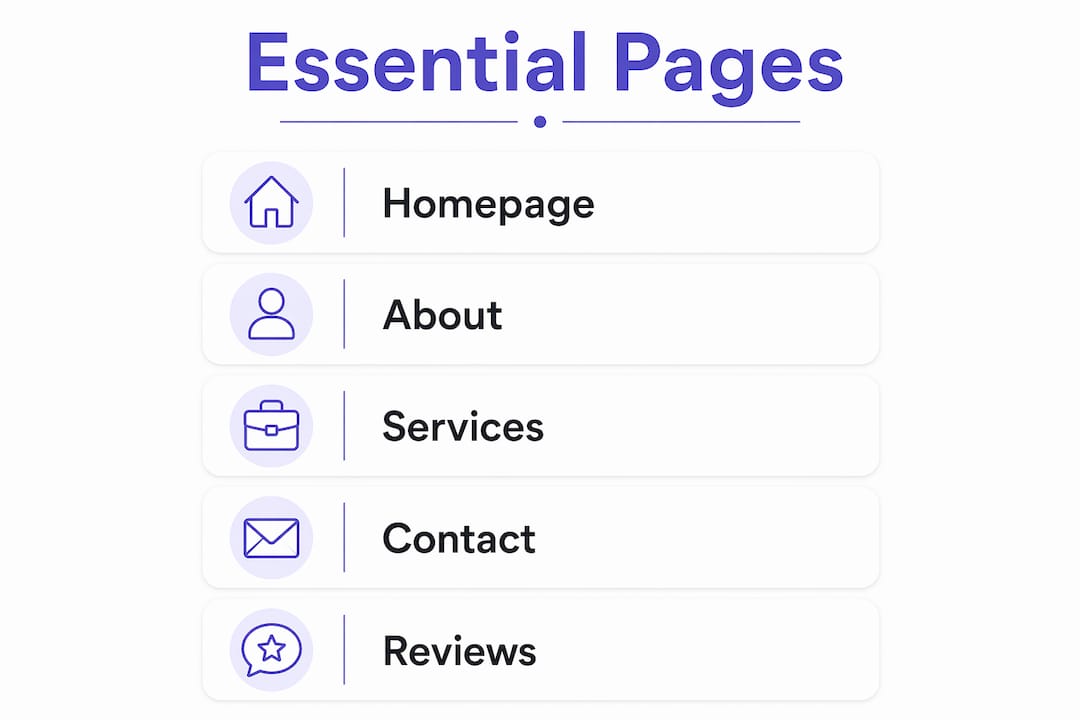
Your homepage carries the heaviest load. Visitors decide whether to stay or leave in roughly 50 milliseconds, which means your headline, subheadline, and primary CTA must communicate exactly who you serve and what you do before anything else loads. A headline like “Plumbing Repairs in Austin, TX. Same-Day Service.” does that job. “Welcome to Our Website” does not.
Here is what each core page needs to do its job:
- Homepage: Clear headline naming your service and location, one primary CTA (call, book, or get a quote), and a brief trust signal such as years in business or number of clients served.
- About page: Real photos of you or your team, a short origin story that explains why you started the business, and one sentence on what makes you different from competitors in your area.
- Services page: One page per service if possible, with plain-language descriptions, pricing ranges where you can share them, and a CTA at the bottom of each page.
- Contact page: A short form with three fields maximum (name, phone, message), your physical address, business hours, and an embedded Google Map.
- Testimonials page: At least five reviews with full names and, where possible, photos. Video testimonials outperform text by a significant margin for local service businesses.
Pro Tip: Keep your contact form to three fields or fewer. Each extra field reduces conversions by 10%, and most local businesses only need a name, phone number, and a brief message to qualify a lead.
For a deeper look at homepage layout best practices tailored to local customers, Cosmicdigitalstudios has a dedicated 2026 guide worth reviewing before you finalize your design.
How to optimize your local business site for mobile, speed, and local SEO
Mobile optimization is not optional. Mobile devices account for nearly 59% of global website traffic, which means more than half of your potential customers are viewing your site on a phone. A site that loads slowly or breaks on mobile loses those visitors before they ever read your headline.
Follow this checklist to cover the core technical and SEO requirements:
- Test on real devices. Use your own iPhone or Android to check every page. Emulators miss real-world issues like tap target sizes and font rendering.
- Compress all images. Convert photos to WebP format and compress them below 150KB per image. Use tools like Squoosh or ShortPixel to do this in minutes.
- Write location-specific meta titles. Format them as: Service + City + Differentiator. Example: “Emergency Plumber in Denver | Same-Day Service.”
- Claim and fully optimize your Google Business Profile. Add your hours, photos, service areas, and a link to your website. This single step drives more local foot traffic than almost any other action.
- Add local keywords to page copy. Mention your city, neighborhood, and nearby landmarks naturally in your homepage and service page copy. Do not force it; write for the reader first.
- Encourage Google reviews consistently. Send a follow-up text or email to every satisfied customer with a direct link to your review page. 76% of nearby phone searchers visit a business within 24 hours when they find accurate contact info and a strong local SEO presence.
- Add LocalBusiness schema markup. This structured data tells Google your name, address, phone number, and hours in a format it can read directly. Most modern platforms add this automatically, but verify it with Google’s Rich Results Test.
- Use personalized CTAs. Personalized call-to-action buttons convert 202% better than generic text like “Submit” or “Click Here.” Replace generic buttons with specific language: “Book My Free Estimate” or “Call Us Now.”
Fast-loading pages also directly impact your search rankings. The benefits of fast-loading local websites extend beyond user experience to Google’s Core Web Vitals scores, which influence where you appear in local search results.
How can AI tools simplify building and maintaining your local business website?
AI website builders have crossed from novelty to necessity for small business owners who need professional results without a developer budget. Lovable.dev and similar tools generate industry-tailored websites with proper branding, images, and CTAs based on a single business prompt. You describe your business, your location, and your primary service, and the builder produces a structured site ready for editing.
The practical workflow looks like this. You type a prompt such as: “I run a family-owned HVAC company in Charlotte, NC. I want a site that gets people to call for same-day service.” The AI generates a homepage with a local headline, a services section, a contact form, and a CTA button. You then edit the copy, swap in real photos, and connect your domain. The entire process takes a few hours, not weeks.
Beyond the initial build, AI tools now handle ongoing maintenance tasks that used to require a developer. You can update service descriptions, add new testimonials, or change your hours through a conversational interface. Some platforms also integrate booking systems, payment processors, and menu displays without any coding. For a local restaurant, salon, or contractor, this means your site stays current without monthly developer fees.
Pro Tip: Write a detailed prompt before you open any AI builder. Include your business name, city, primary service, ideal customer, and one unique selling point. A specific prompt produces a far more usable first draft than a vague one. Pair this with AI-driven brand strategies to keep your messaging consistent across your site and social channels.
Key takeaways
A local business website in 2026 succeeds when it combines the right platform, five core pages, mobile-first design, and local SEO into a single conversion-focused asset.
| Point | Details |
|---|---|
| Platform choice drives outcomes | Match your platform to your technical comfort and growth goals before you build. |
| Five pages cover the essentials | Homepage, About, Services, Contact, and Testimonials handle every stage of the buyer journey. |
| Mobile and speed are non-negotiable | With 59% of traffic on mobile, a slow or broken mobile experience costs you real customers. |
| Local SEO starts with Google | Claim your Google Business Profile and add LocalBusiness schema to capture nearby searchers. |
| AI builders cut launch time | Tools like lovable.dev produce professional sites from plain English prompts in hours, not weeks. |
What I’ve learned from watching local businesses build websites in 2026
Most small business owners I work with make the same mistake. They spend weeks debating colors, fonts, and logo placement while their contact form sits broken and their Google Business Profile is unclaimed. The design decisions that feel most important are usually the least impactful on revenue.
The sites that actually generate leads share three traits: a headline that names the service and the city, a phone number visible above the fold on mobile, and a contact form with three fields or fewer. That is it. Everything else is secondary until those three elements are working.
My honest recommendation is to launch with an AI builder or WordPress plus Elementor, get the five core pages live, and start collecting real feedback from actual visitors. A site that is live and imperfect beats a perfect site that launches in six months. You will learn more from 100 real visitors than from any amount of pre-launch planning.
The one area where I see businesses consistently underinvest is local SEO maintenance. Claiming your Google Business Profile takes 20 minutes. Keeping it updated with new photos, current hours, and fresh reviews is an ongoing habit that compounds over time. The businesses ranking at the top of local search results are not there because they have the best websites. They are there because they treat their online presence as something that requires regular attention, not a one-time project.
If you are redesigning an existing site, start with the local service website redesign checklist from Cosmicdigitalstudios before touching your current design. It will save you from rebuilding the wrong things.
— Max
Ready to build a local business website that actually converts?
Cosmicdigitalstudios builds fast, modern websites designed specifically for local businesses that need to turn visitors into booked calls and paying customers. Every site is custom-built around your brand, your services, and your local market. No templates. No guesswork.
If your current site is not generating leads, or you are starting from scratch and want it done right the first time, the team at Cosmicdigitalstudios is ready to help. From full website builds to conversion audits, every project is focused on one outcome: more customers for your business. You can also explore how to turn visitors into clients with the strategies Cosmicdigitalstudios uses across every build.
FAQ
How much does it cost to build a local business website in 2026?
DIY website costs range from $0 to $600 for the first year, while professional agency builds can reach $12,000 depending on scope and complexity. Most local businesses land somewhere between $500 and $3,000 for a quality custom site.
How long does it take to build a small business website?
An AI builder can produce a working site in a single afternoon. A custom WordPress build typically takes two to four weeks, while a full agency project can run four to eight weeks depending on the number of pages and revisions.
What is the most important page on a local business website?
The homepage carries the most weight because it is the first page most visitors see. It must communicate your service, your location, and your primary CTA within 50 milliseconds to retain visitors and drive action.
Do I need a Google Business Profile if I already have a website?
Yes. Your website and your Google Business Profile work together. 76% of nearby searchers visit a business within 24 hours when they find accurate local information, and a Google Business Profile is often the first result they see before they ever reach your site.
How often should I update my local business website?
Update your site any time your services, pricing, or hours change. Beyond that, add new photos and testimonials at least once per quarter. Regular updates signal to Google that your site is active, which supports your local search rankings over time.