
Dedicated service pages are the single most effective SEO asset a small business website can have. Understanding why service pages matter for ranking comes down to one core fact: search engines reward focused, intent-matched content, and a homepage simply cannot do that job for every service you offer. In 2026, over 50% of search queries resolve through AI-generated answers before a user ever clicks a link. That means your service pages must serve four audiences at once: Google’s ranking algorithm, AI engines like ChatGPT Search and Perplexity, voice search assistants, and the human visitor ready to hire you.
How do service pages improve search rankings vs. homepages?
Service pages outperform homepages for specific service queries because they match search intent precisely. A homepage is designed to introduce your business broadly. A dedicated service page is built to answer one specific question: “Does this business offer what I need, and are they good at it?”
Homepages cannot rank effectively for individual service keywords because they lack the depth and focus search engines require. Google reads a homepage as a general overview. It reads a service page as a subject-matter document. That distinction directly affects where your pages appear in search results.

| Page Type | Keyword Focus | Ranking Potential | Conversion Fit |
|---|---|---|---|
| Homepage | Brand name, general terms | Low for service queries | Broad, unfocused |
| Service Page | High-intent service keywords | High for specific queries | Targeted, direct |
| Blog Post | Informational queries | Medium, depends on topic | Low purchase intent |
| Generic “Services” Page | Multiple services at once | Diluted across topics | Confusing to visitors |
Building multiple related service pages also signals topical authority to Google. When your site covers web design, landing page design, and funnel building as separate pages, Google recognizes you as a specialist in that category. That topical relevance outperforms keyword stuffing every time.
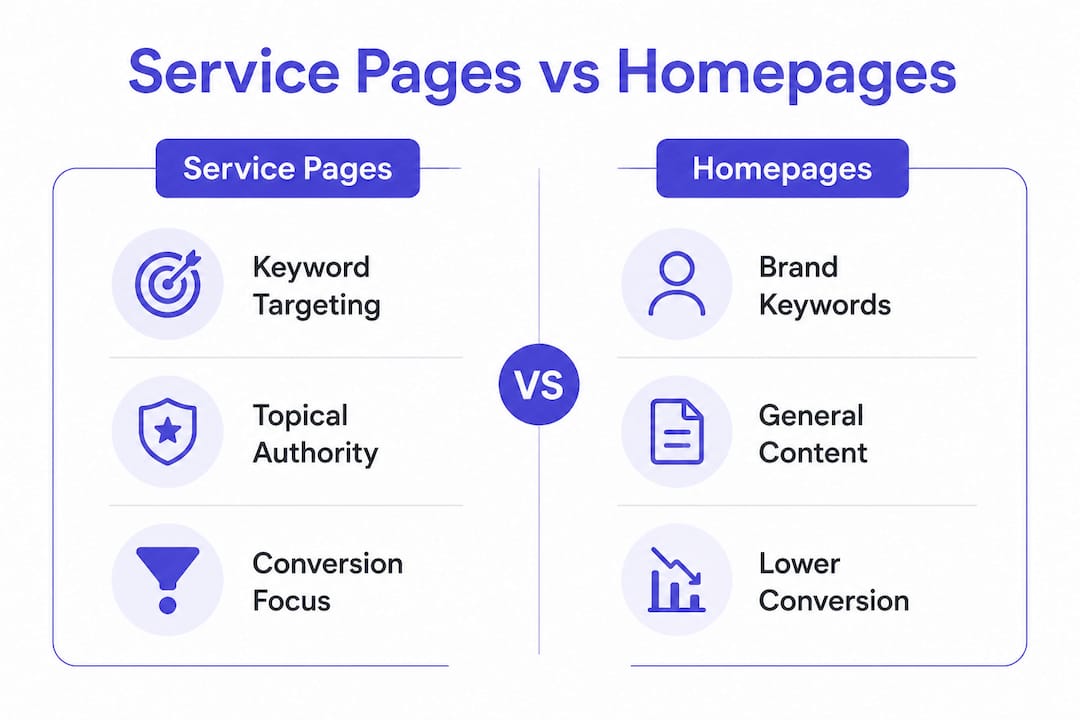
Internal linking between service pages compounds this effect. When your “Web Design” page links to your “Landing Page Design” page, you pass authority between them and help Google understand how your services relate. This network of pages is how small businesses compete with larger sites on a tighter budget.
Pro Tip: Create one dedicated page per service, not one page listing all services. Each page should target a single primary keyword and answer every question a potential client might have before contacting you.
What SEO elements make service pages work in 2026?
The structure of a service page determines whether it ranks in traditional search and gets cited by AI engines. Structured content with clear H2 and H3 headers, along with schema markup, increases the chance that AI answer engines pull your content directly into their responses. Schema types like Service and FAQPage are not optional extras in 2026. They are core ranking factors.
Here is the exact structure that produces results:
- Clear H1 with your primary service keyword. The page title must match what your customer types into Google. “Website Design for Small Businesses in Austin” beats “Our Creative Solutions.”
- An opening paragraph that answers the key question immediately. State what the service is, who it is for, and what problem it solves. Do not bury this in the third paragraph.
- H2 sections covering process, pricing, and outcomes. Visitors and AI engines both scan for these. Transparency here builds trust faster than any testimonial.
- Schema markup for Service and FAQPage. Structured data tells search engines exactly what your page is about, which improves both ranking and AI citation rates.
- An FAQ section at the bottom. FAQs capture long-tail search queries and improve your chances of appearing in voice search results and AI-generated answer boxes.
- Trust signals throughout. Credentials, client results, process explanations, and clear pricing all reduce friction for the visitor and signal EEAT (Experience, Expertise, Authoritativeness, Trustworthiness) to Google.
The biggest mistake businesses make is writing service pages as pure sales copy. Service pages must function as knowledge documents, not brochures. A knowledge document answers questions, explains processes, and gives the reader enough information to make a confident decision. That approach satisfies both human visitors and AI search engines simultaneously.
Pro Tip: Use a tool like Google Search Console to find the exact queries driving impressions to your existing service pages. Then add those questions as H3 subheadings or FAQ entries to capture more of that traffic.
How do service pages drive conversions, not just traffic?
Rankings without conversions are worthless. A properly optimized service page converts visitors better than a generic page because it speaks directly to the specific problem the visitor is trying to solve. That specificity is what turns a browser into a booked call.
The conversion advantages of dedicated service pages include:
- Targeted messaging. A visitor searching “roof repair in Denver” lands on your roof repair page, not your homepage. The content matches their exact need, which keeps them reading.
- Trust built through transparency. Visitors stay longer and contact businesses faster when pages include process explanations, pricing ranges, and real credentials. Hiding your process creates doubt.
- Clear calls to action. A service page has one job: get the visitor to take the next step. That means one primary call to action, placed above the fold and repeated at the bottom of the page.
- Reduced decision fatigue. When a visitor lands on a page built for exactly their need, they do not have to figure out if you offer what they want. That clarity shortens the path to contact.
- Social proof in context. A testimonial from a client who hired you for the exact service on that page is far more persuasive than a generic five-star review on your homepage.
The service page SEO approach connects search visibility directly to lead generation. You are not just attracting traffic. You are attracting people who already know what they want and are evaluating whether you are the right provider. That is the highest-intent traffic available in search.
How do service pages strengthen local SEO?
Local SEO is where service pages deliver some of their most measurable results. A business that serves a specific city or region needs pages that tell Google exactly what services it offers and where. A single “Services” page cannot accomplish that. Dedicated service pages with location-specific content can.
Service area pages combined with service pages create a two-layer local SEO structure that improves both rankings and qualified lead quality. The service page establishes what you do. The service area page establishes where you do it. Together, they give Google a complete picture of your business.
| Local SEO Element | Without Service Pages | With Service Pages |
|---|---|---|
| Keyword targeting | Generic, broad terms only | Specific service plus location terms |
| Google Business Profile support | Weak content signals | Strong page-level authority |
| Qualified lead quality | Mixed intent visitors | High-intent, ready-to-hire visitors |
| Multi-location coverage | One page for all locations | Dedicated pages per service and area |
| AI search citation potential | Low, content too broad | High, structured and specific |
For multi-location businesses, the structure becomes even more critical. A plumbing company serving three cities needs separate pages for each city, ideally paired with service-specific pages for each location. This approach, covered in depth in the local service website redesign checklist, gives Google the granular signals it needs to rank you for hyper-local queries.
Local citations, Google Business Profile, and on-page content all work together. But the service page is the foundation. Without it, the other signals have nowhere strong to point.
Key takeaways
Service pages are the highest-leverage SEO investment a small business can make because they target high-intent queries, build topical authority, and convert visitors into leads more effectively than any other page type.
| Point | Details |
|---|---|
| Service pages outrank homepages | Dedicated pages match search intent precisely, which Google rewards with higher rankings for service queries. |
| Knowledge document structure wins | Pages built with clear headers, schema markup, and FAQs rank in both traditional and AI-driven search. |
| Conversions follow specificity | Targeted service pages reduce friction and move high-intent visitors to contact faster than generic pages. |
| Local SEO requires dedicated pages | Pairing service pages with service area pages creates the two-layer structure Google needs for local rankings. |
| Topical authority compounds over time | A network of related service pages signals expertise to Google and strengthens every page on your site. |
What i have learned after building hundreds of service pages
The most common mistake I see from small business owners is treating service pages as an afterthought. They spend weeks on their homepage design and write three sentences about each service on a single “What We Do” page. Then they wonder why they are not ranking.
Here is what I know from experience: Google does not reward effort on your homepage. It rewards depth and specificity on the pages that match what people are actually searching for. A service page written as a genuine knowledge document, one that explains your process, answers real objections, and gives pricing context, will outrank a polished but shallow competitor page almost every time.
The AI search shift makes this even more urgent. Optimizing content for AI search is not a future concern. It is a present one. AI engines pull answers from structured, specific, well-organized pages. If your service pages are thin, you are invisible in that channel.
The other thing I tell every client: service pages are not set-and-forget. Update them when your process changes, when you add credentials, or when you notice new questions coming in from leads. Fresh, accurate content is a ranking signal. Stale content is a liability.
You do not need a massive budget to compete in local search. You need the right pages, built the right way, with content that actually serves the person reading it.
— Max
Build service pages that rank and convert
If your current website lumps all your services onto one page, you are leaving rankings and revenue on the table. Cosmicdigitalstudios builds custom, conversion-focused service pages designed to rank in Google, get cited by AI engines, and turn visitors into booked calls.
Every service page Cosmicdigitalstudios builds includes proper schema markup, keyword-targeted content, trust signals, and clear calls to action. Whether you need a full website build or want to understand what pages your site is missing, check out the guide on essential website pages every local service business needs. The right structure is the difference between a website that sits there and one that generates leads every week.
FAQ
Why do service pages rank better than homepages?
Service pages target specific, high-intent keywords that match exactly what a searcher is looking for. Homepages are too broad to rank competitively for individual service queries.
How many service pages does a small business need?
Create one dedicated page for each distinct service you offer. If you serve multiple locations, pair each service page with location-specific service area pages for maximum local SEO coverage.
What is schema markup and why does it matter for service pages?
Schema markup is structured code added to your page that tells search engines exactly what your content is about. Service and FAQPage schema types increase your chances of appearing in AI-generated answers and featured snippets.
Do service pages help with AI search engines like ChatGPT and perplexity?
Yes. AI-driven search engines prioritize clear, structured, and FAQ-rich content for citation. Service pages built as knowledge documents are far more likely to be pulled into AI-generated responses than generic pages.
How often should i update my service pages?
Update service pages whenever your process, pricing, or credentials change. Refreshing content with new client results or expanded FAQs at least once or twice per year keeps the page competitive and signals to Google that the information is current.