A VSL page is a dedicated, distraction-free landing page built around a single persuasive video designed to move a visitor toward one specific action. That action is a purchase, a booking, or a signup. Nothing else. The industry term is “video sales letter page,” and it borrows its structure directly from long-form direct-response copywriting, translated into video format. 67% of companies that use video sales letters deploy them on dedicated landing pages. That number tells you this is not an experimental tactic. It is a proven conversion format used across industries from SaaS to coaching to e-commerce.
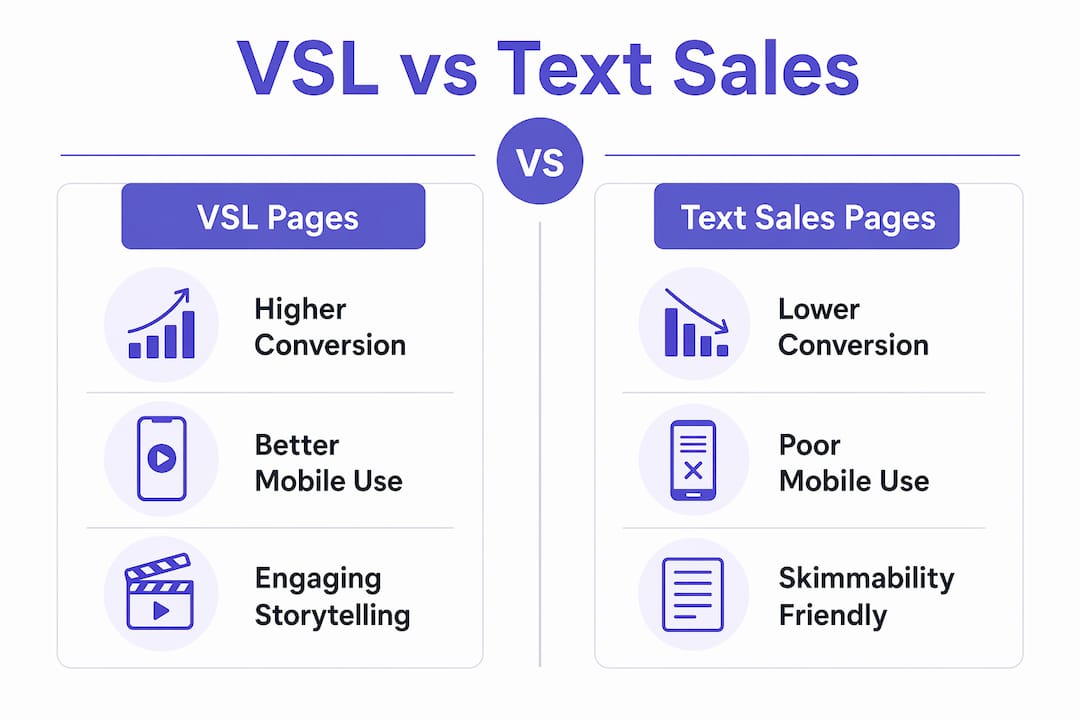
The core advantage of a VSL page over a standard sales page is pacing control. A visitor reading text can scroll to the price, skip the story, and leave before the value lands. A well-built video sales letter page removes that option. The viewer experiences the persuasion sequence in the order you designed it. That control is why VSL pages consistently outperform text-only pages on cold traffic, where visitors arrive with no prior relationship with your brand.
What is a VSL page, and what are its key components?
A VSL page is built around a visual hierarchy that puts the video first and everything else second. The headline sits above the video player and functions as an advertisement for the video itself. It answers one question: “Why should I press play?” A weak headline kills play rates before the video gets a chance.
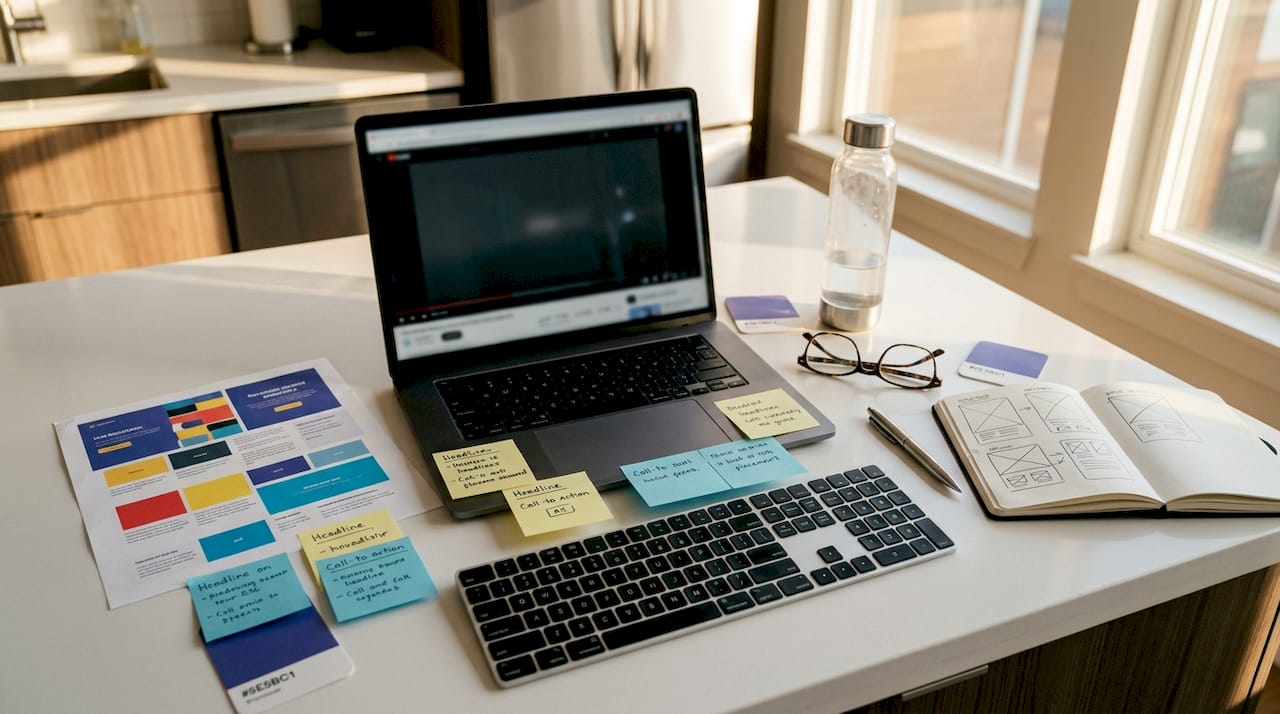
The video player takes up 60–70% of the page width on desktop and expands to full width on mobile. This is not a design preference. It is a structural rule. Every other element on the page exists to support the video, not compete with it. High-converting VSL pages treat the video player as the visual hero and minimize every distraction around it.
Supporting elements below the fold include social proof, testimonials, a short FAQ, and the call-to-action button. These elements serve visitors who finish the video and want confirmation before committing. They also serve the minority of visitors who prefer reading over watching.
Key supporting elements on a well-structured VSL page:
- Headline above the player: Direct, benefit-focused, and written to earn the click on play
- Video player: Full-width on mobile, 60–70% width on desktop, autoplay muted with a dynamic overlay
- Time-delayed CTA button: Appears only when the video reaches the pitch segment
- Testimonials and social proof: Placed below the fold to reinforce the video’s claims
- FAQ section: Addresses objections that the video may not have resolved
- Sticky video player: Follows the viewer on scroll so the video stays visible
Pro Tip: Set your CTA button to appear after the video has delivered its core value proposition. Time-delayed CTA buttons prevent the sales resistance that fires when visitors feel pressured before they understand what you are offering.
Mobile deserves its own design decisions. 80% of traffic arrives via mobile devices, and thumb-friendly CTA buttons require a minimum height of 44px. A sticky video player that follows the viewer as they scroll keeps the video in view without forcing them to scroll back up.
How do VSL pages outperform traditional text-based sales pages?
VSL pages outperform text sales pages on cold traffic by a wide margin. Conversion rates increase by 30–80% when a VSL page replaces a traditional text sales page in cold-traffic campaigns. That range is wide because the gap depends on the quality of the script, the video, and the page design.
The psychological reason is pacing control. As Rob Palmer notes:
“The critical psychological advantage of a VSL is pacing control. Viewers cannot skip ahead or see the offer before the value is built. The marketer maintains full control over the emotional journey.”
A text page hands that control to the reader. A VSL page keeps it with you. The viewer moves through the hook, the problem, the agitation, the solution, and the proof in the sequence you wrote. That sequence is the persuasion engine.
Storytelling amplifies this effect. Information delivered through storytelling is 22 times more memorable than isolated facts. A VSL that tells a client’s transformation story embeds your message far deeper than a bullet list of features ever could.
| Format | Cold traffic performance | Mobile usability | Skimmability |
|---|---|---|---|
| Text sales page | Baseline | High | High |
| Standalone VSL page | 30–80% uplift | Moderate | Low |
| Hybrid VSL + text page | Highest overall | High | High |
Hybrid VSL landing pages that combine video with full long-form text appeal to both video-preferring and text-preferring visitors. On mobile, hybrid formats outperform standalone VSL pages by 25–40%. That gap exists because some visitors will not watch a video on a small screen in a public space. Giving them text as a fallback captures those conversions.
Muted autoplay with a dynamic overlay increases initial play rates by up to 30% over static thumbnail images. Autoplay removes the friction of clicking play. The muted start respects the visitor’s environment. The overlay gives them a visual reason to unmute and engage.
What are practical steps for creating an effective VSL page?
Creating a VSL page that converts starts with the script, not the camera. The structure of a high-converting video sales letter follows a clear sequence: hook, problem, agitation, solution, proof, and call to action. Every section earns the next one.
- Write the hook first. The first 10 seconds determine whether the viewer stays. Name the problem directly and make it specific to your audience.
- Agitate the problem. Show the viewer you understand the cost of not solving it. Emotional resonance here drives attention through the middle of the video.
- Present the solution clearly. Introduce your offer as the direct answer to the problem you just described. No jargon. No feature lists.
- Add proof. Use real client results, screenshots of conversations, or before-and-after outcomes. Raw, unpolished testimonials feel more authentic and convincing than polished corporate videos.
- Deliver the CTA. State exactly what the viewer should do next and why they should do it now. One action only.
- Set the time-delayed CTA button. Program the button to appear on the page only when the video reaches the pitch segment. This keeps the viewer in the persuasion sequence before the ask appears.
Pro Tip: Founder-led videos under 90 seconds that show a real face and use natural speech build more trust than high-production videos with actors. Authenticity converts. Production value does not.
Page design follows the same principle of focus. Remove the navigation bar. Remove social media links. Remove anything that gives the visitor a reason to leave before they reach the CTA. The page has one job. Every design element should serve that job or be cut.
For mobile, use a sticky video player that locks to the top of the screen as the visitor scrolls. Pair it with a CTA button that meets the 44px minimum height. Test your page on a real phone before launch, not just a browser simulator.
What are common VSL page examples and applications in 2026?
VSL pages appear across nearly every online business category. The format adapts to the offer, the audience, and the traffic source.
Common use cases by industry:
- SaaS products: Founder-led VSLs explaining the core problem the software solves, placed on free trial or demo request pages
- Coaching and consulting: VSL pages used as the primary conversion tool for discovery call bookings, often paired with a coaching landing page structure
- E-commerce: Short product VSLs on high-ticket item pages, replacing or supplementing standard product descriptions
- Service businesses: VSL pages used in paid ad funnels to warm up cold traffic before a contact form or booking widget
The format of the video itself varies by brand and audience. Founder-led videos work best for personal brands and service businesses. Animated VSLs with text overlays perform well for SaaS products where screen recording and motion graphics can demonstrate the software in action. Text-overlay videos with voiceover suit markets where the founder prefers not to appear on camera.
| VSL format | Best for | Production complexity |
|---|---|---|
| Founder-led talking head | Coaching, consulting, services | Low |
| Animated with voiceover | SaaS, tech products | Medium |
| Text overlay with narration | Info products, e-commerce | Low to medium |
| Screen recording with narration | Software demos, tutorials | Low |
Placement in the funnel matters as much as the format. Cold traffic from paid ads lands best on a pure VSL page with no navigation and a single CTA. Warm traffic from email or retargeting can land on a hybrid page that combines the video with supporting text, since those visitors already have some trust built. Understanding the difference between a landing page and a website helps you place VSL pages correctly within your overall funnel.
The 2026 trend is clear: minimalist design and human authenticity outperform high-production value. Visitors have grown skeptical of polished corporate videos. A founder speaking directly to camera in a clean, simple setting converts better than a studio-produced spot with actors and stock music.
Key Takeaways
A VSL page converts cold traffic by combining pacing control, storytelling, and distraction-free design into a single focused video sales letter experience.
| Point | Details |
|---|---|
| Pacing control drives conversions | VSL pages prevent skipping, keeping viewers in the persuasion sequence from hook to CTA. |
| Hybrid formats win on mobile | Combining video with text lifts mobile conversions by 25–40% over standalone VSL pages. |
| Time-delayed CTAs reduce resistance | Show the CTA button only after the video delivers its core value to avoid early drop-off. |
| Authenticity outperforms production | Raw testimonials and founder-led videos build more trust than polished corporate content. |
| Design must remove distractions | Strip navigation, external links, and competing CTAs so the video player stays the focal point. |
What most marketers get wrong about VSL pages
Most marketers treat a VSL page as a video embedded on a regular website page. That is the wrong mental model. A VSL page is a controlled environment. The moment you add a navigation bar, a footer with links, or a sidebar, you have broken the pacing control that makes the format work.
The second mistake is chasing production quality over authenticity. I have seen six-figure ad budgets spent on studio-produced VSLs that underperformed a founder’s iPhone recording by a wide margin. Viewers do not reward polish. They reward honesty. A real person talking about a real problem in plain language converts because it feels true.
Mobile-first design is not optional in 2026. If your VSL page was designed on a desktop and then “made responsive,” it is probably losing conversions on mobile. The sticky video player, the 44px CTA button, and the hybrid text fallback are not nice-to-haves. They are the baseline for any page receiving real traffic.
The timing of your CTA reveal is the detail most marketers skip. Showing the button too early signals that you are selling before you have delivered value. Showing it too late loses the viewer who was ready to act. Align the button reveal with the moment in the video where you present the offer. That alignment is where the conversion happens.
— Max
How Cosmicdigitalstudios builds VSL pages that convert
If you understand what a VSL page should do but are not sure how to build one that actually does it, that is exactly where Cosmicdigitalstudios works.
Cosmicdigitalstudios designs and builds custom VSL landing pages with mobile-first layouts, sticky video players, time-delayed CTA buttons, and clean page architecture that keeps visitors focused on one action. Every page is built around your offer, your audience, and your funnel stage. Whether you need a standalone VSL page for paid traffic or a hybrid page for warm leads, the build is tailored to convert. If you want visitors to book calls, sign up, or buy, the page needs to be built for that outcome from the first line of code.
FAQ
What is a video sales letter page?
A video sales letter page is a dedicated landing page built around a persuasive marketing video that guides visitors through a problem-solution sequence toward one specific action like a purchase or booking.
How long should a VSL video be?
Founder-led VSL videos perform best at under 90 seconds for awareness-stage audiences. Longer videos work for warm traffic that already trusts the brand.
Do VSL pages work for cold traffic?
VSL pages increase conversion rates by 30–80% on cold traffic compared to text sales pages, primarily because pacing control prevents visitors from skipping the persuasion sequence.
What is the best CTA strategy for a VSL page?
Use a time-delayed CTA button that appears only when the video reaches the pitch segment. This prevents early sales resistance and keeps the viewer in the persuasion sequence before the ask.
Do I need high production value for a VSL?
No. Human-centric videos featuring a founder’s face and natural speech build trust faster than high-production videos. Authenticity in both the video and testimonials consistently outperforms polished corporate content.
Recommended
- What Is a Portfolio Page? Your 2026 Guide – cosmicdigitalstudios.com
- What Is a Thank You Page? Purpose, Tips, and Best Practices – cosmicdigitalstudios.com
- What Is a Service Area Page? Local SEO Guide for 2026 – cosmicdigitalstudios.com
- Why Service Pages Matter for Rankings in 2026 – cosmicdigitalstudios.com